

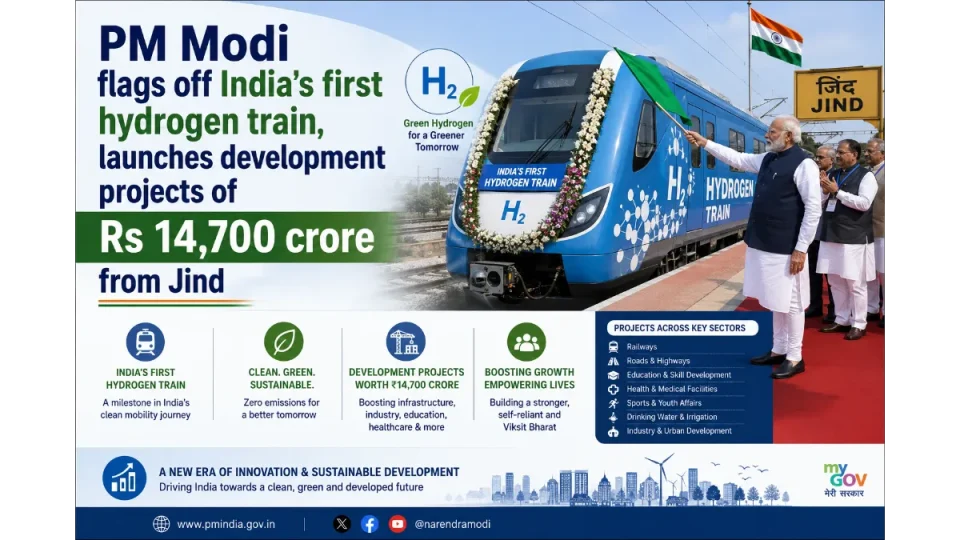
Prime Minister Narendra Modi flagged off India’s first hydrogen fuel cell train from Jind, Haryana, marking a major milestone in green rail mobility. He also inaugurated and laid the foundation for development projects worth over Rs 14,700 crore, including highways, healthcare institutions and urban infrastructure across the state.
Key Highlights
- PM Modi flags off India’s first hydrogen-powered train between Jind and Sonipat.
- The hydrogen train emits only water vapour and is powered by a 3,200 HP propulsion system.
- Projects worth over Rs 14,700 crore, including highways, healthcare and rail infrastructure, were launched in Haryana.
- The Delhi-Amritsar-Katra Expressway and other connectivity projects are expected to boost regional growth and reduce travel time.
New Delhi, July 17: Prime Minister Narendra Modi on Friday flagged off India’s first hydrogen fuel cell train from Jind, Haryana, ushering in a new era of clean and sustainable rail transportation. Running between Jind and Sonipat, the 10-coach hydrogen-powered train covers the 90-kilometre route in about two hours and represents a significant step towards decarbonising Indian Railways.
Powered by a 3,200 HP hydrogen fuel cell propulsion system, one of the most powerful of its kind globally, the train generates its own electricity onboard using hydrogen and emits only water vapour, making it an environmentally friendly alternative to conventional diesel-powered trains. Designed and assembled using indigenous technology, the project places India among the select nations operating hydrogen-powered railway systems.
Alongside the launch of the hydrogen train, the Prime Minister inaugurated and laid the foundation stone for development projects worth over Rs 14,700 crore across Haryana. A major highlight was the dedication of the 157.92-km Delhi-Amritsar-Katra Expressway (Packages 1–5), built at a cost of around Rs 9,680 crore. The expressway will reduce travel time between Delhi and Katra from nearly 14 hours to about six hours, while cutting the Delhi-Amritsar journey to around four hours, boosting tourism, pilgrimage and logistics.
PM Modi also dedicated the Ambala-Kala Amb Highway and the Jind-Gohana Greenfield Highway, significantly improving regional connectivity and reducing travel times. He laid the foundation stone for the Hansi-Barwala Brownfield Highway Project, which will further strengthen Haryana’s road network and support industrial and agricultural growth.
The Prime Minister inaugurated the Elevated Railway Track in Kurukshetra, easing traffic congestion at railway crossings and improving both road safety and railway operations. He also dedicated the Pandit Neki Ram Sharma Government Medical College in Bhiwani, Maharishi Chyawan Medical College, and Rao Tula Ram Hospital in Koriawas, Narnaul, enhancing medical education, healthcare infrastructure and specialist services across the state.
Further strengthening Haryana’s cultural infrastructure, PM Modi laid the foundation stone for the Sikh Museum in Kurukshetra, which will showcase the history of Sikhism, the teachings of the Sikh Gurus and the community’s contribution to India’s civilisation through modern interactive technologies.
The launch of India’s first hydrogen train and the rollout of Rs 14,700 crore worth of infrastructure projects underscore the government’s commitment to green mobility, modern transport, improved healthcare and sustainable economic development, positioning Haryana as a key hub for next-generation infrastructure.
