

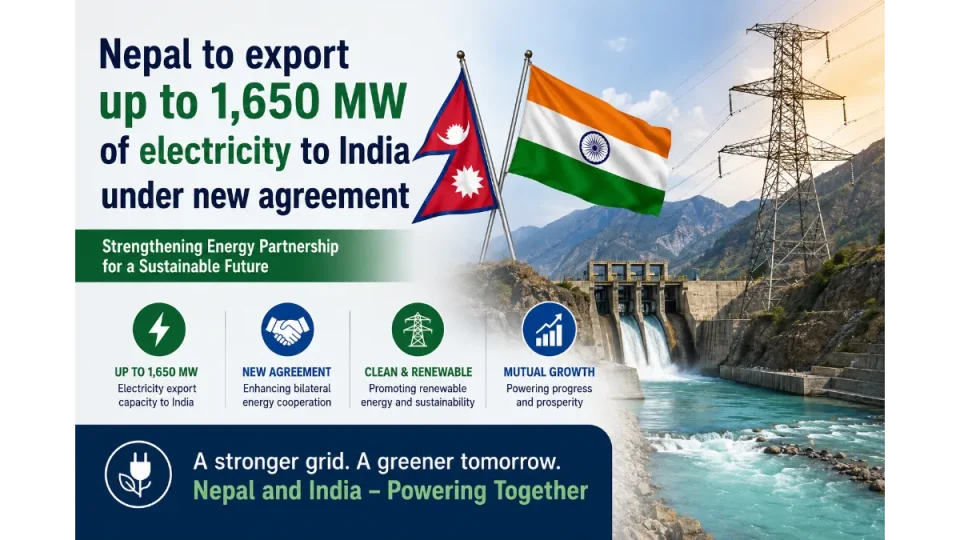
India and Nepal have agreed to expand cross-border electricity trade, allowing Nepal to export up to 1,650 MW of power to India through two 400 kV transmission lines. The agreement also supports new transmission projects, strengthens regional energy connectivity and promotes long-term power cooperation between the two neighbouring countries.
Key Highlights
- Nepal can now export up to 1,650 MW of electricity to India under the new agreement.
- Electricity trade will take place through the Dhalkebar–Muzaffarpur and Dhalkebar–Sitamarhi 400 kV transmission lines.
- India and Nepal approved several new cross-border transmission projects to strengthen energy connectivity.
- The agreement is expected to boost renewable energy trade and regional energy security.
Kathmandu, July 16: India and Nepal have agreed to significantly enhance cross-border electricity trade, allowing Nepal to export up to 1,650 MW of electricity to India and import up to 1,400 MW through two high-capacity 400 kV transmission lines. The decision was taken during the 13th Nepal–India Joint Steering Committee (JSC) meeting held in Pokhara, Nepal, reflecting the growing strategic partnership in the energy sector.
The revised power trading arrangement will utilise the Dhalkebar–Muzaffarpur and Dhalkebar–Sitamarhi 400 kV cross-border transmission lines. While the Dhalkebar–Muzaffarpur line has been operational since 2016, the Dhalkebar–Sitamarhi transmission line is nearing completion, enabling a substantial increase in electricity transfer capacity between the two countries.
The meeting, co-chaired by Sarita Dawadi, Secretary at Nepal’s Ministry of Energy, Water Resources and Irrigation, and Pankaj Kumar, Secretary at India’s Ministry of Power, reviewed progress on bilateral energy cooperation. The two sides agreed to expand power trade from the earlier limit of 1,100 MW of exports and 1,000 MW of imports through the existing transmission infrastructure.
India and Nepal also approved the Detailed Project Report (DPR) for the Chameliya–Jauljibi 220 kV double-circuit transmission line, targeting completion by December 2028. In addition, both countries agreed to accelerate the formation of a joint venture between the Nepal Electricity Authority (NEA) and Power Grid Corporation of India Limited (PGCIL) to develop the Inaruwa–New Purnea and Dododhara (New Lamki)–Bareilly 400 kV transmission line projects.
The meeting further approved the DPR for the Motihari–Nijgadh 400 kV transmission line, which is expected to facilitate additional electricity exports from Nepal to India by 2034-35. It also endorsed the upgradation of the Muzaffarpur–Dhalkebar transmission line using High Temperature Low Sag (HTLS) conductors to increase transmission capacity. Technical studies will continue for the proposed Lucknow–Kohalpur (Lamahi) 400 kV transmission line.
Officials also reviewed progress on the New Butwal–Gorakhpur 400 kV transmission line, which will initially operate at 220 kV until the New Butwal substation is completed in December 2027. Under the interim arrangement, the line will enable Nepal to export up to 200 MW and import up to 130 MW of electricity. The Nepal section of the project is being developed with support from the Millennium Challenge Corporation (MCC).
The new agreement marks a significant step in India-Nepal energy cooperation, strengthening cross-border electricity trade, supporting renewable energy integration and improving regional energy security through expanded transmission infrastructure.
