

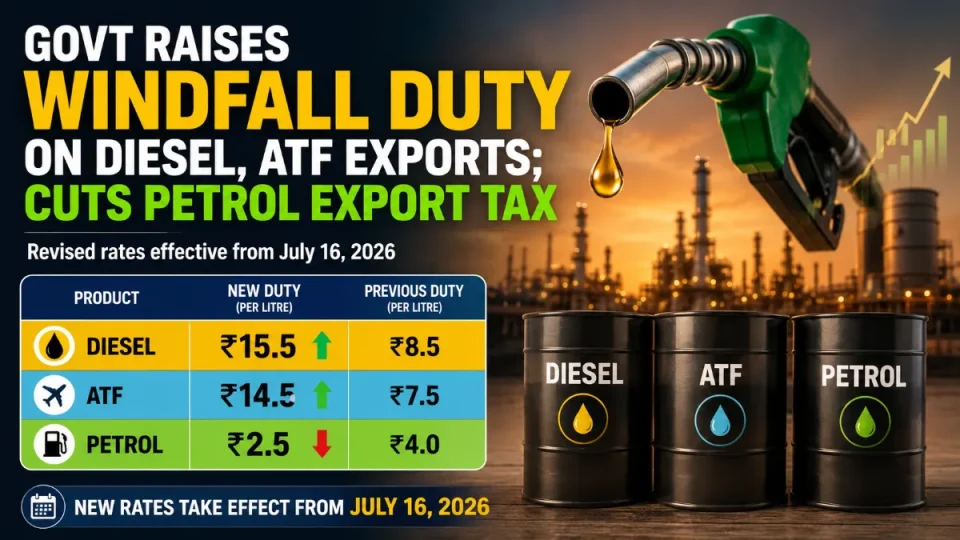
The Central Government has increased windfall duties on diesel and aviation turbine fuel (ATF) exports while reducing the export levy on petrol, effective July 16, 2026. The move follows higher global crude oil prices and stronger refining margins, driven by escalating geopolitical tensions in the Middle East. This update comes in the context of the government’s broader strategy regarding the Windfall Tax. This adjustment is part of a larger framework that includes the implications of the Windfall Tax on various sectors, particularly in relation to the ongoing economic situation and the consideration of the overall impact of the Windfall Tax.
Key Highlights
- Diesel export duty increased to Rs 15.5 per litre.
- ATF export duty raised to Rs 14.5 per litre.
- Petrol export duty reduced to Rs 2.5 per litre.
- New windfall tax rates took effect from July 16, 2026.
Related News
Centre Increases Windfall Tax on Diesel and ATF Exports; Petrol Export Duty Remains Unchanged
The Central Government has revised the Special Additional Excise Duty (SAED) on petroleum exports, increasing the windfall tax on diesel and aviation turbine fuel (ATF) while reducing the levy on petrol exports. The revised rates came into effect from July 16, 2026, according to a notification issued by the Finance Ministry.
Under the latest revision, the export duty on diesel has been raised from Rs 8.5 per litre to Rs 15.5 per litre, while the levy on ATF exports has increased from Rs 7.5 per litre to Rs 14.5 per litre. Meanwhile, the export duty on petrol has been lowered from Rs 4 per litre to Rs 2.5 per litre, providing some relief to petrol exporters.
The decision comes amid a sharp rise in international crude oil prices, which has significantly improved refining margins. The surge in oil prices has been linked to heightened geopolitical tensions involving the United States and Iran, increasing uncertainty in global energy markets.
Earlier this month, the government had adopted a different approach by raising the export duty on petrol while reducing taxes on diesel and ATF exports. The latest revision reflects the government’s policy of adjusting windfall taxes in line with changing global market conditions and refining profitability.
The windfall tax mechanism enables the government to capture a portion of extraordinary profits earned by refiners when international oil prices rise sharply. These duties are reviewed periodically to ensure they remain aligned with global crude prices, export economics, and domestic energy interests.
The latest changes are expected to increase government revenue from fuel exports while ensuring that taxation remains responsive to evolving global oil market trends. The periodic review of these levies continues to provide flexibility in managing India’s energy and fiscal priorities.
The revised windfall tax on diesel, ATF, and petrol exports reflects India’s strategy of balancing fiscal interests with changing global crude oil prices while maintaining a responsive taxation framework for the petroleum secto
FAQs
1. What is the new export duty on diesel?
The government has increased the diesel export duty to Rs 15.5 per litre.
2. What is the revised export duty on ATF?
The export duty on aviation turbine fuel has been raised to Rs 14.5 per litre.
3. Has the petrol export duty been reduced?
Yes. The petrol export duty has been lowered to Rs 2.5 per litre from Rs 4 per litre.
4. Why does India impose windfall taxes?
Windfall taxes help the government capture extraordinary profits earned by oil companies when global crude prices and refining margins rise significantly
