

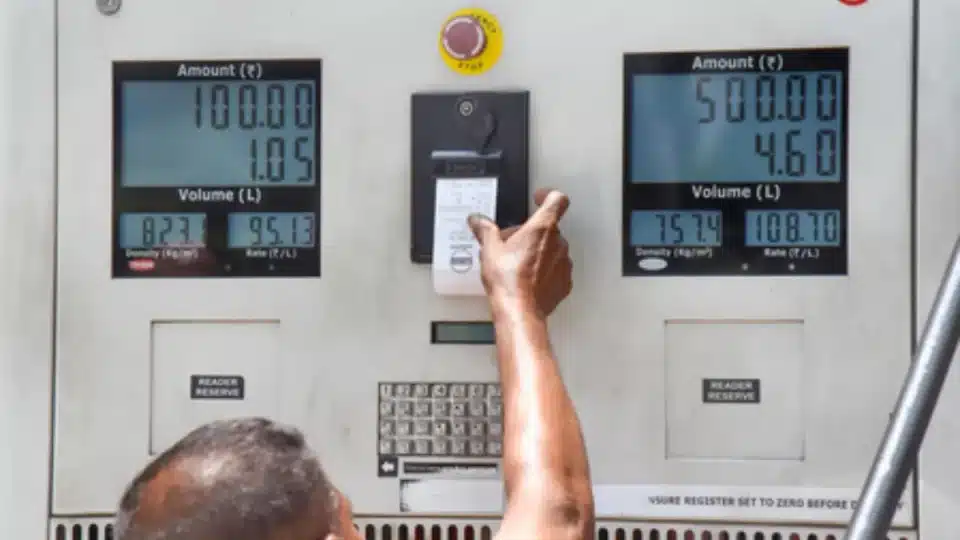
The financial pressure on India’s oil marketing companies (OMCs) has eased considerably, with petrol under-recoveries declining by 83 per cent and diesel under-recoveries falling by 75 per cent since April 1. According to the Ministry of Petroleum and Natural Gas, fuel price revisions and government support measures have significantly reduced daily losses amid improving global crude oil market conditions.
Key Highlights Box
✅ Petrol under-recoveries fall 83% from Rs 24 per litre to Rs 3 per litre.
✅ Diesel under-recoveries decline 75% from Rs 105 per litre to Rs 27 per litre.
✅ Daily OMC losses reduced to around Rs 600 crore in May.
✅ Four fuel price revisions implemented during May 2026.
✅ Petrol price in Delhi increased from Rs 94.77 to Rs 102.12 per litre.
✅ Government sacrificed Rs 1.23 lakh crore in excise revenue.
✅ Global crude prices decline after Strait of Hormuz reopening.
New Delhi, June 15: India’s oil marketing companies (OMCs) have witnessed a significant reduction in financial stress following a combination of fuel price revisions and government support measures, according to data shared by the Ministry of Petroleum and Natural Gas.
The latest figures, presented by Sujata Sharma, Joint Secretary in the Ministry of Petroleum and Natural Gas, indicate a sharp decline in fuel under-recoveries, improving the financial position of state-run fuel retailers.
Petrol under-recoveries have fallen by 83 per cent, declining from Rs 24 per litre on April 1 to just Rs 3 per litre.
Similarly, diesel under-recoveries have reduced by 75 per cent, falling from Rs 105 per litre to Rs 27 per litre during the same period.
The improvement reflects the impact of multiple policy interventions, including phased fuel price increases implemented by the Centre and fiscal measures designed to support oil marketing companies amid elevated international crude oil prices.
According to government data, under-recoveries had already fallen to around Rs 600 crore per day in May, compared to approximately Rs 750 crore per day reported on May 18.
The decline highlights the effectiveness of recent pricing adjustments in reducing the burden on fuel retailers.
A major turning point came during the last week of May when the government approved an average fuel price increase of Rs 2.7 per litre.
Officials estimated that the measure alone would help reduce overall OMC losses by at least 44 per cent.
The Centre implemented four phased fuel price revisions on May 15, May 19, May 23 and May 25, gradually adjusting retail prices to better align with prevailing international market conditions.
As a result, petrol prices in Delhi increased from Rs 94.77 per litre to Rs 102.12 per litre, while diesel prices rose from Rs 87.67 per litre to Rs 95.20 per litre during the same period.
Despite the price increases, the government continued to absorb a substantial portion of the financial burden to protect consumers from the full impact of rising crude oil costs.
The Centre reduced excise duties on petrol and diesel, resulting in a revenue sacrifice of approximately Rs 1.23 lakh crore over a period of 78 days.
The fiscal support helped moderate retail fuel price increases while providing relief to oil marketing companies facing mounting losses.
The easing of financial pressure on OMCs also coincides with positive developments in global energy markets.
According to the latest updates, international crude oil prices fell by nearly 5 per cent on Monday following an agreement between the United States and Iran and the announcement regarding the reopening of the Strait of Hormuz.
The reopening of the crucial maritime energy corridor has eased concerns about disruptions to global oil supplies and helped improve sentiment in international energy markets.
The decline in crude prices could provide additional relief to oil marketing companies and potentially reduce future pressure on domestic fuel pricing.
Industry observers note that sustained stability in global crude markets would further strengthen the financial position of OMCs and reduce the need for future pricing interventions.
The latest developments are being closely monitored as India continues balancing consumer protection, energy security and the financial health of its fuel distribution companies.
The sharp reduction in petrol and diesel under-recoveries marks a significant improvement in the financial health of India’s oil marketing companies. Supported by fuel price revisions, excise duty adjustments and easing global crude oil prices, OMCs are gradually recovering from one of the most challenging periods of fuel market volatility while continuing to ensure stable fuel supplies across the country.
FAQ Section
Q1. What are under-recoveries in the oil sector?
Under-recoveries occur when oil marketing companies sell fuel below its actual cost and absorb the resulting losses.
Q2. How much have petrol under-recoveries declined?
Petrol under-recoveries have fallen by 83 per cent, from Rs 24 per litre to Rs 3 per litre.
Q3. How much have diesel under-recoveries reduced?
Diesel under-recoveries have declined by 75 per cent, from Rs 105 per litre to Rs 27 per litre.
Q4. Why have OMC losses reduced?
Losses have decreased due to fuel price revisions, government support measures and improving global crude oil prices.
Q5. How much revenue did the government sacrifice through excise duty reductions?
The government sacrificed approximately Rs 1.23 lakh crore in revenue through excise duty reductions on petrol and diesel.
Related posts :
 Government Restricts Diesel Sales to Curb Hoarding as OMCs Absorb Rs 500 Crore Daily Losses
 India Restricts Bulk Diesel and Petrol Sales at Retail Pumps for 90 Days Amid Fuel Supply Concerns
 India Prepared to Handle Global Crude Oil Volatility Amid West Asia Tensions, Says Hardeep Singh Puri
 OPEC+ Announces Fresh Oil Output Increase of 188,000 Barrels Per Day from July 2026
 Government Assures Uninterrupted LPG, Petrol and Diesel Supply Amid Middle East Crisis; 1.49 Crore LPG Cylinders Delivered in 3 Days
 Assam and Nagaland signs MoU with MoPNG to Accelerate Oil and Gas Exploration in Northeast
