

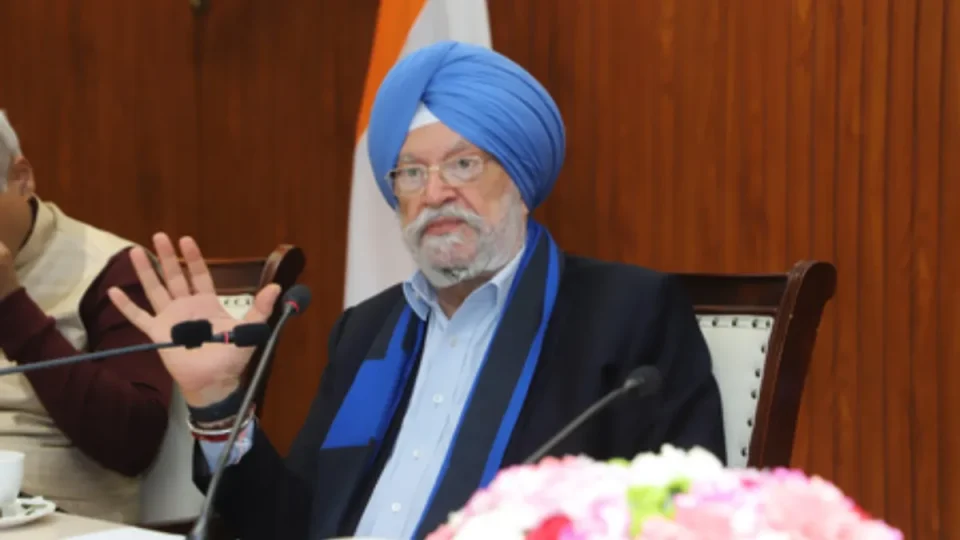
India is well-equipped to manage fluctuations in global crude oil markets despite rising tensions in West Asia, Petroleum Minister Hardeep Singh Puri said. He highlighted diversified oil sourcing, growing domestic energy production, ethanol blending, renewable energy expansion and the government’s commitment to ensuring energy security and affordable fuel access.
✅ India remains prepared to tackle crude oil market volatility.
✅ Hardeep Singh Puri says energy security is strong despite West Asia tensions.
✅ Around 20% of India’s crude imports pass through the Strait of Hormuz.
✅ Government expanding domestic oil exploration and renewable energy capacity.
✅ Rs 90,000 crore allocated under Samudra Manthan initiative.
✅ Petrol prices remain lower than four years ago due to tax reductions.
✅ Subsidised LPG eligibility revised to prevent misuse of welfare benefits.
New Delhi, June 10: India remains well-prepared to manage any volatility in global crude oil markets despite escalating tensions in West Asia, Union Petroleum and Natural Gas Minister Hardeep Singh Puri said on Wednesday.
Speaking to IANS, the minister stated that the government has effectively managed fluctuations in international oil prices over recent months and will continue to monitor developments closely to safeguard India’s energy interests.
Puri said the government’s strategy has been focused on maintaining stability in fuel supplies and prices despite uncertainties in global markets.
“Our constant effort has been, and will continue to be, to manage the situation in the same way we have managed it over the last 100 days,” the minister said, adding that future policy decisions would depend on how global geopolitical developments evolve.
Addressing concerns over oil supplies amid tensions in West Asia, Puri emphasized that India’s energy security framework is significantly stronger today due to diversified sourcing strategies and enhanced domestic production capabilities.
He noted that approximately 20 per cent of India’s crude oil imports and nearly 7 per cent of LPG supplies pass through the Strait of Hormuz, a strategically important maritime route in the region.
While acknowledging ongoing discussions surrounding Iran-US relations and regional stability, the minister refrained from speculating on future geopolitical outcomes.
Puri highlighted India’s progress toward energy self-reliance through expanded domestic exploration activities, increased ethanol blending and rapid growth in renewable energy generation.
“Our exploration and production activities are increasing, biofuel blending has gone up and solar capacity is also growing. As a result, we are moving towards self-reliance in the energy sector,” he said.
The minister also pointed to the government’s Samudra Manthan initiative, under which Rs 90,000 crore has been earmarked for drilling new wells and strengthening domestic oil and gas production infrastructure.
On fuel pricing, Puri said petrol prices in Delhi continue to remain below levels recorded four years ago despite global crude oil volatility.
He attributed this to repeated reductions in central excise duties on petrol and diesel by the Modi government since 2021, along with VAT cuts implemented by several BJP-governed states.
Responding to concerns regarding changes in subsidised LPG cylinder eligibility under the Pradhan Mantri Ujjwala Yojana, the minister said the government acted to curb misuse of subsidies.
According to Puri, authorities received reports indicating that some beneficiaries were diverting subsidised LPG cylinders for commercial purposes or selling them to third parties, prompting a reassessment of subsidy entitlements.
He reiterated that the government’s primary objective remains ensuring affordable energy access for citizens while improving transparency, efficiency and accountability in welfare schemes.
As geopolitical tensions continue to influence global energy markets, the government maintains that India’s diversified oil sourcing, expanding domestic production, renewable energy investments and welfare-focused policies have strengthened the country’s energy security. Officials remain confident that India is well-positioned to manage potential disruptions while advancing its long-term goal of energy self-reliance.
FAQ Section
Q1. What did Hardeep Singh Puri say about India’s energy security?
He said India remains well-prepared to manage crude oil market volatility due to diversified import sources and growing domestic energy production.
Q2. How much of India’s crude oil imports pass through the Strait of Hormuz?
Approximately 20 per cent of India’s crude oil imports and 7 per cent of LPG supplies pass through the Strait of Hormuz.
Q3. What is the Samudra Manthan initiative?
It is a government initiative under which Rs 90,000 crore has been allocated to boost domestic oil and gas exploration and drilling activities.
Q4. Why were changes made to subsidised LPG cylinder eligibility?
The government revised eligibility norms to prevent misuse of subsidised LPG cylinders for commercial purposes.
Q5. How is India moving towards energy self-reliance?
India is expanding domestic oil exploration, increasing ethanol blending, promoting biofuels and rapidly growing solar energy capacity.
