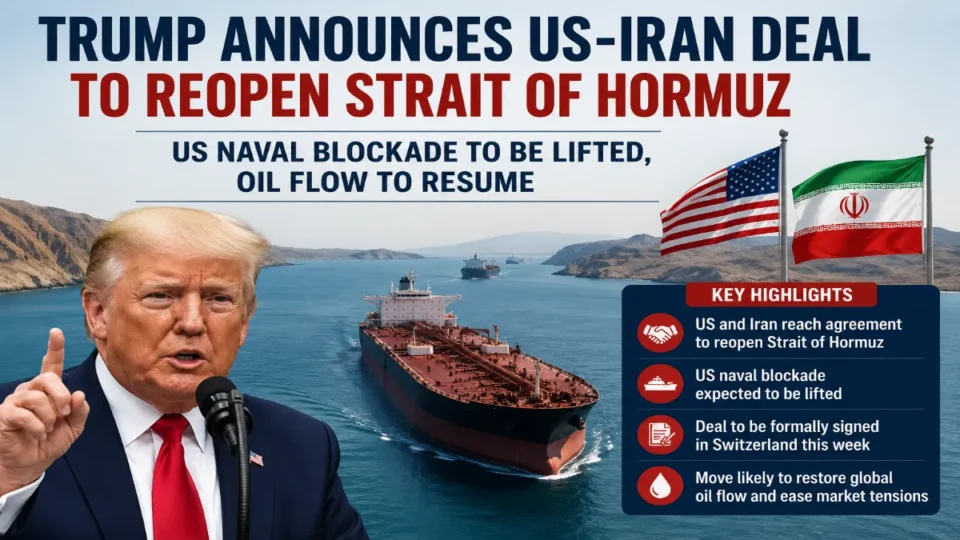
US President Donald Trump announced that the United States and Iran have reached an agreement to reopen the Strait of Hormuz and end the US naval blockade, a move that could restore global oil shipments, ease energy market concerns, and reduce regional tensions. The proposed agreement is expected to be formally signed later this week, according to statements from both US and Iranian officials.
KEY HIGHLIGHTS
• Trump announced a completed US-Iran agreement to reopen the Strait of Hormuz.
• The US naval blockade is expected to be lifted under the proposed deal.
• A formal signing ceremony is reportedly planned in Switzerland later this week.
• The development could help restore global oil shipments and stabilize energy markets.
US President Donald Trump announced that the United States and Iran have completed a deal aimed at reopening the Strait of Hormuz and ending the US naval blockade, a development that could have major implications for global energy markets and regional stability.
In a series of social media posts, Trump described the agreement as a significant diplomatic breakthrough, stating that the deal would allow the immediate reopening of the strategically important waterway through which a substantial share of the world’s seaborne oil trade passes.
“The Deal with the Islamic Republic of Iran is now complete,” Trump said, adding that he had authorized the reopening of the Strait of Hormuz and the removal of the US naval blockade.
The announcement comes after months of heightened tensions that disrupted shipping activity and contributed to volatility in international oil prices. Market participants have closely monitored developments in the Gulf region due to the Strait’s critical role in global energy supply chains.
Trump further stated that the agreement would support the resumption of commercial shipping and facilitate the removal of mines from the waterway. He described the arrangement as a step toward long-term peace and security in the Middle East.
According to reports cited by international media outlets, negotiators from both countries have been engaged in intensive discussions with the support of regional mediators. The proposed framework reportedly focuses on reopening the Strait of Hormuz, ending military hostilities, and restoring freedom of navigation for commercial vessels.
Iranian Deputy Foreign Minister for Legal and International Affairs Kazem Gharibabadi reportedly stated that the US naval blockade would be lifted and that a peace memorandum of understanding is expected to be signed in Switzerland later this week.
Iranian officials have also indicated that future discussions regarding Iran’s nuclear programme and sanctions relief would depend on the implementation of preliminary commitments and verification measures.
The development has drawn global attention because the Strait of Hormuz remains one of the world’s most important maritime trade routes. Any disruption in the passage directly impacts oil-exporting nations, energy importers, shipping companies, and global financial markets.
While the reported agreement focuses on restoring navigation and easing immediate tensions, several broader geopolitical issues between Washington and Tehran are expected to remain under discussion in future negotiations.
CONCLUSION
If formally signed and implemented, the proposed US-Iran agreement could mark an important step toward restoring stability in the Gulf region. The reopening of the Strait of Hormuz would support global energy supplies, improve shipping confidence, and potentially reduce uncertainty across international oil markets. However, the long-term success of the arrangement will depend on implementation, verification, and progress in broader diplomatic negotiations.
FAQ
Q1. What is the Strait of Hormuz ?
The Strait of Hormuz is a strategically important waterway connecting the Persian Gulf to global shipping routes and carries a significant portion of the world’s oil exports.
Q2. What did Donald Trump announce ?
Trump announced that the United States and Iran had completed a deal to reopen the Strait of Hormuz and end the US naval blockade.
Q3. Why is the Strait of Hormuz important ?
The waterway is a critical route for international energy supplies, making it essential for global oil trade and shipping.
Q4. Has the agreement been formally signed ?
According to reported statements, a formal signing ceremony is expected to take place in Switzerland later this week.
Q5. What impact could the deal have on oil markets ?
The reopening of the Strait could improve oil supply flows, reduce shipping disruptions, and help stabilize global energy prices.