


For the first time in India, seven Net-zero Climate Resilient City Action Plans 2070 were releasedtogether, all of whichare in alignment with India’s ambitious target to achieve net-zero emissions by 2070. The launch also made India the first country in South Asia and Southeast Asia to launch seven Net-zero Climate Resilient City Action Plans 2070. This initiative underscores the commitment of Indian cities to combat climate change and enhance community resilience.
The Net-zero CRCAPs of the seven CapaCITIES partner cities are aligned with India’s 2070 Net-zero GHG emissions target unveiled by Narendra Modi, Prime Minister of India at the CoP26, Glasgow 2021.
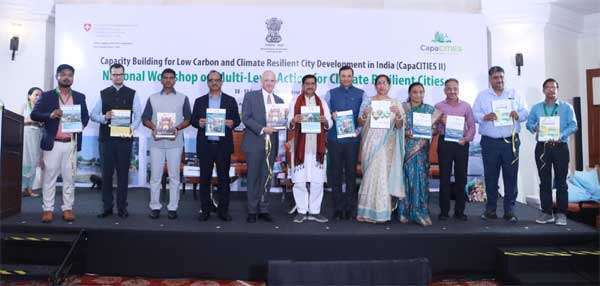
19 September 2024, New Delhi– For the first time in South and Southeast Asia, seven Net-zero Climate Resilient City Action Plans2070,for the cities of Ahmedabad, Rajkot, and Vadodara, Coimbatore, Tiruchirapalli, Tiruneveli Udaipur and Siliguri,were released togetherat the National Workshop on Multi-Level Action for Climate Resilient Cities, held on 18 and 19 September 2024. These plans arein alignment with India’s ambitious target to achieve net-zero emissions by 2070 as committed by Narendra Modi, Prime Minister at the CoP26 in Glasgow, 2021.
The city of Ahmedabad released its Net-zero CRCAP 2070 earlier, in July 2023, during U20 Mayoral Summit, setting a precedent for other cities.This initiative underscores the commitment of Indian cities to combat climate change and enhance community resilience, marking a significant milestone in advancing urban climate resilience in India. This was also a major milestone for the Swiss Agency for Development and Cooperation(SDC) supported CapaCITIES project
The CapaCITIES project has significantly enhanced the ability of the eight Indianpartner citiesto develop and implement low-carbon, climate-resilient strategies, contributing to both national and global climate goals. CapaCITIES also trained the cities in the preparation of large-scale bankable projects.
The workshop was presided over by Tokhan Sahu, Minister of State, Ministry of Housing and Urban Affairs, Government of India.The event was also attended by Rahul Kapoor, Joint Secretary, MoHUA, Government of India and Mission Director, Smart Cities Mission, Philippe Sas, Head of International Cooperation and Counsellor, SDC, Dr Debolina Kundu, Director, NIUA and Emani Kumar, Executive Director, ICLEI South Asia. The workshop alsobrought together more than 150 participants, which included government officialsfrom 30 citiesacross 16 states in India, and experts fromagencies likeAsian Development Bank, World Bank and other sector experts.
The participantsdeliberatedon the various climate interventions that were implemented as they embarked on their climate resilient journey. The solutions discussed included, an urban flood earlywarning system in Tirunelveli, solar powered opportunity charging stationsfor electric busesin Ahmedabad, catchment areaandwatershed management approaches inurban planning and restoration of water bodiesin Tiruchirappalli,implementation ofa green mobility zone in Udaipur,implementation of Miyawaki forests in Vadodara, Udaipur and Siliguri,a scale-up case of a waste to bio-CNG facility and a floating solar projectin Coimbatore, among others.
Key highlightsfrom the eight Net-zero Climate Resilient City Action Plans
- All 8 cities require climate finance ofmore than USD85,000 billion until 2070, for varied climate action projects in the transport, buildings, biodiversity, water supply, SWM, wastewater, stormwater,renewable energy and energy efficiency sectors among others.
- City emissions reductions of up to 91% lower than business-as-usual scenario expected by 2070with existing technology.Bending the curve to achieve net-zero emissions is possible only through further policy changesand new technologiesthat may evolve over time.
- Approximately 8lakh green jobs are expected to be created through implementation of the climate actions highlighted in the plans.
Quotes from the workshop:
Tokhan Sahu, Minister of State, Ministry of Housing and UrbanAffairs, Government of Indiasaid, “The very high temperatures of 2024, extremely heavy rainfall experienced in Gujarat recently, and the extreme cold are all manifestations of climate change. The worst effects of climate changearemore acutely felt by the elderly, children and the poor. It is crucial to address the adverse effects of climate change. In that regard, I welcome the excellent climate change adaptation and mitigation strategies provided by the Net-zero Climate Resilient City Action Plans prepared through CapaCITIES project.”
Rahul Kapoor, IAS, Joint Secretary, MoHUA and Mission Director, Smart Cities Mission, “With increasing extreme climate events, cities must plan for resilience, leverage climate finance, foster green livelihoods and scale up interventions.”
Philippe Sas, Head International Cooperation and Counsellor, Swiss Agency for Development and Cooperation stated “Sustainable planning adopted by Switzerland focuses on engineering longevity, innovation & co-benefits. These best practices contribute significantly to India’s national missions & subnational climate action planning.”
Dr. Debolina Kundu, Acting Director, National Institute of Urban Affairsremarked,“Strategic integration across urban areas is key for climate action. Comprehensive and integrated climate action plans are also required for peripheral towns across India.”Emani Kumar, Executive Director ICLEI South Asiaadded, “India has set a new benchmark in urban climate action by becoming the first South Asian and Southeast Asian country to launch seven Net-Zero Climate Resilient City Action Planstogether at once. This accomplishment reflects the dedication of Indian cities to integrate climate resilience into urban planning and development strategies through collaborative efforts, innovation, and strong partnerships.”
