

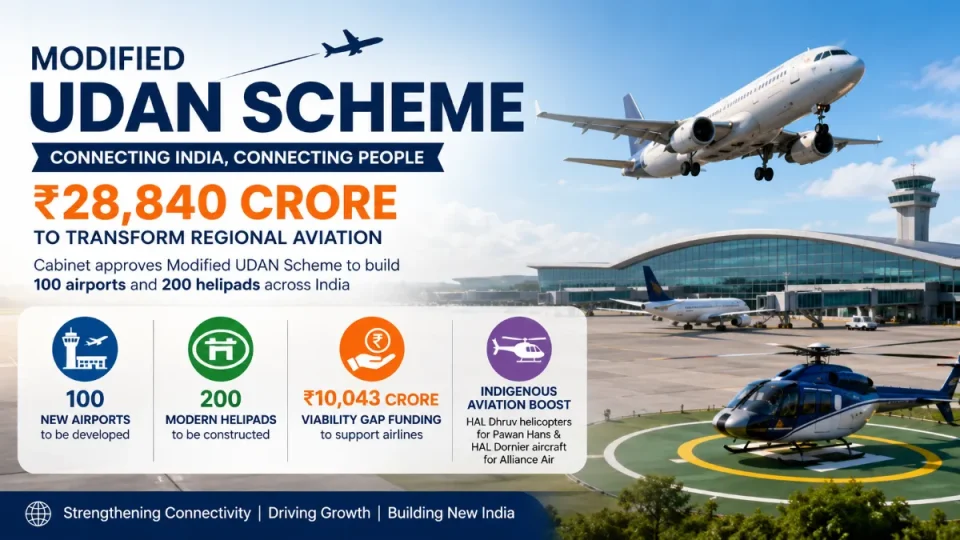
The Union Cabinet has approved the Modified UDAN Scheme coming under the Ministry of Civil Aviation with a ₹28,840 crore outlay to strengthen regional air connectivity across India. The ambitious programme will develop 100 new airports, 200 modern helipads, provide operational support to regional airports, and offer viability gap funding to airlines, making air travel more accessible while boosting infrastructure and economic growth.
Key Highlights
- Modified UDAN Scheme approved with a total investment of ₹28,840 crore.
- 100 new airports and 200 modern helipads will be developed over the next eight years.
- ₹10,043 crore allocated as Viability Gap Funding (VGF) to support regional airline operations.
- HAL Dhruv helicopters and HAL Dornier aircraft to strengthen indigenous aviation under Atmanirbhar Bharat.
India is set to witness another major transformation in regional aviation with the approval of the Modified UDAN (Ude Desh ka Aam Nagrik) Scheme, backed by an investment of ₹28,840 crore. The enhanced programme aims to expand affordable air connectivity, improve aviation infrastructure and connect underserved and remote regions through a stronger network of airports, helipads and regional air services. The initiative builds on the success of the original Regional Connectivity Scheme (RCS)-UDAN, which has significantly expanded India’s domestic aviation sector since its launch in 2016.
The government plans to develop 100 new airports by upgrading existing unserved airstrips with an allocation of ₹12,159 crore over the next eight years. To ensure long-term sustainability, the scheme also provides Operation and Maintenance (O&M) support for regional airports, heliports and water aerodromes for up to three years. This support will help maintain aviation infrastructure while encouraging airlines to expand services to smaller cities and remote destinations.
Recognising the need for better connectivity in geographically challenging areas, the Modified UDAN Scheme includes the construction of 200 modern helipads with a projected investment of ₹3,661 crore. These facilities are expected to improve emergency medical access, disaster response, tourism, administrative services and regional mobility, particularly in hilly and inaccessible regions where conventional airports are not practical.
To make regional routes commercially sustainable, the government has earmarked ₹10,043 crore as Viability Gap Funding (VGF) over a ten-year period. Airlines operating under the scheme will receive financial support for up to five years through a phased funding mechanism. The initiative also promotes Atmanirbhar Bharat by proposing the induction of HAL Dhruv helicopters for Pawan Hans and HAL Dornier aircraft for Alliance Air, strengthening India’s indigenous aviation manufacturing ecosystem while improving regional connectivity.
The ₹28,840 crore Modified UDAN Scheme marks a significant milestone in India’s aviation sector by expanding regional connectivity, strengthening airport infrastructure and promoting indigenous aircraft manufacturing. The initiative is expected to make air travel more accessible, stimulate regional economic development and further position India among the world’s fastest-growing aviation markets.
FAQs
1. What is the Modified UDAN Scheme?
The Modified UDAN Scheme is the government’s regional aviation programme designed to improve affordable air connectivity by developing airports, helipads and supporting airline operations.
2. What is the total budget of the Modified UDAN Scheme?
The scheme has been approved with a total outlay of ₹28,840 crore.
3. How many airports and helipads will be developed?
The programme aims to develop 100 new airports and 200 modern helipads over the next eight years.
4. What is Viability Gap Funding (VGF)?
VGF is financial assistance provided by the government to airlines to make regional routes commercially viable during the initial years of operation.
