

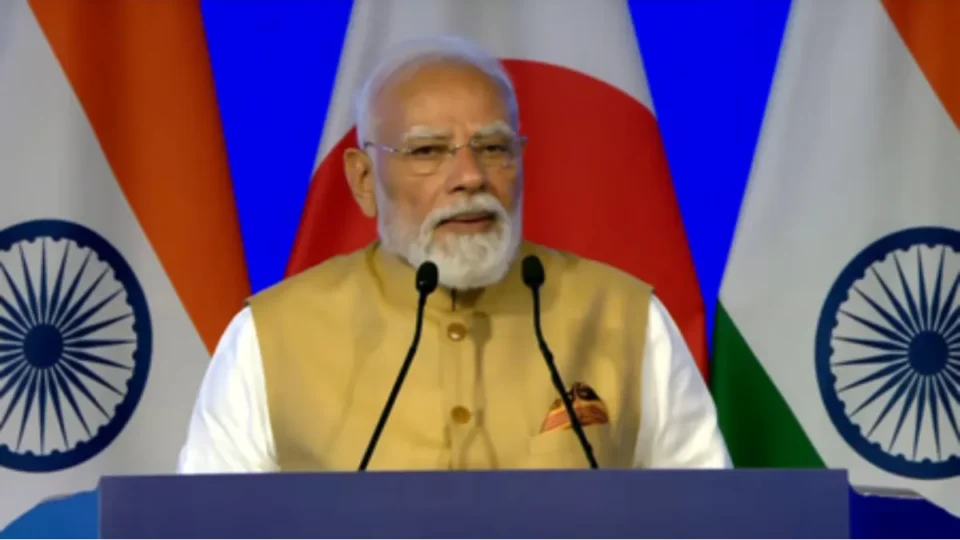
Prime Minister Narendra Modi said India has transformed its economic DNA over the past 12 years by adopting the Japanese philosophy of ‘Kaizen’ or continuous improvement. Speaking at the India-Japan Joint Economic Forum, he highlighted India’s 7.7% GDP growth, next-generation reforms, and urged Japanese businesses to invest in sectors such as artificial intelligence, defence, healthcare, manufacturing, and economic security.
Key Highlights
- PM Modi says India’s economic DNA has been transformed through the Kaizen philosophy of continuous improvement.
- India recorded 7.7% GDP growth in the last financial year, remaining the world’s fastest-growing major economy.
- Prime Minister invites Japanese businesses to invest in India’s reform-driven economy and incentive-backed sectors.
- India and Japan to deepen cooperation in AI, economic security, defence, healthcare, and innovation.
New Delhi, July 02: Prime Minister Narendra Modi on Thursday said India has fundamentally transformed its economic DNA over the past 12 years by embracing the Japanese philosophy of Kaizen, or continuous improvement, while reaffirming India’s position as one of the world’s most attractive destinations for Japanese businesses and long-term investors.
Addressing the India-Japan Joint Economic Forum in New Delhi during the visit of Japanese Prime Minister Sanae Takaichi, the Prime Minister said India continues to remain the world’s fastest-growing major economy, achieving 7.7% GDP growth in the last financial year despite global economic uncertainties.
“India is the world’s fastest-growing major economy. India’s GDP growth was 7.7 per cent in the last financial year,” Prime Minister Modi said.
Highlighting the government’s reform journey, he stated that India has transformed its economic framework by adopting the philosophy of Kaizen, which emphasizes continuous improvement across governance, policy-making, and economic management.
“Over the last 12 years, we have been transforming our economic DNA by pursuing the philosophy of Kaizen, that is, continuous improvement in India,” he said.
The Prime Minister noted that the government’s reform agenda has consistently focused on improving governance, simplifying taxation, enhancing ease of doing business, reducing regulatory burdens, and creating a transparent, investor-friendly ecosystem that encourages both domestic and foreign investment.
He said the government has implemented next-generation reforms in taxation, governance, and business regulations, while progressively opening more sectors of the economy to private sector participation.
“We are opening every sector to the private sector, and in many sectors we are providing incentives. I believe Japanese companies can also benefit from these opportunities,” the Prime Minister said.
He added that several industries are being supported through targeted government incentive schemes, creating new opportunities for Japanese companies to expand manufacturing, technology partnerships, and investments in India.
Referring to the Japan Bank for International Cooperation (JBIC) Annual Survey, Prime Minister Modi said India has been ranked as the most promising investment destination for Japanese businesses for four consecutive years, demonstrating the confidence of Japanese investors in India’s economic reforms and long-term growth prospects.
Emphasizing the strength of the India-Japan Special Strategic and Global Partnership, the Prime Minister said he and Japanese Prime Minister Sanae Takaichi have agreed to deepen cooperation in several future-oriented sectors, including economic security, artificial intelligence (AI), defence, healthcare, advanced technology, innovation, and resilient supply chains.
According to PM Modi, expanding collaboration in these strategic sectors will make the India-Japan partnership more futuristic, dynamic, and limitless, while contributing to sustainable economic growth in both countries.
Calling upon the business community to play a proactive role, the Prime Minister said the governments of India and Japan have already established strategic synergy, mutual confidence, and policy clarity, and now it is the responsibility of industry leaders to convert these policy frameworks into tangible investments, technology partnerships, manufacturing collaborations, and innovation-driven growth.
His address comes during the 16th India-Japan Annual Summit, which aims to strengthen cooperation across economic, strategic, technological, and regional dimensions of the bilateral relationship.
Conclusion
Prime Minister Narendra Modi’s emphasis on the philosophy of Kaizen reflects India’s commitment to continuous reforms, economic modernization, and investment-led growth. By highlighting India’s strong macroeconomic performance, investor-friendly policies, and expanding cooperation with Japan in AI, defence, healthcare, advanced manufacturing, and economic security, the Prime Minister reinforced India’s position as a preferred global investment destination and a trusted strategic partner for Japan.
