

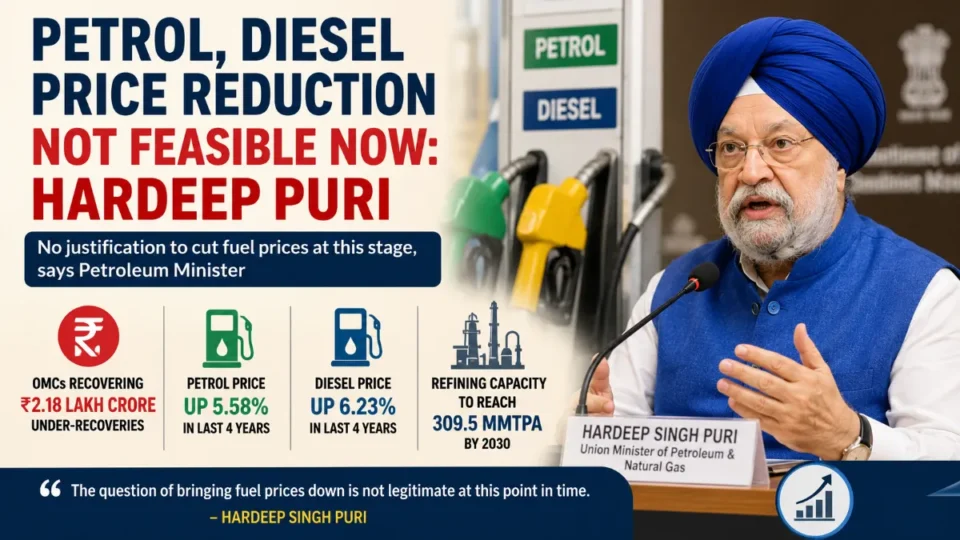
Union Petroleum and Natural Gas Minister Hardeep Singh Puri has ruled out any immediate reduction in petrol and diesel prices, stating that state-run oil marketing companies (OMCs) are still recovering cumulative under-recoveries of around Rs 2.18 lakh crore. He said fuel prices have remained largely stable despite global crude oil volatility and reaffirmed that India maintained uninterrupted fuel supplies even during recent geopolitical tensions.
Key Highlights
| No immediate fuel price cut | Government says there is no justification for reducing petrol and diesel prices now. |
| Rs 2.18 lakh crore recovery | OMCs are still recovering huge cumulative under-recoveries. |
| Fuel prices largely stable | Petrol rose 5.58% and diesel 6.23% in the last four years despite volatile crude prices. |
| Energy security strengthened | India plans to expand refining capacity to 309.5 MMTPA by 2030. |
BodyNew Delhi: Consumers expecting a reduction in petrol and diesel prices will have to wait, as Union Petroleum and Natural Gas Minister Hardeep Singh Puri has made it clear that there is currently no justification for lowering retail fuel prices.
The minister said India has successfully protected consumers from the sharp fluctuations in global crude oil prices, ensuring that fuel prices have remained relatively stable over the past four years despite geopolitical uncertainties and international market volatility.
According to Puri, petrol prices have increased by only 5.58 per cent, while diesel prices have risen by 6.23 per cent during the last four years. He said these modest increases demonstrate the government’s efforts to shield consumers from the full impact of rising global crude prices.
A major reason for maintaining current fuel prices is that state-run Oil Marketing Companies (OMCs) are still recovering cumulative under-recoveries of nearly Rs 2.18 lakh crore. The minister explained that these companies continue to hold fuel inventories purchased when crude oil prices were significantly higher, making any immediate reduction in retail prices financially impractical.
“The question of bringing fuel prices down is not legitimate at this point in time,” Puri said while explaining the government’s position.
Highlighting India’s preparedness during recent geopolitical developments, Puri said the country successfully managed fuel supplies even during tensions surrounding the Strait of Hormuz, one of the world’s most critical oil shipping routes.
He pointed out that none of India’s nearly 1.07 lakh fuel retail outlets experienced shortages or dry-outs, reflecting the government’s effective planning and robust supply chain management.
Looking ahead, the minister said the government is investing heavily in expanding India’s energy infrastructure. The country’s refining capacity is expected to increase to 309.5 million metric tonnes per annum (MMTPA) by 2030, with several refinery expansion and greenfield projects already under implementation.
These projects, expected to be completed over the next few years, will significantly strengthen India’s long-term energy security, improve domestic refining capabilities and reduce dependence on imported petroleum products.
Conclusion
The government’s latest position indicates that petrol and diesel prices are unlikely to be reduced in the immediate future as oil marketing companies continue recovering past losses and managing higher-cost inventories. At the same time, India is accelerating investments in refining capacity and energy infrastructure to ensure stable fuel supplies and stronger energy security for the future.
