

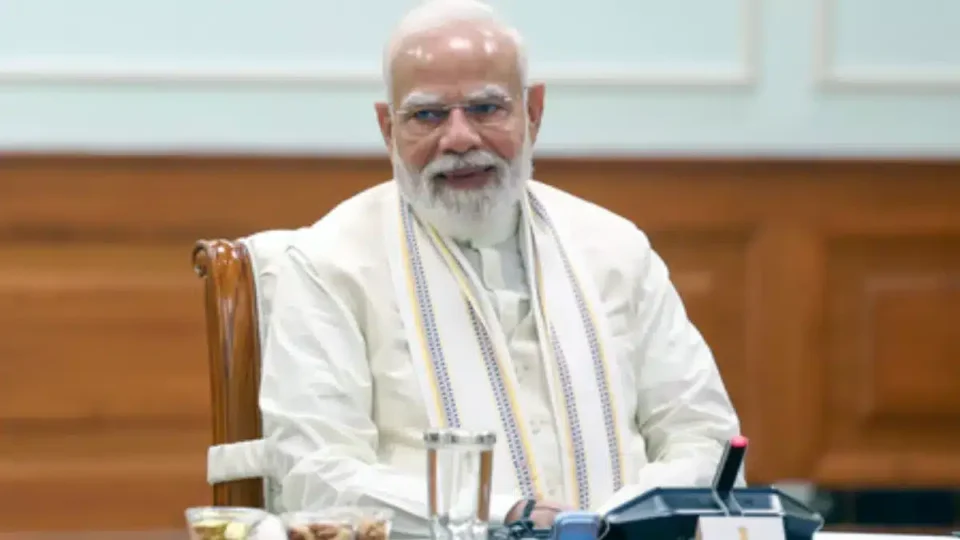
Prime Minister Narendra Modi said India has transformed its economic DNA over the past 12 years by adopting the Japanese philosophy of ‘Kaizen’ or continuous improvement. Addressing the India-Japan Joint Economic Forum, he highlighted India’s 7.7% GDP growth, next-generation economic reforms, and called on Japanese businesses to expand investments in sectors such as artificial intelligence, defence, healthcare, and manufacturing.
Key Highlights
- PM Modi says India has transformed its economic DNA through the philosophy of Kaizen.
- India recorded 7.7% GDP growth in the last financial year, remaining the world’s fastest-growing major economy.
- Prime Minister invites Japanese companies to invest in India’s reform-driven economy.
- India and Japan agree to deepen cooperation in AI, defence, healthcare, and economic security.
New Delhi, July 02: Prime Minister Narendra Modi on Thursday said that India has transformed its economic DNA over the past 12 years by embracing the Japanese philosophy of ‘Kaizen’, or continuous improvement, while inviting Japanese businesses to become partners in India’s next phase of economic growth and industrial transformation.
Addressing the India-Japan Joint Economic Forum in New Delhi, the Prime Minister said India continues to be the world’s fastest-growing major economy, recording 7.7% GDP growth during the last financial year despite global economic uncertainties.
“Over the last 12 years, we have been transforming our economic DNA by pursuing the philosophy of Kaizen, that is, continuous improvement in India,” Prime Minister Modi said.
He explained that the Government’s reform agenda has consistently focused on improving governance, simplifying taxation, enhancing ease of doing business, and creating a transparent, investment-friendly ecosystem that encourages domestic and foreign investment.
Highlighting India’s ongoing economic transformation, the Prime Minister said the government has implemented next-generation reforms across taxation, governance, business regulations, and digital administration, while progressively opening more sectors to private participation.
He noted that the Government is also extending sector-specific incentive schemes to promote investments in strategic industries, creating significant opportunities for Japanese companies looking to expand their operations in India.
“We are opening every sector to the private sector, and in many sectors we are providing incentives. I believe Japanese companies can also benefit from these opportunities,” he said.
Referring to the Japan Bank for International Cooperation (JBIC) Annual Survey, Prime Minister Modi said India has been ranked as the most promising destination for Japanese businesses for four consecutive years, reflecting the growing confidence of Japanese investors in India’s economic potential and policy stability.
The Prime Minister emphasized that the India-Japan Special Strategic and Global Partnership has entered a new phase of cooperation, supported by strong political trust and shared economic objectives.
He said he and Japanese Prime Minister Sanae Takaichi have agreed to further strengthen collaboration in economic security, artificial intelligence (AI), defence, healthcare, advanced technology, innovation, and resilient supply chains, making the bilateral partnership more future-ready.
According to the Prime Minister, these areas of cooperation will not only deepen strategic ties but also create new business opportunities, strengthen industrial collaboration, and contribute to sustainable economic growth in both countries.
Highlighting the close coordination between the two governments, PM Modi said India and Japan share strategic synergy, mutual trust, and policy clarity, providing an enabling environment for businesses to translate government initiatives into concrete investments and long-term partnerships.
He urged industry leaders from both countries to seize emerging opportunities and play a greater role in strengthening bilateral trade, investment, manufacturing, technology transfer, and innovation.
The address comes amid the 16th India-Japan Annual Summit, where both countries are working to expand cooperation across economic, strategic, technological, and regional priorities.
Conclusion
Prime Minister Narendra Modi’s remarks at the India-Japan Joint Economic Forum underscore India’s commitment to continuous economic reforms inspired by the philosophy of Kaizen. By highlighting India’s robust economic growth, investment-friendly reforms, and expanding cooperation with Japan in AI, defence, healthcare, and advanced manufacturing, the Prime Minister reaffirmed India’s position as one of the world’s most attractive investment destinations and a key strategic partner for Japan.
