

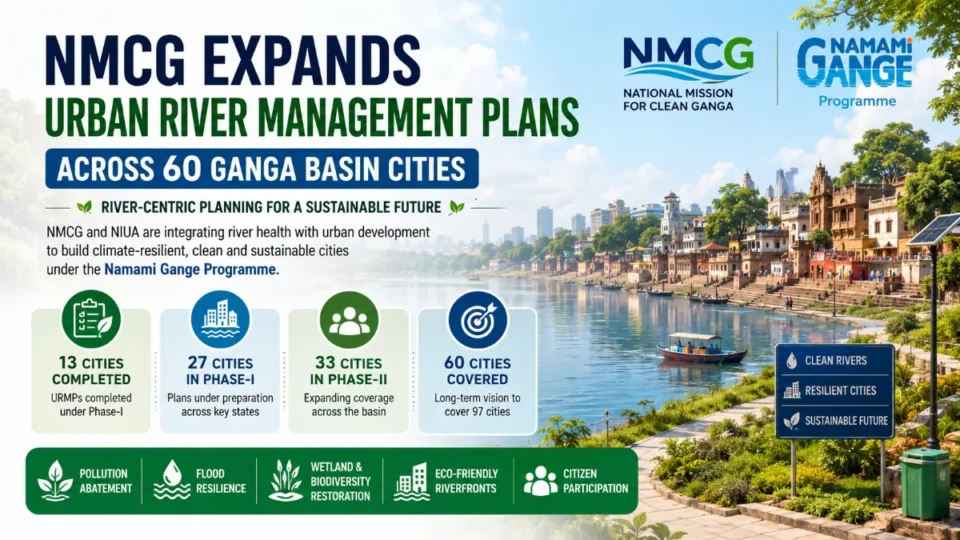
The National Mission for Clean Ganga (NMCG), in collaboration with the National Institute of Urban Affairs (NIUA), has completed Urban River Management Plans (URMPs) for 13 cities and is expanding the initiative across 60 cities in the Ganga Basin. Supported under the Namami Gange Programme, the initiative aims to integrate river health, urban planning, flood resilience, pollution control and sustainable development through a river-centric approach.
Key Highlights
🔹 URMPs completed for 13 cities under Phase-I of the Namami Gange Programme.
🔹 Plans under preparation for 27 cities in Phase-I and 33 cities in Phase-II.
🔹 Initiative aims to cover 60 Ganga Basin cities, with a long-term goal of reaching 97 cities.
🔹 Focus areas include river rejuvenation, flood resilience, pollution control, eco-tourism and citizen participation.
New Delhi: In a significant step towards river-centric urban development, the National Mission for Clean Ganga (NMCG) under the Ministry of Jal Shakti, in partnership with the National Institute of Urban Affairs (NIUA), has accelerated the implementation of Urban River Management Plans (URMPs) across cities located in the Ganga Basin. The initiative, supported under the Namami Gange Programme, represents one of the world’s largest coordinated efforts to integrate river conservation with urban planning.
The programme is inspired by Prime Minister Narendra Modi’s vision of placing rivers at the centre of urban development and civic life. Moving beyond traditional city-centric planning, the initiative seeks to create sustainable, resilient and environmentally responsible urban ecosystems by aligning development strategies with river health.
So far, URMPs have been completed for 13 cities, while plans are being developed for 27 cities under Phase-I and 33 additional cities under Phase-II, taking the overall coverage to 60 cities across the Ganga Basin. The initiative spans multiple states including Uttarakhand, Uttar Pradesh, Bihar, Jharkhand and West Bengal.
The Urban River Management Plan framework is built around three key pillars environmental sustainability, economic development and social well-being. It includes a comprehensive agenda covering floodplain regulation, pollution abatement, wetland restoration, enhancement of riparian buffers, treated water reuse, eco-sensitive riverfront development, biodiversity conservation and citizen engagement. Cities are expected to implement these interventions through regulatory reforms, infrastructure projects and community-driven initiatives.
The programme builds on successful pilot projects undertaken in cities such as Ayodhya, Kanpur and Chhatrapati Sambhaji Nagar, where locally tailored river management strategies demonstrated the benefits of integrating ecological restoration with urban development. Encouraged by these outcomes, the initiative is now being expanded across the Ganga Basin through a phased approach.
Several cities, including Rishikesh, Haldwani-Kathgodam, Ramnagar, Gorakhpur, Shahjahanpur, Bijnor, Prayagraj, Buxar, Chapra and Gaya, have already completed their plans. These city-specific strategies include innovative solutions such as constructed wetlands, sponge landscapes, bioswales, ecological drain rejuvenation, groundwater recharge systems and blue-green infrastructure to improve river health and climate resilience.
The initiative has also moved beyond planning to implementation. In Kanpur, pilot projects are underway to rejuvenate the Central Ordnance Depot (COD) Drain and restore urban water bodies using advanced Lake Assessment and Monitoring Analysis System (LAMAS) technology. These projects are expected to demonstrate how river-sensitive planning can deliver measurable environmental, social and economic benefits.
To support implementation, NMCG is promoting priority interventions through the Performance Based Incentive Grant (PBIG) mechanism under its partnership with the World Bank. Planned projects include wetland restoration, faecal sludge and septage management, eco-friendly riverfront development, riparian buffer creation and technology-enabled river management solutions.
With a long-term vision of covering all 97 cities along the main stem of the Ganga, the initiative aims to establish a nationally adaptable framework for river-sensitive urban planning and sustainable development across India.
Conclusion
The expansion of Urban River Management Plans across Ganga Basin cities marks a transformative shift in India’s approach to urban planning. By integrating river conservation, climate resilience, ecological restoration and community participation, the NMCG initiative is laying the foundation for sustainable, future-ready cities while advancing the objectives of the Namami Gange Programme.
FAQ Section
Q1. What is an Urban River Management Plan (URMP)?
A URMP is a river-sensitive urban planning framework that integrates river health, flood management, pollution control and sustainable urban development.
Q2. How many cities are covered under the URMP initiative?
The initiative currently covers 60 cities across the Ganga Basin, with a long-term target of 97 cities.
Q3. Which organisations are implementing the programme?
The initiative is being implemented by NMCG in collaboration with the National Institute of Urban Affairs (NIUA).
Q4. What are the key objectives of URMPs?
The plans focus on river rejuvenation, flood resilience, pollution abatement, biodiversity conservation, eco-tourism and citizen engagement.
