

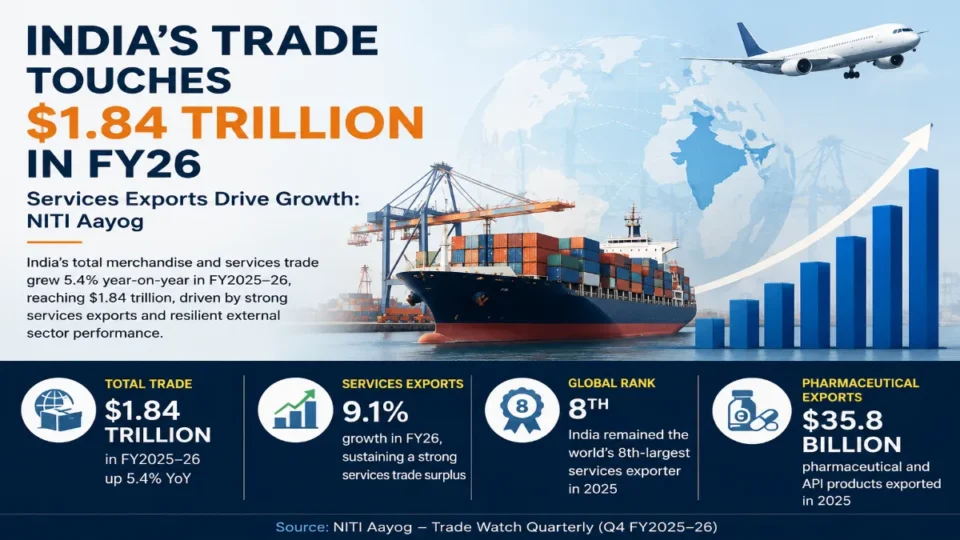
India’s total merchandise and services trade grew by 5.4 per cent year-on-year to reach $1.84 trillion in FY2025-26, driven by strong services exports and resilient external sector performance despite global uncertainties, according to NITI Aayog’s latest Trade Watch Quarterly report. This growth highlights the significance of India’s Trade in the global market.
Key Highlights
- India’s total trade reached $1.84 trillion in FY26, up 5.4%.
- Services exports grew 9.1%, sustaining a strong trade surplus.
- India remained the world’s 8th-largest services exporter in 2025.
- Pharmaceutical exports and APIs touched $35.8 billion, highlighting sector strength.
India’s total merchandise and services trade expanded by 5.4 per cent year-on-year to reach $1.84 trillion during FY2025-26, reflecting the resilience of the country’s external sector amid continued global economic uncertainty, according to NITI Aayog’s latest “Trade Watch Quarterly” report.
The report was released in New Delhi by NITI Aayog Vice-Chairman Ashok Kumar Lahiri in the presence of senior officials, including the CEO of NITI Aayog.
According to the report, India’s trade performance during the January–March quarter of FY2025-26 remained stable, supported largely by robust growth in services exports. While merchandise exports witnessed moderation and imports increased, the overall composition of trade remained balanced.
A major highlight of the report is the strong performance of India’s services sector. Services exports recorded a growth of 9.1 per cent, significantly outpacing import growth and helping maintain a strong services trade surplus. India retained its position as the world’s eighth-largest services exporter in 2025, with services exports registering a compound annual growth rate (CAGR) of 10.3 per cent between 2015 and 2025, well above the global average.
Overall exports increased by 4.2 per cent during FY2025-26, while imports rose by 6.5 per cent, underscoring India’s growing engagement with the global economy.
The report also places special emphasis on India’s pharmaceutical sector, which has emerged as a strategic pillar of the economy. Backed by strong manufacturing capabilities, global competitiveness in generic medicines, and increasing integration into international healthcare supply chains, the sector continues to strengthen India’s global standing.
Global pharmaceutical and Active Pharmaceutical Ingredients (API) demand is estimated at approximately $1.3 trillion in 2025. India exported pharmaceutical and API products worth $35.8 billion during the year, reinforcing its role as a major supplier of affordable medicines worldwide.
India’s pharmaceutical exports remain concentrated in formulations, particularly generic medicines and retail medicaments, where the country enjoys a strong global presence. However, NITI Aayog noted that global pharmaceutical markets are increasingly shifting towards high-value segments such as biologics, immunologicals, biosimilars, and advanced therapeutics, areas where India still has significant room for expansion.
The report further highlights India’s continued dependence on imported pharmaceutical raw materials and intermediates, especially from China, despite improvements in specialised chemical intermediates and antibiotic production.
At the state level, Telangana, Gujarat and Maharashtra have emerged as the leading pharmaceutical hubs, accounting for a significant share of India’s production, exports and participation in global value chains. Their success has been driven by strong industrial ecosystems, cluster-based development, globally competitive companies and supportive government policies.
Looking ahead, NITI Aayog believes India’s pharmaceutical sector is well-positioned to deepen its role in global value chains. Expanding domestic API manufacturing, investing in research and development, strengthening innovation ecosystems, improving regulatory efficiency and enhancing market access in key export destinations will be crucial to achieving higher value addition.
The report concludes that with sustained investments in technology, skills and innovation, India can further strengthen its position as a leading global pharmaceutical manufacturing and healthcare innovation hub while supporting long-term growth in trade and exports.
Conclusion:
NITI Aayog’s latest Trade Watch Quarterly underscores the resilience of India’s external sector, with services exports emerging as a key growth engine. The report also highlights the immense potential of India’s pharmaceutical industry to become a larger contributor to global healthcare supply chains through innovation, value addition and enhanced manufacturing capabilities.
FAQs
Q1: What was India’s total trade during FY2025-26 ?
India’s total merchandise and services trade reached $1.84 trillion, registering a growth of 5.4 per cent.
Q2: How much did services exports grow in FY26?
Services exports grew by 9.1 per cent, helping maintain a strong services trade surplus.
Q3: What is India’s rank among global services exporters?
India remained the world’s eighth-largest services exporter in 2025.
Q4: How much did India export in pharmaceutical and API products?
India exported pharmaceutical and API products worth $35.8 billion in 2025.
Q5: Which states lead India’s pharmaceutical sector?
Telangana, Gujarat and Maharashtra are the leading pharmaceutical manufacturing and export hubs.
