

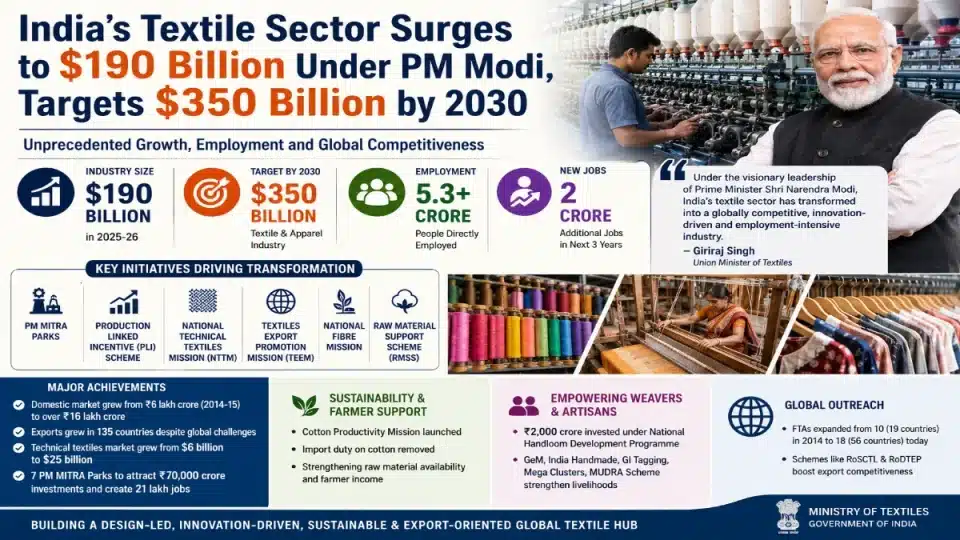
India’s textile and apparel industry has grown to nearly $190 billion in 2025-26 under Prime Minister Narendra Modi’s leadership and is expected to reach $350 billion by 2030, Union Textiles Minister Giriraj Singh said. Driven by flagship initiatives such as PM MITRA Parks, the PLI Scheme, and the National Technical Textiles Mission, the sector has become a major contributor to employment, exports, and economic growth.
Key Highlights
✅ India’s textile industry reaches nearly USD 190 billion in 2025-26
✅ Government targets USD 350 billion textile market by 2030
✅ Sector employs over 5.3 crore people and may add 2 crore jobs
✅ PM MITRA Parks expected to attract ₹70,000 crore investment and create 21 lakh jobs
India’s textile and apparel sector has witnessed a remarkable transformation over the last 12 years under the leadership of Prime Minister Narendra Modi, emerging as a globally competitive, innovation-driven, and employment-intensive industry, Union Textiles Minister Giriraj Singh said on Thursday.
Must Read
- Textiles PLI Scheme : Deadline for Fresh Applications Extended to March 31
- PLI Scheme for Textiles: Application Window Extended
- Over 60 applicants approved under PLI scheme for textiles
- PLI scheme to be expanded to garment sector: Textiles Minister
Highlighting the achievements of the Ministry of Textiles, Singh said the sector’s growth has been guided by the Prime Minister’s 5F Vision — Farm to Fibre, Fibre to Factory, Factory to Fashion, and Fashion to Foreign, creating an integrated value chain that connects farmers, weavers, artisans, manufacturers, and exporters across the country.
According to the Minister, India’s textile industry has expanded to nearly USD 190 billion in 2025-26 and is poised to achieve a target of USD 350 billion by 2030. The domestic textile market has grown significantly from around ₹6 lakh crore in 2014-15 to over ₹16 lakh crore, reflecting the sector’s strong contribution to India’s economic growth.
The textile and apparel sector currently provides direct employment to more than 5.3 crore people and is expected to create nearly 2 crore additional jobs over the next three years. The government has introduced several transformative initiatives including PM MITRA Parks, the Production Linked Incentive (PLI) Scheme, National Technical Textiles Mission (NTTM), Textiles Export Promotion Mission (TEEM), National Fibre Mission, and Raw Material Support Scheme (RMSS) to strengthen the industry’s competitiveness and sustainability.
To support cotton farmers and ensure adequate raw material supply, the government launched the Cotton Productivity Mission and removed import duty on cotton. Export competitiveness has been enhanced through RoSCTL and RoDTEP schemes, while India’s Free Trade Agreement network has expanded from 10 FTAs covering 19 countries in 2014 to 18 FTAs covering 56 countries.
Despite global trade uncertainties, India has diversified its export destinations and recorded export growth in 135 countries. The Minister also highlighted the rapid rise of technical textiles, with the sector expanding from around USD 6 billion to USD 25 billion under the National Technical Textiles Mission.
Infrastructure development has received a major boost through integrated textile parks and seven PM MITRA Parks, which are expected to attract investments worth ₹70,000 crore and generate approximately 21 lakh employment opportunities.
Minister of State for Textiles Pabitra Margherita noted that nearly ₹2,000 crore has been invested through the National Handloom Development Programme, benefiting lakhs of weavers through improved infrastructure, skill development, and market access. Initiatives such as the Government e-Marketplace (GeM), India Handmade portal, GI tagging, Mega Handloom Clusters, and the Weavers’ MUDRA Scheme have further strengthened the handloom ecosystem.
Textiles Secretary Neelam Shami Rao emphasized the growing role of women in the textile sector as workers and entrepreneurs. She expressed confidence that continued policy support, technological innovation, skill enhancement, and infrastructure development will help India emerge as a leading global textile powerhouse and contribute significantly to the vision of Viksit Bharat.
India’s textile sector has emerged as one of the country’s strongest economic growth drivers, supported by policy reforms, infrastructure development, export promotion, and innovation-focused initiatives. With ambitious targets for investment, exports, and employment, the industry is well-positioned to strengthen India’s global manufacturing footprint and play a crucial role in achieving the vision of a developed India by 2047.
FAQ Section
Q1. What is the current size of India’s textile industry?
India’s textile industry has reached nearly USD 190 billion in 2025-26.
Q2. What is the government’s target for the textile sector by 2030?
The government aims to expand the textile industry to USD 350 billion by 2030.
Q3. How many people are employed in India’s textile sector?
The textile and apparel sector currently provides direct employment to more than 5.3 crore people.
Q4. What are PM MITRA Parks?
PM MITRA Parks are integrated textile manufacturing parks designed to attract investments, boost production, and generate employment.
Q5. How much investment are PM MITRA Parks expected to attract?
The seven PM MITRA Parks are expected to attract investments worth approximately ₹70,000 crore.
Related posts :
 Ministry of Textiles
 Prime Minister of India, Shri Narendra Modi
 Rubio Highlights Energy Cooperation, Invites PM Modi to White House
 India Myanmar Relations Get Boost as PM Modi Holds Talks with Min Aung Hlaing
 PM Modi to Unveil Delhi-Mumbai Expressway Stretches and Highway Projects Worth Rs 12,421 Crore in Surat on June 5
 PM Narendra Modi Becomes India’s Longest-Serving Elected Prime Minister, Completes 4,399 Days in Office
