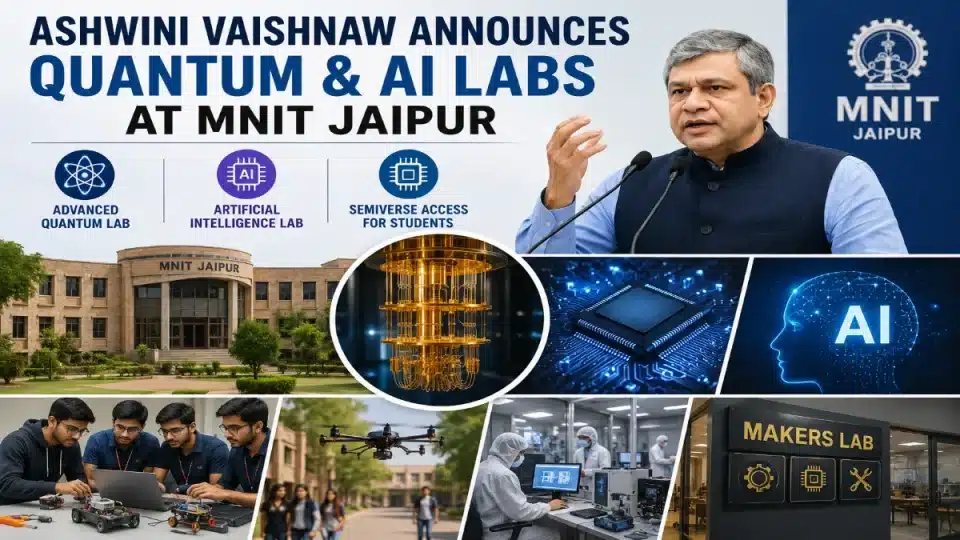
Union Minister Ashwini Vaishnaw has announced the establishment of Advanced Quantum Computing and Quantum Communications Labs and an Artificial Intelligence Lab at Malaviya National Institute of Technology (MNIT) Jaipur. The initiative aims to strengthen India’s capabilities in quantum technologies, semiconductor design, post-quantum cryptography, and AI research while providing students access to Lam Research’s Semiverse semiconductor training platform.
Key Highlights Box
✅ Advanced Quantum Computing and Quantum Communications Lab to be established at MNIT Jaipur
✅ AI Lab to be connected with the IndiaAI Mission network
✅ Students to get access to Lam Research’s Semiverse semiconductor training platform
✅ Focus on Quantum Key Distribution (QKD), Quantum Computing and Quantum Sensing
✅ Government providing EDA tools to 323+ universities under Chips to Startup Programme
✅ More than 100 student-designed chips fabricated at SCL Mohali
✅ Makers Lab inaugurated for hands-on learning in software and hardware technologies
Jaipur, June 12 Union Minister for Electronics & Information Technology, Railways and Information & Broadcasting Ashwini Vaishnaw has announced the establishment of an Advanced Quantum Computing and Quantum Communications Lab at Malaviya National Institute of Technology (MNIT), Jaipur, marking a significant step in strengthening India’s deep-tech and semiconductor ecosystem.
The new facility will be established under the Ministry of Electronics and Information Technology’s (MeitY) Electronics and ICT Academic Project and will focus on developing indigenous capabilities in Quantum Key Distribution (QKD), Quantum Computing simulation and Quantum Sensing hardware components.
Addressing students and faculty members at MNIT Jaipur, Vaishnaw emphasized that while Artificial Intelligence is driving the current technological revolution, Quantum Technology is expected to lead the next major wave of innovation.
The Union Minister said the research work undertaken through the proposed quantum lab would be of strategic importance to the country. He highlighted the significance of Quantum Key Distribution technology for national security and urged MNIT Jaipur to emerge as a leader in the field of post-quantum cryptography.
In another major announcement, Vaishnaw revealed that students of MNIT Jaipur will gain access to Lam Research’s Semiverse platform, a digital twin-based semiconductor fabrication and training ecosystem. The platform will enable students to explore semiconductor chip structures in three dimensions, understand advanced chip manufacturing processes and simulate fabrication workflows in a virtual environment.
Highlighting the growing opportunities in the semiconductor sector, the Minister noted that industry estimates indicate a demand for more than one million semiconductor design professionals globally. He said India is well-positioned to bridge this talent gap, citing the presence of leading technology companies such as NVIDIA, Qualcomm, ARM and AMD, which are already designing advanced 2nm and 3nm semiconductor chips in India.
Vaishnaw also highlighted the government’s Chips to Startup (C2S) Programme, under which Electronic Design Automation (EDA) tools from industry leaders including Synopsys, Cadence and Renesas have been provided to more than 323 universities across the country.
According to the Minister, these advanced design tools have already enabled the fabrication of more than 100 student-designed semiconductor chips at the Semiconductor Laboratory (SCL) in Mohali. He encouraged students to leverage these resources to develop innovative semiconductor technologies.
To further boost research and innovation, the Union Minister announced the establishment of an Artificial Intelligence Lab at MNIT Jaipur. The facility will provide advanced computing infrastructure and research tools while being integrated with the broader IndiaAI Mission network. He also highlighted the work being carried out by IIT Jodhpur in developing deepfake detection technologies as an example of India’s growing AI capabilities.
During the visit, Vaishnaw, along with Rajasthan Minister of State (Independent Charge) for Energy Heeralal Nagar and Rajasthan MLA Gopal Sharma, inaugurated the Makers Lab at MNIT Jaipur. The facility will offer experiential and hands-on training opportunities in software and hardware technologies, including sensors, embedded systems, computing devices and electronic systems.
The Minister also interacted with students and faculty members, reviewing innovative projects in artificial intelligence, robotics, drones, structural engineering and post-quantum cryptography.
The announcements reinforce the government’s commitment to building a robust ecosystem for emerging technologies, positioning India as a global hub for quantum computing, artificial intelligence and semiconductor innovation.
The establishment of advanced Quantum Computing and AI laboratories at MNIT Jaipur, coupled with access to cutting-edge semiconductor training platforms, reflects the government’s focus on nurturing future-ready talent and accelerating India’s leadership in emerging technologies.
FAQ Section
Q1. What new labs have been announced at MNIT Jaipur?
Advanced Quantum Computing and Quantum Communications Lab and an Artificial Intelligence Lab.
Q2. What is the purpose of the Quantum Lab?
The lab will focus on Quantum Key Distribution, Quantum Computing simulation and Quantum Sensing technologies.
Q3. What is Lam Research’s Semiverse platform?
It is a digital twin-based semiconductor fabrication and training ecosystem that helps students learn chip design and manufacturing virtually.
Q4. What is the Chips to Startup (C2S) Programme?
A Government of India initiative that provides advanced semiconductor design tools to educational institutions across the country.
Q5. How many universities have received EDA tools under the programme?
More than 323 universities have received industry-grade semiconductor design tools.