

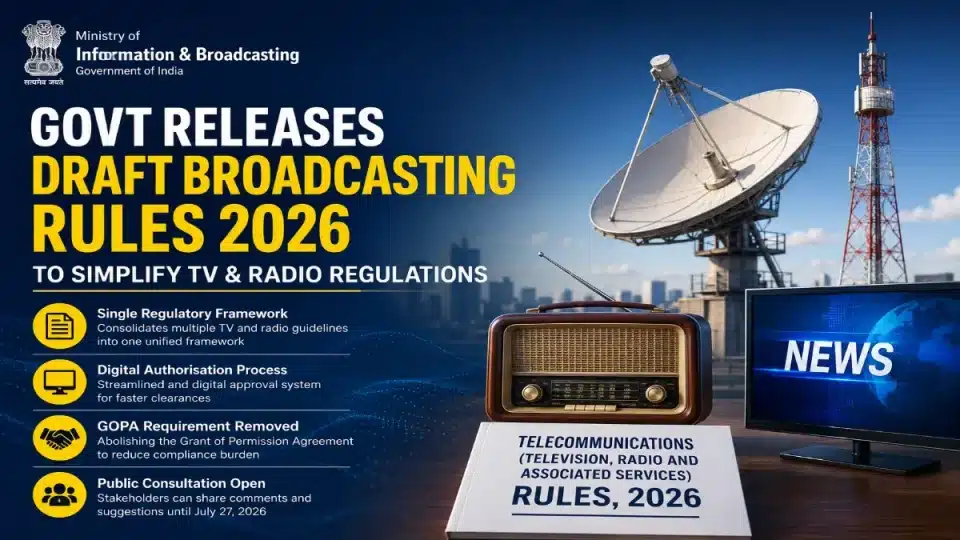
The Ministry of Information & Broadcasting has unveiled the Draft Telecommunications (Television, Radio and Associated Services) Rules, 2026, proposing a unified regulatory framework for television and radio broadcasting services under the Telecommunications Act, 2023. The draft rules aim to simplify compliance, digitise authorisation processes, remove procedural hurdles, and improve ease of doing business across India’s broadcasting sector.
Key Highlights
✅ Single regulatory framework to replace multiple television and radio broadcasting guidelines
✅ Digital authorisation process to streamline approvals and reduce paperwork
✅ Grant of Permission Agreement (GOPA) requirement removed to ease compliance burden
✅ Public comments and stakeholder suggestions invited until July 27, 2026
New Delhi, June 12 The Ministry of Information & Broadcasting (MIB) has published the Draft Telecommunications (Television, Radio and Associated Services) Rules, 2026, marking a major step towards modernising and simplifying India’s broadcasting regulatory framework. The draft rules have been released for public consultation and seek to consolidate a wide range of television and radio broadcasting regulations under the Telecommunications Act, 2023.
According to the ministry, the proposed framework is designed to create a unified and significantly simplified rule book for broadcasters, replacing multiple existing guidelines with a single regulatory structure. The move is expected to enhance regulatory clarity, reduce compliance burdens, and improve the overall ease of doing business for operators in the broadcasting sector.
The draft rules integrate several existing policy frameworks, including guidelines related to uplinking and downlinking of satellite television channels, licensing of Direct-to-Home (DTH) broadcasting services, and regulations governing Headend-in-the-Sky (HITS) broadcasting services. In addition, the framework incorporates policies covering the expansion of private FM radio broadcasting under Phase III and the establishment of community radio stations across the country.
Once notified, the new rules will replace multiple existing broadcasting guidelines, creating a more streamlined and harmonised regulatory environment for television and radio service providers. The ministry believes that a consolidated framework will make it easier for businesses to understand and comply with regulatory requirements while supporting future sector growth.
One of the key features of the draft rules is the introduction of a digital implementation mechanism for authorisation processes, which is expected to improve transparency and reduce processing time. The framework also proposes simplified authorisation procedures and the removal of the requirement for signing the Grant of Permission Agreement (GOPA), a measure aimed at reducing administrative complexity.
The draft further provides for a transparent adjudication mechanism, ensuring fair and efficient handling of regulatory matters. These reforms are intended to facilitate continuity for existing operators while creating opportunities for innovation and investment within the broadcasting ecosystem.
The Ministry of Information & Broadcasting has invited stakeholders, industry representatives, and members of the public to submit comments and suggestions on the draft rules. Inputs can be sent to the Under Secretary (BP&L) of the ministry until July 27, 2026, following which the government will review feedback before finalising the regulatory framework.
The proposed rules are expected to play a crucial role in shaping the future of India’s broadcasting industry by promoting efficiency, transparency, and a more business-friendly regulatory environment.
The Draft Telecommunications (Television, Radio and Associated Services) Rules, 2026 represent a significant regulatory reform aimed at simplifying broadcasting regulations in India. By consolidating multiple guidelines into a single framework, digitising authorisation processes, and reducing compliance requirements, the government seeks to create a more transparent, efficient, and investment-friendly environment for television and radio broadcasters.
FAQ Section
Q1. What are the Draft Telecommunications (Television, Radio and Associated Services) Rules, 2026 ?
The draft rules are proposed regulations aimed at consolidating existing television and radio broadcasting guidelines into a single framework under the Telecommunications Act, 2023.
Q2. What is the purpose of the new broadcasting rules ?
The rules aim to simplify regulations, improve ease of doing business, digitise authorisation procedures, and reduce compliance burdens for broadcasters.
Q3. Which broadcasting services are covered under the draft rules ?
The framework covers satellite TV channels, DTH services, HITS services, FM radio broadcasting, and community radio stations.
Q4. What major compliance change has been proposed ?
The draft proposes removing the requirement for signing the Grant of Permission Agreement (GOPA) and introducing a digital authorisation process.
Q5. Until when can stakeholders submit feedback ?
Comments and suggestions can be submitted to the Ministry of Information & Broadcasting until July 27, 2026.
