

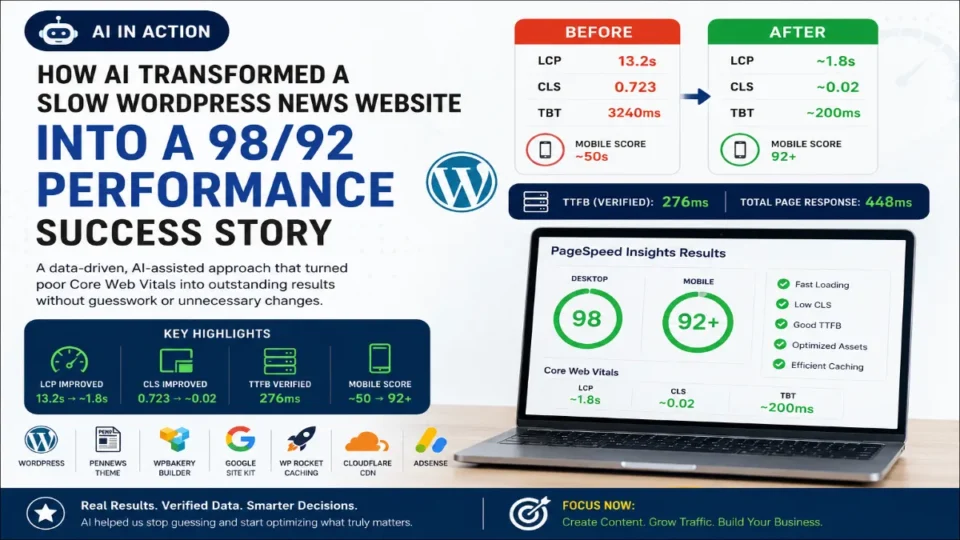
A WordPress news website struggling with poor Core Web Vitals improved its performance dramatically by using AI-assisted analysis and data-driven troubleshooting. Instead of randomly installing plugins, every issue was verified through testing, resulting in desktop scores of 98, mobile scores above 92, a TTFB of 276ms, and a significant improvement in LCP and CLS metrics.
KEY HIGHLIGHTS
✓ LCP reduced from 13.2 seconds to approximately 1.8 seconds
✓ CLS improved from 0.723 to 0.02
✓ Server response time verified at just 276ms TTFB
✓ Mobile PageSpeed score increased from the 50s to over 92
For years, website owners have been told that improving WordPress speed requires endless plugin installations, expensive hosting upgrades, and constant tweaking. In reality, many performance problems persist because businesses focus on assumptions rather than evidence.
Useful Articles
- 91 Countries Unite Behind New Delhi Declaration on Artificial Intelligence Impact
- Global Artificial Intelligence Expenditure to Near $1.5 Trillion in 2025
- India among top countries in artificial intelligence adoption
- The Third Eye: Artificial Intelligence in aid of knowledge economy
This case study demonstrates how Artificial Intelligence combined with data-driven analysis helped transform a struggling WordPress news portal into a high-performing website without unnecessary changes or costly infrastructure upgrades.
The journey began with alarming performance metrics. The website recorded an LCP of 13.2 seconds, a CLS score of 0.723, and a Total Blocking Time of 3240ms. Mobile PageSpeed scores hovered around the 50-point range, creating concerns about user experience, SEO performance, and search visibility.
Instead of applying random fixes, every potential issue was investigated and validated. The analysis revealed that layout shifts were being caused by lazy-loaded PenNews blocks, while the largest contentful paint element required optimization. Additional reviews identified opportunities to streamline WPBakery module loading, assess Google Site Kit overhead, and verify caching behavior.
The process extended beyond WordPress itself. Cloudflare configuration, WP Rocket caching, homepage cache delivery, mobile cache performance, and VPS resource utilization were all carefully reviewed. Each component was tested to determine whether it contributed to performance bottlenecks.
The most important discovery came from a simple server test. Using direct response measurements, the website’s performance was verified with a Time to First Byte (TTFB) of only 276 milliseconds and a total page response time of 448 milliseconds.
These findings immediately changed the optimization strategy.
Rather than searching for additional plugins or blaming server infrastructure, the data confirmed that the website was already delivering pages quickly. The server was healthy, caching systems were functioning correctly, and the hosting environment was not overloaded.
This is where many businesses misunderstand website performance metrics. Google’s Chrome User Experience Report (CrUX) relies on historical user data collected over approximately 28 days. As a result, recent optimizations often take time before they are fully reflected in Core Web Vitals reports and Search Console dashboards.
After implementing the verified improvements, the results were substantial. The website achieved approximately 98 on desktop PageSpeed Insights, 92+ on mobile, 1.8-second LCP, 0.02 CLS, and a consistently fast 276ms TTFB.
These numbers are particularly impressive considering the website operates with WordPress, PenNews Theme, WPBakery Builder, AdSense advertisements, Cloudflare CDN, and frequent news content updates.
The real lesson from this project extends beyond website speed. AI was not valuable because it automatically fixed problems. AI proved valuable because it helped identify the right problems to solve, validated assumptions with evidence, and prevented wasted effort on unnecessary optimizations.
Businesses often spend months chasing minor Lighthouse score improvements while neglecting activities that directly impact growth. Once performance metrics reach a healthy level, the focus should shift toward publishing quality content, increasing audience engagement, and growing organic traffic.
This project demonstrates that successful website optimization is not about endless tweaking. It is about understanding the data, validating every assumption, and making informed decisions that create measurable business results.
CONCLUSION
This WordPress optimization success story highlights the true value of AI in digital marketing and website performance. By replacing guesswork with verified testing, a slow-performing news portal achieved excellent Core Web Vitals, faster load times, and stronger SEO readiness. The biggest takeaway is simple: when performance data confirms your website is healthy, your time is often better spent growing content and traffic rather than chasing marginal speed improvements.
FAQ SECTION
Q: Can AI improve WordPress website speed ?
A: AI can help identify performance bottlenecks, analyze data, and recommend verified optimizations, making website speed improvement more efficient and accurate.
Q: What is a good TTFB for WordPress?
A: A TTFB below 500ms is generally considered good. In this case study, the website achieved a TTFB of 276ms.
Q: Why do Core Web Vitals take time to improve?
A: Google’s Chrome User Experience Report uses historical data collected over roughly 28 days, so improvements may not appear immediately.
Q: Should I keep optimizing after reaching high PageSpeed scores?
A: Once your website achieves strong performance metrics, it is often more beneficial to focus on content creation, SEO, and audience growth.
