

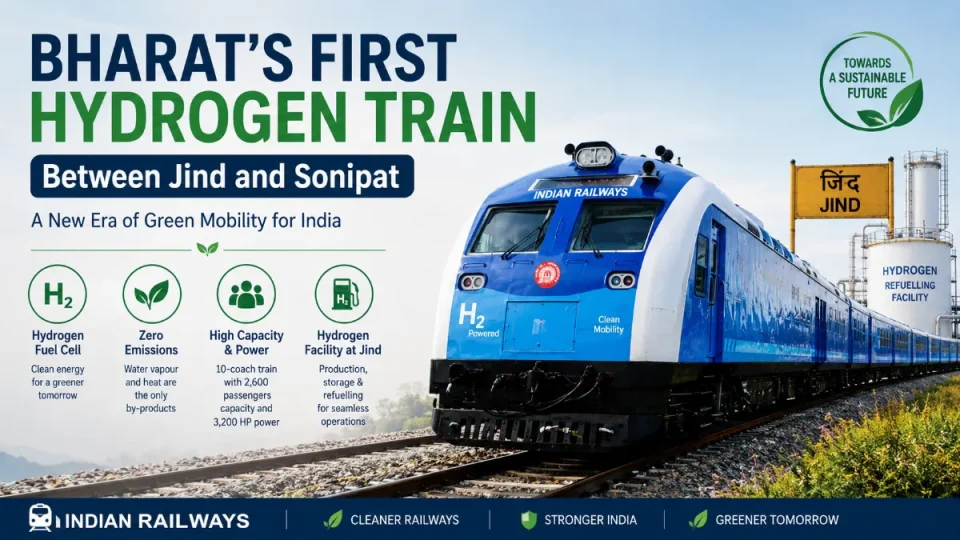
Indian Railways is preparing to launch Bharat’s first hydrogen-powered train on the Jind Sonipat section in Haryana, marking a major milestone in India’s clean transportation journey. Equipped with hydrogen fuel cell technology, advanced battery systems, and indigenous engineering, the train is designed to offer zero-emission rail travel while reducing dependence on fossil fuels. This initiative is a significant step in the vision for sustainable mobility by PM Modi.
Key Highlights
- India’s first hydrogen fuel cell-powered train to operate between Jind and Sonipat.
- Zero tailpipe emissions, with water vapour and heat as the only by-products.
- 10-coach configuration, around 2,600 passenger capacity, and 3,200 HP (2,400 kW) power.
- Dedicated Hydrogen Production, Storage and Refuelling Facility established at Jind.
Indian Railways Ready for a New Era of Green Mobility
India is preparing to enter a new chapter in sustainable transportation with the launch of Bharat’s first Hydrogen Fuel Cell Powered Train. The pioneering project, developed by Indian Railways, represents a significant leap toward cleaner mobility and aligns with India’s long-term commitment to achieving Net Zero emissions and reducing fossil fuel dependence.
The hydrogen-powered train will initially operate on the Jind–Sonipat railway section in Haryana. The project combines advanced fuel cell technology with indigenous engineering capabilities and demonstrates India’s growing expertise in developing environmentally friendly transportation systems.
Unlike diesel locomotives, hydrogen-powered trains generate electricity onboard using hydrogen and oxygen through a fuel cell. This electrochemical process produces electricity to drive the train’s traction motors without combustion. The only emissions from the system are water vapour and heat, making the train one of the cleanest modes of railway transportation.
The train also features a hybrid propulsion system. Along with hydrogen fuel cells, it incorporates Lithium Ferro Phosphate (LFP) batteries that provide additional power during acceleration and store regenerative braking energy when the train slows down. Hydrogen is stored safely in high-pressure cylinders at around 350 bar, ensuring reliable operations.
How Hydrogen Fuel Cell Technology Works
The hydrogen train follows a six-stage energy cycle:
- Water serves as the initial resource.
- Through electrolysis, water is split into hydrogen and oxygen.
- Hydrogen is compressed and stored in high-pressure cylinders.
- Inside the fuel cell, hydrogen reacts with oxygen to produce electricity.
- Electricity powers the train’s traction motors.
- The only by-products released are water vapour and heat.
This process eliminates combustion, resulting in significantly lower environmental impact than conventional diesel-powered trains.
Major Environmental Benefits
The hydrogen train offers multiple environmental and operational advantages.
Because there is no combustion, it produces zero carbon emissions during operation. The technology significantly reduces greenhouse gas emissions, helping Indian Railways move toward greener transportation.
Hydrogen trains are also considerably quieter than diesel locomotives, reducing noise pollution in towns and villages along railway corridors.
By replacing diesel fuel, the project can reduce India’s dependence on imported fossil fuels and support the country’s clean energy transition.
How It Compares with Diesel and Electric Trains
Compared with diesel locomotives, hydrogen trains eliminate exhaust emissions while maintaining strong performance.
Unlike conventional electric trains, hydrogen-powered trains can operate without continuous overhead electrification infrastructure, making them particularly suitable for routes where electrification is expensive or operationally difficult.
The onboard fuel cell effectively acts as a mobile power plant, supplying electricity directly to the traction motors.
Global Benchmark in Hydrogen Rail Technology
According to the project details shared by Indian Railways, the train establishes several notable benchmarks.
The hydrogen train has been designed in a 10-coach formation, significantly larger than many hydrogen train demonstrators operating internationally.
It is expected to carry approximately 2,600 passengers, making it one of the highest-capacity hydrogen-powered passenger trains globally.
The train will generate 3,200 HP (2,400 kW) of power, positioning it among the world’s most powerful hydrogen-powered train configurations.
Hydrogen Facility at Jind
A dedicated Hydrogen Production, Storage and Refuelling Facility has been established at Jind to support daily operations.
Key Features
- Safe hydrogen production and dispensing systems
- Total hydrogen storage capacity of 3,000 kg
- Combination of low-pressure and high-pressure storage
- Dual dispensing system for both driving power cars
- Refuelling capability of approximately 3.6 kg per minute per driving power car
- Storage pressure up to 500 bar
The facility has been designed to ensure reliable and continuous hydrogen-powered rail operations.
Beyond Railways
Hydrogen fuel cell technology has applications beyond passenger rail transportation.
Potential sectors include:
- Heavy-duty trucks
- Defence vehicles
- Inland waterways
- Marine transport
- Industrial mobility
- Future public transportation systems
The project is expected to accelerate India’s broader hydrogen economy and strengthen indigenous clean energy technologies.
Conclusion
The launch of Bharat’s first hydrogen-powered train marks a major milestone for Indian Railways and India’s clean energy ambitions. By combining hydrogen fuel cells, advanced battery systems and indigenous engineering, the project demonstrates how sustainable technology can transform public transportation while reducing emissions and dependence on fossil fuels.
FAQs
1. What is Bharat’s first hydrogen train?
Bharat’s first hydrogen train is an Indian Railways hydrogen fuel cell-powered passenger train developed to operate between Jind and Sonipat in Haryana. Instead of using diesel fuel, it generates electricity onboard through hydrogen fuel cells. The train represents India’s first operational use of hydrogen technology in passenger rail transport and supports the country’s transition toward low-carbon mobility.
2. How does a hydrogen fuel cell train work?
A hydrogen fuel cell train produces electricity through an electrochemical reaction rather than combustion. Hydrogen stored in high-pressure cylinders combines with oxygen from the surrounding air inside a fuel cell. This reaction generates electricity, which powers the train’s traction motors. Since there is no burning of fuel, the only by-products released are water vapour and heat, making it an environmentally friendly technology.
3. Why is hydrogen considered a clean fuel for railways?
A hydrogen fuel cell train produces electricity through an electrochemical reaction rather than combustion. Hydrogen stored in high-pressure cylinders combines with oxygen from the surrounding air inside a fuel cell. This reaction generates electricity, which powers the train’s traction motors. Since there is no burning of fuel, the only by-products released are water vapour and heat, making it an environmentally friendly technology.
4. What are the environmental advantages of hydrogen trains?
Hydrogen is regarded as a clean fuel because it does not emit carbon dioxide during train operations. Unlike diesel engines that burn fossil fuels and release greenhouse gases, hydrogen fuel cells generate electricity without combustion. When green hydrogen produced using renewable energy is used, the entire fuel cycle becomes even more sustainable and contributes significantly to India’s climate goals.
Hydrogen trains provide several environmental benefits, including:
Zero carbon emissions during operation
Water vapour as the primary exhaust
Reduced dependence on fossil fuels
Lower greenhouse gas emissions
Reduced air pollution
Much quieter operation than diesel locomotives
Support for India’s Net Zero commitments
These advantages make hydrogen trains one of the cleanest public transport technologies currently available.
5. Why did Indian Railways choose the Jind–Sonipat route?
The Jind–Sonipat section in Haryana has been selected because it allows Indian Railways to demonstrate hydrogen train technology alongside the dedicated Hydrogen Production, Storage and Refuelling Facility at Jind. The route serves as the first operational corridor for evaluating hydrogen-powered rail transportation under Indian conditions before wider deployment.
6. How much power does India’s hydrogen train generate?
According to project information, the train develops 3,200 horsepower (approximately 2,400 kW), making it one of the most powerful hydrogen-powered passenger trains developed globally. This power output enables it to operate a full-sized passenger service while maintaining efficient performance.
7. What is the passenger capacity of India’s hydrogen train?
The train has been designed in a 10-coach configuration capable of carrying approximately 2,600 passengers. This capacity is significantly larger than many hydrogen train prototypes operating internationally, making it suitable for Indian passenger demand.
8. How is hydrogen stored safely onboard the train?
Hydrogen is stored inside specially designed high-pressure cylinders installed in the train’s power cars. The onboard storage operates at around 350 bar, while the storage and refuelling facility at Jind is designed for pressures of up to 500 bar. Multiple safety systems, monitoring mechanisms, and engineering standards ensure secure storage and operation.
9. Can hydrogen trains replace diesel trains across India?
Hydrogen trains have strong potential to replace diesel locomotives on selected non-electrified routes, especially where extending overhead electrification is technically challenging or economically expensive. However, widespread deployment will depend on hydrogen production, storage infrastructure, operational costs, and long-term economic feasibility.
10. What role will hydrogen play in India’s future transportation ecosystem?
Hydrogen is expected to become an important component of India’s clean mobility strategy. Beyond railways, hydrogen fuel cell technology can be used in heavy commercial vehicles, buses, ships, defence equipment, industrial transport, mining vehicles and future public transportation systems. As India’s green hydrogen ecosystem expands, hydrogen could play a significant role in reducing emissions across multiple sectors while improving national energy security.
