

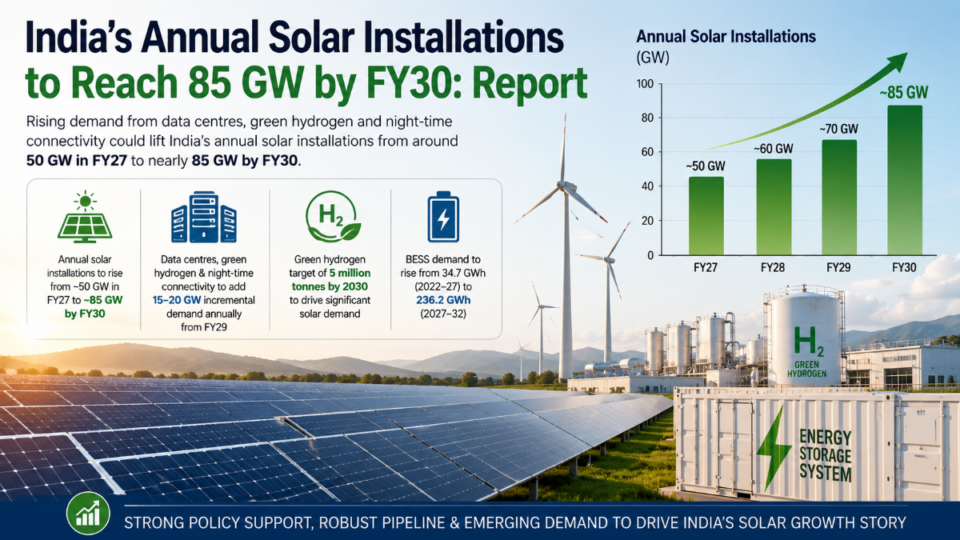
India’s annual solar installations could increase from around 50 GW in FY27 to nearly 85 GW by FY30, driven by growing demand from data centres, green hydrogen projects and battery energy storage systems (BESS), according to an Equirus Securities report. The country’s expanding renewable energy pipeline and infrastructure investments are expected to support sustained growth in the solar sector.
Key Highlights
- India’s annual solar installations could rise to 85 GW by FY30.
- Data centres, green hydrogen and BESS may add 15-20 GW of annual solar demand from FY29.
- India has a 215 GW utility solar pipeline built through FY26.
- Growing demand for firm renewable power is boosting Solar+BESS projects.
India’s renewable energy sector is poised for another phase of rapid expansion, with annual solar installations expected to increase from nearly 50 GW in FY27 to around 85 GW by FY30, according to a report released by Equirus Securities.
The report highlights that emerging demand from data centres, green hydrogen production and round-the-clock renewable power requirements could generate an additional 15-20 GW of solar demand every year from FY29 onwards, creating significant opportunities for developers, equipment manufacturers and infrastructure companies.
India already has a strong utility-scale solar project pipeline, supported by 145 GW of signed Power Purchase Agreements (PPAs) and another 68 GW of pending project awards, ensuring a healthy execution pipeline for the coming years.
According to the report, the country has built a 215 GW utility renewable energy pipeline through Letters of Award (LOAs) issued between FY18 and FY26. Out of this, 145 GW of PPAs have been signed, while 75 GW projects have already been commissioned, leaving a sizeable balance pipeline of 70 GW, including 58 GW of solar capacity and 12 GW of wind projects.
The report notes that 58 GW of unsigned solar PPAs remain under various stages, with nearly 43 GW belonging to plain solar and hybrid projects, where the probability of signing remains relatively low. However, 15 GW of Round-The-Clock (RTC), Firm and Dispatchable Renewable Energy (FDRE), and Solar+BESS projects are considered highly likely to move forward because of increasing demand for uninterrupted renewable electricity.
One of the biggest growth drivers is India’s rapidly expanding data centre ecosystem. More than 300 data centre projects have been approved, while global technology companies including AWS, Microsoft and Google have announced investments worth ₹2-3 lakh crore each in India’s digital infrastructure. As artificial intelligence and cloud computing expand, data centres will require reliable clean energy throughout the day, making Solar coupled with Battery Energy Storage Systems (BESS) one of the most economical solutions.
The report estimates that every 100 MW data centre would require nearly 250 MW of solar power, 150 MW of wind capacity and approximately 450 MWh of battery storage to operate entirely on renewable energy.
The National Green Hydrogen Mission is also expected to become a major catalyst for solar demand. India’s target of producing 5 million tonnes of green hydrogen annually by 2030 could require nearly 100 GW of dedicated solar capacity, as every one million tonnes of hydrogen production is estimated to need around 20 GW of solar power.
Battery storage is emerging as another high-growth segment. India’s Battery Energy Storage System (BESS) demand is projected to increase from 34.7 GWh during 2022-2027 to 236.2 GWh during 2027-2032, supported by renewable energy integration, grid stability requirements, government policy incentives and improving project economics.
The report concludes that the current shift towards firm renewable power solutions, supported by storage technologies, will favour integrated Independent Power Producers (IPPs) capable of delivering electricity during both solar and non-solar hours.
Conclusion
India’s renewable energy transition is entering a new growth phase where solar power, battery storage, data centres and green hydrogen are becoming deeply interconnected. With strong policy support, a massive project pipeline and rising clean energy demand, the country is well positioned to significantly expand its solar capacity while accelerating its journey towards energy security and net-zero goals.
Frequently Asked Questions (FAQs)
1. How much could India’s annual solar installations reach by FY30?
India’s annual solar installations could reach around 85 GW by FY30, according to Equirus Securities.
2. What sectors will drive future solar demand?
Data centres, green hydrogen production, Battery Energy Storage Systems (BESS), and round-the-clock renewable power are expected to be the key growth drivers.
3. What is India’s current utility solar pipeline?
India has built a 215 GW renewable energy pipeline, with 145 GW of signed PPAs and **70 GW of projects still under execution.
4. Why are Battery Energy Storage Systems important?
BESS enables renewable power to be supplied even during non-solar hours, improving grid stability and reliable clean energy supply.
5. How does green hydrogen increase solar demand?
Producing one million tonnes of green hydrogen requires nearly 20 GW of dedicated solar capacity, making solar power essential for achieving India’s hydrogen targets.
