

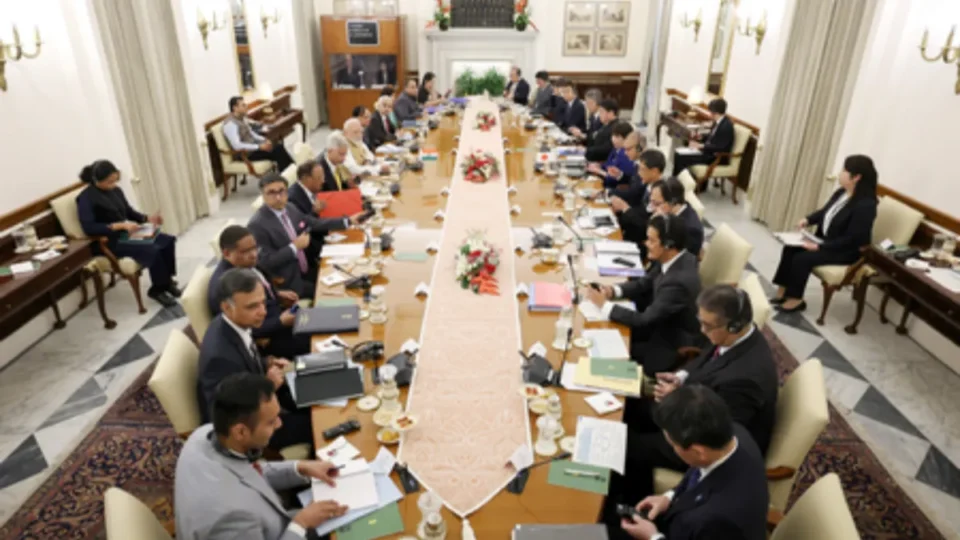
Prime Minister Narendra Modi and Japanese Prime Minister Sanae Takaichi concluded the 16th India-Japan Annual Summit by signing landmark agreements on economic security, artificial intelligence, energy resilience, and the first India-Japan defence co-development project. The two leaders also reviewed trade, investment, emerging technologies, Indo-Pacific cooperation, and unveiled plans to celebrate 75 years of diplomatic relations.
Key Highlights
- India and Japan adopted landmark agreements on Economic Security, Artificial Intelligence, and Energy Resilience.
- PM Modi announced the first India-Japan defence co-development project.
- Both countries exchanged key MoUs covering clean energy, critical technologies, and R&D cooperation.
- India and Japan will celebrate the 75th anniversary of diplomatic relations with a series of joint activities.
New Delh, July 02: Prime Minister Narendra Modi and Japanese Prime Minister Sanae Takaichi on Thursday held comprehensive bilateral talks during the 16th India-Japan Annual Summit in New Delhi, reaffirming their commitment to strengthening the India-Japan Special Strategic and Global Partnership across strategic, economic, technological, and regional domains.
According to the Ministry of External Affairs (MEA), the leaders reviewed the entire spectrum of bilateral relations, including trade, investment, economic security, energy cooperation, defence, emerging technologies, artificial intelligence (AI), innovation, and people-to-people exchanges. They also exchanged views on important regional and global developments.
Describing the summit as a major milestone, MEA spokesperson Randhir Jaiswal said the discussions resulted in “concrete progress on key priorities” of the bilateral relationship.
The two countries adopted three landmark documents:
- Joint Declaration on Economic Security
- Joint Statement on Cooperation in the Field of Artificial Intelligence
- Joint Statement on Energy Resilience
These agreements are expected to strengthen collaboration in critical sectors, enhance supply chain resilience, promote technology partnerships, and deepen strategic cooperation between the two countries.
In addition, India and Japan exchanged several Memoranda of Understanding (MoUs) and agreements covering economic security, clean energy, critical and emerging technologies, research and development, and innovation.
The two governments also agreed on a comprehensive programme of activities to commemorate the 75th anniversary of the establishment of diplomatic relations between India and Japan, further strengthening cultural, educational, and people-to-people ties.
The summit marked Prime Minister Sanae Takaichi’s first official visit to India since assuming office and follows Prime Minister Narendra Modi’s visit to Tokyo in August 2025 for the 15th India-Japan Annual Summit, reflecting the growing momentum in bilateral engagement.
Addressing a joint press conference after the talks, Prime Minister Narendra Modi announced that India and Japan have signed an agreement for their first defence co-development project, marking a new chapter in bilateral defence cooperation.
The Prime Minister highlighted the complementary strengths of the two countries, stating that Japan’s expertise in precision engineering combined with India’s software capabilities would accelerate global innovation in Artificial Intelligence.
Referring to his remarks at the recent G7 Summit, PM Modi emphasized that mutual trust has become the most valuable strategic asset in an increasingly uncertain global environment.
“The India-Japan partnership stands tall on this touchstone,” he said, underlining the deep strategic confidence shared by the two nations.
Prime Minister Modi further stressed that India and Japan share a common vision of a free, prosperous, inclusive, and rules-based Indo-Pacific, adding that both countries have launched several initiatives that will contribute to long-term peace, stability, connectivity, and economic prosperity across the region.
He noted that, as two of the world’s leading economies and major democracies, India and Japan are committed to expanding cooperation in areas including economic security, advanced manufacturing, semiconductors, AI, clean energy, resilient supply chains, maritime security, and defence technology.
The outcomes of the summit reaffirm the growing strategic convergence between the two countries at a time of significant geopolitical and economic transformation.
Conclusion
The 16th India-Japan Annual Summit has significantly advanced the India-Japan Special Strategic and Global Partnership through landmark agreements on economic security, artificial intelligence, energy resilience, and defence co-development. With expanded cooperation in critical technologies, clean energy, Indo-Pacific security, and innovation, the summit has laid the foundation for a stronger, future-oriented partnership that will benefit both nations and contribute to regional stability and global economic growth.
