

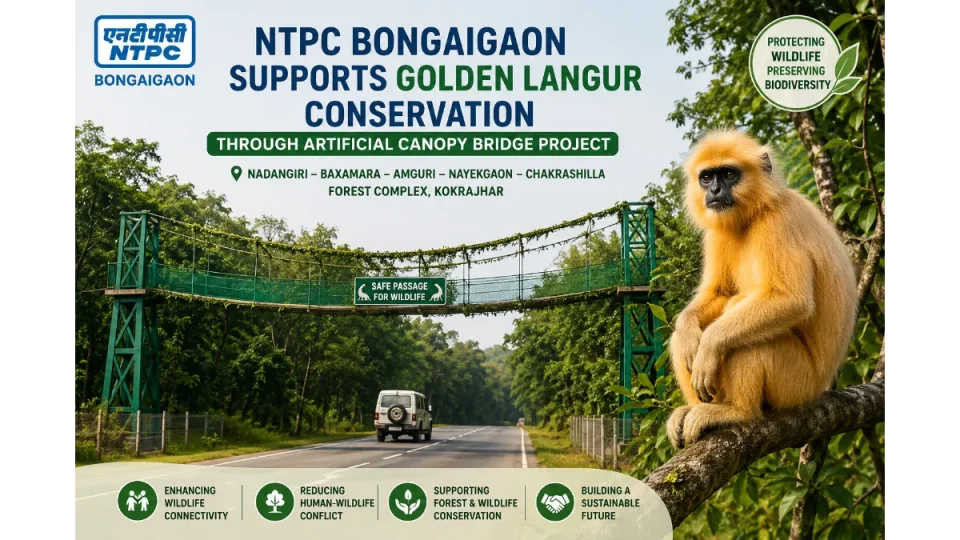
NTPC Bongaigaon has supported a ₹10 lakh conservation project to protect the endangered Golden Langur in Assam’s Kokrajhar district by installing six artificial canopy bridges, planting 2,000 native saplings and deploying scientific monitoring systems to improve habitat connectivity and reduce road-related wildlife fatalities.
Key Highlights
- NTPC Bongaigaon funded a ₹10 lakh Golden Langur conservation project under its Sustainable Development initiatives.
- Six artificial canopy bridges have been installed to reconnect fragmented forest habitats.
- The project includes 2,000 native tree plantations, camera traps and wildlife awareness signages.
- The initiative was implemented with the Haltugaon Forest Division and the Primate Research Centre, North-East India.
New Delhi, July 21: Strengthening its commitment to environmental sustainability and biodiversity conservation, NTPC Bongaigaon has supported an innovative conservation initiative to protect the endangered Golden Langur (Trachypithecus geei) by establishing artificial canopy bridges across the Nadangiri–Baxamara–Amguri–Nayekgaon–Chakrashilla Forest Complex in Kokrajhar district, Assam. The project was implemented during FY 2025–26 with financial assistance of ₹10 lakh under NTPC’s Sustainable Development initiatives.
The project, titled “Establishing Artificial Canopy Bridges as Road Overpass and Linking Populations of Endangered Golden Langur through Village Corridor”, was implemented in collaboration with the Haltugaon Forest Division and the Primate Research Centre, North-East India. The partnership combines scientific expertise, forest management and corporate support to improve habitat connectivity and ensure the long-term survival of one of the world’s rarest primate species.
The Golden Langur, found primarily in western Assam and neighbouring Bhutan, faces increasing threats from habitat fragmentation, shrinking forest corridors and expanding road networks. As disconnected tree canopies force these arboreal primates to descend onto roads, they become vulnerable to vehicle collisions and other human-induced risks.
To address this challenge, six artificial canopy bridges were installed at strategically selected locations, enabling Golden Langurs and other tree-dwelling wildlife to move safely between fragmented forest patches without coming to the ground. The intervention is expected to improve habitat connectivity, reduce road-related mortality and facilitate genetic exchange between isolated langur populations, strengthening the species’ long-term ecological resilience.
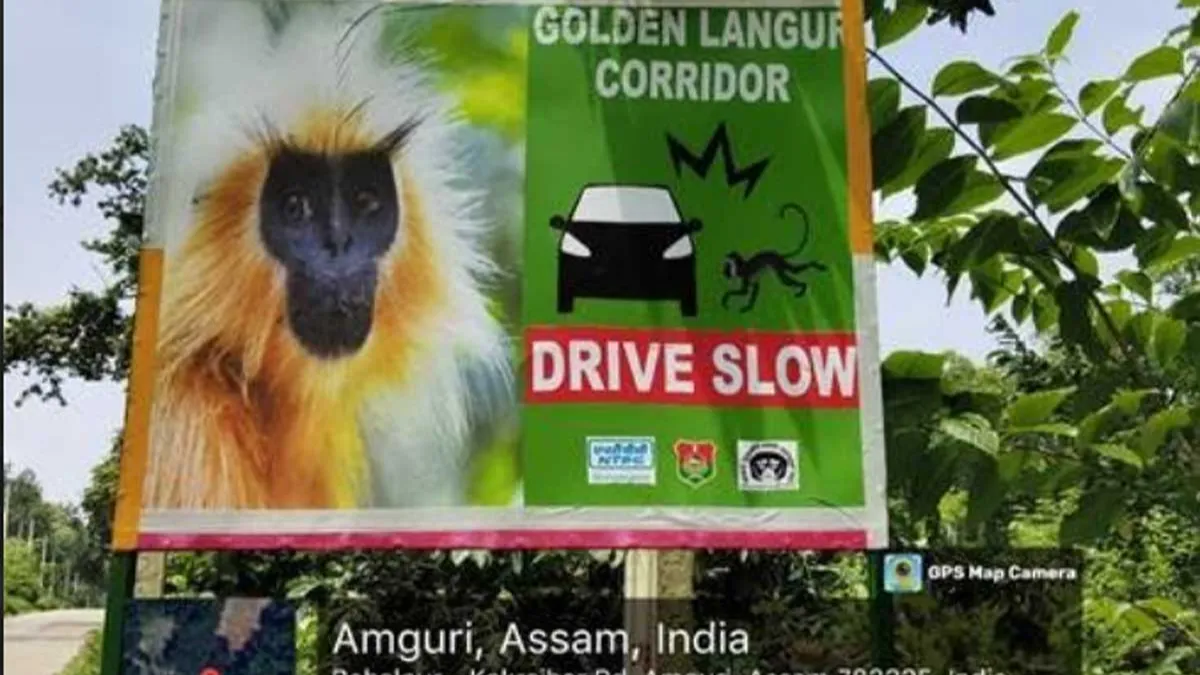
The project also incorporates scientific monitoring through the installation of three camera traps to document wildlife movement, study behavioural patterns and evaluate the effectiveness of the canopy bridges. In addition, four wildlife awareness and road safety signages have been placed along key stretches to encourage motorists to reduce speed while increasing awareness about the conservation needs of the endangered primate.
As part of the habitat restoration programme, 2,000 native tree saplings have been planted across the project area to enhance green cover and gradually restore natural canopy connectivity. By integrating wildlife-friendly infrastructure, habitat restoration, scientific research and community awareness, the initiative aims to deliver lasting conservation benefits while encouraging greater participation from local communities in protecting Assam’s unique biodiversity.
The Golden Langur Canopy Conservation Project demonstrates how collaboration between a public sector enterprise, the Forest Department and scientific institutions can create practical solutions for wildlife conservation. Through innovative infrastructure and ecological restoration, NTPC Bongaigaon is contributing to the long-term protection of one of India’s most endangered primate species while reinforcing its commitment to sustainable development.
