

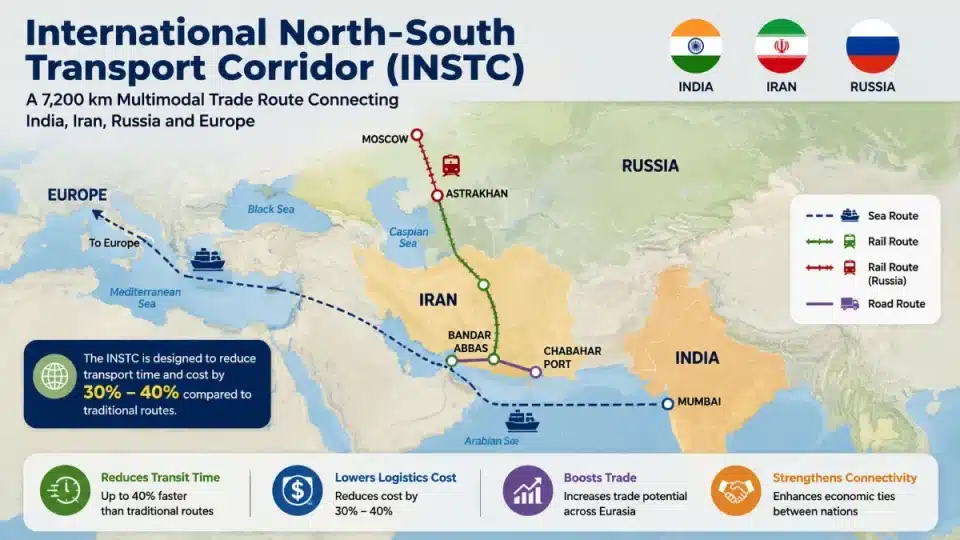
The International North-South Transport Corridor (INSTC) is a 7,200-km multimodal trade route connecting India, Iran and Russia through sea, rail and road networks, significantly enhancing trade efficiency and fostering regional economic development. Designed to reduce transportation costs and transit time by up to 40%, the corridor is emerging as a strategic alternative for strengthening Eurasian trade and regional connectivity. The INSTC not only facilitates trade but also encourages collaboration in areas such as technology and infrastructure development, making it a pivotal component of the global supply chain.
Key Highlights
Importance of the INSTC in Global Trade
The INSTC is poised to reshape the landscape of global trade by providing an efficient alternative to the lengthy traditional routes. As international tensions and supply chain disruptions increase, the corridor will serve as a reliable pathway for commodities and goods. With the backing of participating nations, the INSTC aims to promote not just the flow of trade but also cultural and diplomatic exchanges.
- INSTC is a 7,200-km multimodal corridor linking India, Iran, Russia and Europe.
- Transport time and logistics costs can be reduced by up to 40%.
- Chabahar Port and Iran’s rail network play a crucial role in the corridor.
- India, Russia and Iran continue strengthening trade and connectivity through the strategic route.
The International North-South Transport Corridor (INSTC) is one of the world’s most significant multimodal trade initiatives, connecting Iran, Russia and Europe through an integrated network of sea, rail and road transport. Stretching over 7,200 kilometres, the corridor aims to create a faster, cost-effective and more reliable trade route for cargo movement across Eurasia. This trade route not only facilitates economic transactions but also has the potential to enhance diplomatic relations between the nations involved, creating a more stable regional environment.
Moreover, with the rise of e-commerce and the demand for quick delivery times, the INSTC will be integral in meeting the logistical challenges posed by modern trade. The logistics networks established by this corridor will facilitate last-mile delivery solutions, ensuring that goods reach consumers in a timely manner, thus enhancing customer satisfaction and driving economic growth across the regions involved.
Originally conceived by Russia and Iran, the INSTC seeks to reduce dependence on traditional maritime routes by providing a shorter transportation corridor between the Indian Ocean, Persian Gulf, Caspian Sea and Northern Europe. According to government estimates, the route can reduce transit time by nearly 40 per cent while lowering logistics costs by 30–40 per cent, making international trade more competitive. As more countries recognize the potential of the route, additional partnerships are expected to emerge, further strengthening the corridor’s role in global trade.
This corridor will facilitate greater collaboration in technology transfer, enhancing capabilities in sectors like telecommunications, enhancing the efficiency of trade operations, and creating job opportunities across the region. These developments are likely to pave the way for a more interconnected economic landscape in Eurasia, offering considerable advantages to businesses and consumers alike.
The corridor has gained strategic importance as it expands its economic partnerships with Eurasian nations. Chabahar Port in Iran serves as a key gateway for exports, while Iran’s expanding railway infrastructure connects cargo to the Caspian Sea and Russian transport networks. The project also strengthens access to Central Asian markets, supporting long-term regional connectivity.
Beyond trade, the INSTC is expected to support cooperation in energy, infrastructure, manufacturing, logistics and defence production. Russia remains an important partner for India in sectors such as oil and gas, nuclear energy, defence equipment and industrial development. With the growing emphasis on sustainable energy practices, it is anticipated that renewable energy initiatives will gain momentum within the framework of the INSTC, fostering innovation and economic resilience across the participating nations.
The corridor complements a broader vision of resilient supply chains, diversified trade routes and enhanced global connectivity. As geopolitical dynamics reshape international commerce, the INSTC offers businesses an alternative to longer maritime routes and helps improve economic integration across Asia, the Middle East and Europe.
With continued infrastructure upgrades and policy coordination among participating countries, the Russia-Iran trade corridor is expected to play an increasingly important role in facilitating international trade. As freight volumes rise and logistics networks become more efficient, the INSTC is positioned to become one of the world’s leading multimodal transport corridors, significantly impacting global logistics trends and enhancing competitiveness in international markets.
The International North-South Transport Corridor represents a transformative connectivity project that strengthens trade between Iran, Russia and Europe, offering faster logistics, lower transportation costs and new economic opportunities for businesses across Eurasia. This initiative stands as a testament to the power of collaboration in overcoming geographical and political barriers in trade.
FAQs
1. What is the International North-South Transport Corridor (INSTC)?
The INSTC is a 7,200-km multimodal transport corridor connecting India, Iran, Russia and Europe through sea, rail and road networks.
2. How does INSTC benefit India?
The corridor improves trade connectivity, reduces logistics costs, expands access to Central Asia and strengthens India’s global supply chains.
3. Why is Chabahar Port important for INSTC?
Chabahar Port serves as India’s gateway to Iran and Central Asia, supporting cargo movement through the corridor.
4. How much time does INSTC save?
Government estimates suggest the corridor can reduce transit time by nearly 40% while lowering transportation costs by 30–40%.
