

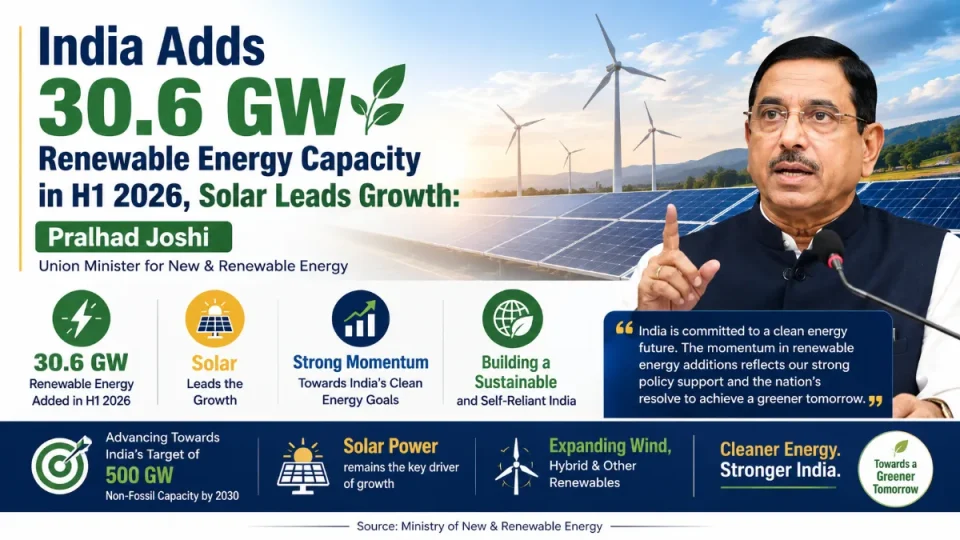
India added 30.6 GW of renewable energy capacity during the first half of 2026, registering 25% year-on-year growth, Union Minister Pralhad Joshi said. Solar power contributed 26.34 GW, while India’s total installed renewable energy capacity reached 288 GW, accounting for 52% of the country’s installed power capacity.
Key Highlights
- India added 30.6 GW of renewable energy capacity in H1 2026, up 25% year-on-year.
- Solar energy accounted for 26.34 GW of new installations, growing 43% over last year.
- Total installed renewable energy capacity reached 288 GW as of June 30, 2026.
- Renewable energy now accounts for 52% of India’s total installed power generation capacity.
New Delhi, July 18: India has added 30,581.31 MW (30.6 GW) of renewable energy capacity during the first half of 2026, recording a 25% year-on-year increase, according to Union Minister for New and Renewable Energy Pralhad Joshi. The strong growth underscores India’s accelerating transition towards clean energy under the leadership of Prime Minister Narendra Modi.
Sharing the latest figures on social media platform X, the minister said solar energy remained the primary driver of capacity expansion, with 26.34 GW of solar capacity added between January and June 2026. This represents a 43% year-on-year increase, reflecting continued momentum in India’s solar power sector supported by policy reforms and rising investments.
According to data from the Central Electricity Authority (CEA), India’s total installed renewable energy capacity, including large hydro projects, reached 288 GW as of June 30, 2026. Renewable sources now account for 52% of the country’s total installed electricity generation capacity, marking a significant milestone in India’s clean energy transition. Solar energy remains the largest contributor with an installed capacity of 162 GW, followed by wind energy at 57 GW.
The achievement builds on a record year in 2025, when India witnessed nearly 60% growth in annual renewable energy additions, making it the fastest-growing major renewable energy market globally, according to the International Energy Agency (IEA). The agency reported that India commissioned nearly 50 GW of solar photovoltaic (PV) capacity in 2025, almost doubling installations from the previous year, while wind power additions exceeded 6 GW.
Highlighting the progress, Pralhad Joshi said the latest milestones reaffirm India’s commitment to accelerating the clean energy transition, strengthening energy security, and advancing towards a self-reliant and sustainable future. The government continues to promote renewable energy through large-scale solar parks, wind projects, rooftop solar, battery storage and green hydrogen initiatives.
Despite the rapid expansion, the International Energy Agency noted that offshore wind development continues to face challenges due to project delays, cost pressures and supply chain constraints. The increasing share of renewable energy also presents new operational challenges for India’s power grid, requiring investments in energy storage, grid modernisation and transmission infrastructure to ensure reliable electricity supply.
India’s addition of 30.6 GW of renewable energy capacity in just six months highlights the country’s remarkable progress in clean energy deployment. With solar power driving the expansion and renewables now accounting for more than half of installed power capacity, India is strengthening its position as one of the world’s fastest-growing renewable energy markets.
