

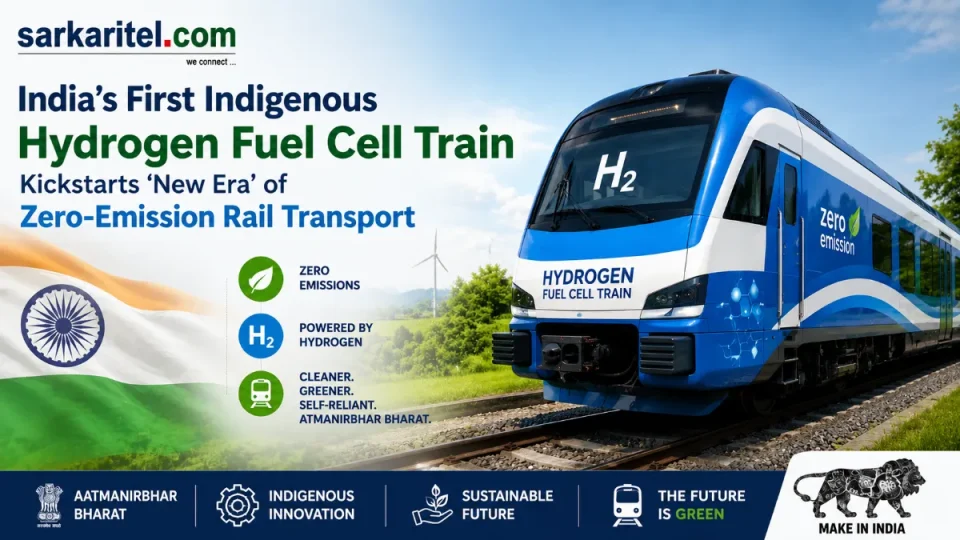
India has launched its first indigenous Hydrogen Fuel Cell Train, marking a major milestone in zero-emission rail transport and clean mobility. Developed with indigenous technology, the hydrogen-powered train will operate on the Jind–Sonipat section of Northern Railway, strengthening India’s hydrogen ecosystem and sustainable transportation goals.
Key Highlights
- India’s first indigenous Hydrogen Fuel Cell Train begins operations on the Jind–Sonipat route.
- Train uses Proton Exchange Membrane (PEM) Fuel Cell technology with zero emissions.
- Carries 2,600 passengers and produces only water vapour and heat.
- Dedicated hydrogen production and refuelling facility established at Jind, Haryana.
New Delhi, July 27: India has entered a new chapter in green transportation with the launch of its first indigenous Hydrogen Fuel Cell Train, reinforcing the country’s commitment to clean energy, zero-emission mobility, and the Atmanirbhar Bharat vision. Announced by the government on Sunday, the hydrogen-powered train has been designed, engineered and integrated in India using indigenous technology and will operate on the Jind–Sonipat section of Northern Railway. With a passenger capacity of 2,600, the project demonstrates India’s growing capability to develop advanced hydrogen-powered transportation systems while reducing dependence on fossil fuels.
The train is powered by a Proton Exchange Membrane Fuel Cell (PEMFC), which generates electricity through a chemical reaction between hydrogen and oxygen across a Perfluorosulfonic Acid (PFSA) polymer membrane. Unlike conventional diesel locomotives, the process emits only water vapour and heat, making it a 100% zero-emission mode of rail transport. The hydrogen-powered train has an operational speed of 75 kmph and a design speed of 110 kmph, making it suitable for regional passenger services while significantly lowering carbon emissions and improving environmental sustainability.
To support the new technology, Indian Railways has established a dedicated hydrogen refuelling ecosystem at Jind, Haryana. The facility includes hydrogen production, storage, compression and dispensing infrastructure, creating a complete ecosystem for hydrogen-based railway operations. The project reflects India’s broader strategy of developing a domestic hydrogen value chain, encouraging innovation and promoting the use of clean fuels across the transportation sector. It also complements the country’s long-term ambitions under the National Green Hydrogen Mission to accelerate the adoption of hydrogen as a sustainable energy source.
Safety has been given top priority in the development of the train. It is equipped with advanced hydrogen leak detection systems capable of identifying even the smallest leaks in real time, ensuring safe and reliable operations. Beyond being a technological achievement, the indigenous hydrogen fuel cell train lays the foundation for a hydrogen-powered railway ecosystem in India. The initiative is expected to drive innovation, reduce greenhouse gas emissions, strengthen domestic manufacturing capabilities and position India among the global leaders in sustainable rail transportation.
The launch of India’s first indigenous Hydrogen Fuel Cell Train is a landmark achievement for Indian Railways, accelerating the country’s transition to zero-emission transport, strengthening the domestic hydrogen ecosystem and advancing India’s clean energy and sustainable mobility goals.
