

By Pravin Kumar Singh
As the world witnesses Donald Trump’s return to the White House, a new wave of geopolitical turbulence has begun to sweep across the globe. With his signature brand of transactional diplomacy, unilateral tariffs, and suspicion of multilateralism, Trump’s second term is already reshaping the contours of global engagement. From climate catastrophes and crumbling governance frameworks to raging conflicts and recalibrated supply chains, the post-pandemic, post-unipolar world is emerging with intensity and unpredictability.
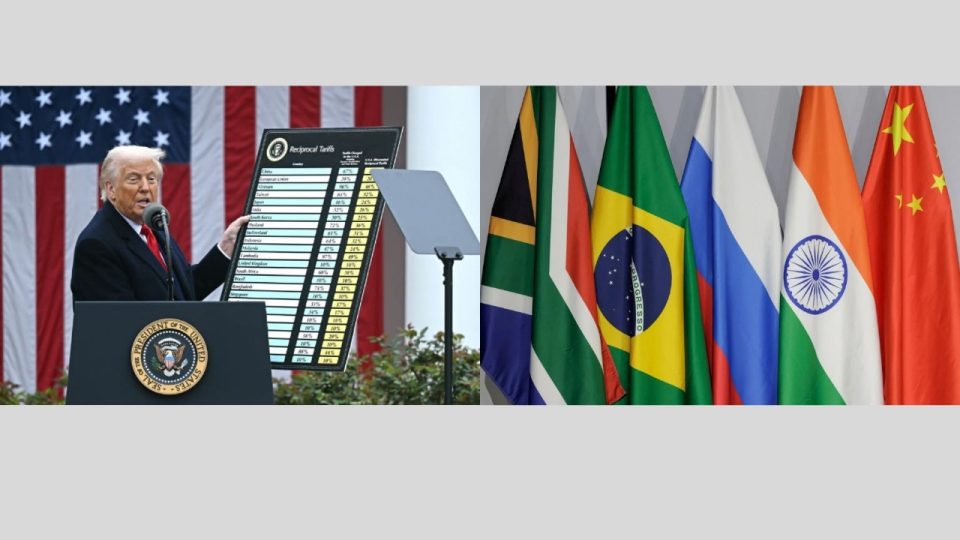
In the midst of this flux stands BRICS—a coalition of Brazil, Russia, India, China, and South Africa—casting itself as both a challenger to Western dominance and a test case for South-South solidarity. But for India, the moment is fraught with contradictions and complexities.
BRICS: A Coalition of Unequals
With over 40% of the global population and a quarter of global GDP, BRICS appears formidable on paper. China and India lead the pack in economic dynamism—China with its expansive industrial capacity and strategic Belt and Road Initiative, and India with a booming tech sector, growing consumer base, and youthful energy. Brazil and Russia are rich in resources but geopolitically vulnerable. South Africa, though strategically positioned, struggles with structural economic hurdles.
By 2030, BRICS is expected to contribute over half of global GDP growth, thanks largely to India and China. But internal disparities and competing national interests raise a crucial question: Can BRICS transform from a symbolic coalition into a cohesive, strategic bloc?
The Trump Variable: Protectionism Reloaded
Trump’s return brings with it the resurrection of trade protectionism. His administration’s introduction of sweeping “reciprocal tariffs”—including a 26% levy on Indian goods—marks a sharp departure from cooperative trade practices. Framed as a measure to enforce parity, these tariffs disproportionately impact Indian industries ranging from textiles to pharmaceuticals, and place immense strain on the already fragile Indo-U.S. trade equation.
India, which has for years walked a tightrope between Western partnerships and BRICS commitments, must now recalibrate its posture. The message from Washington is clear: multilateralism is optional, and trade will be dictated by strength and symmetry. As the world’s largest democracy, India must brace itself for transactionalism dressed as diplomacy.
At the same time, Trump’s disdain for global climate frameworks and skepticism of development financing institutions could undermine multilateral efforts on climate and development—areas where India seeks greater leadership and support.
Currency Ambitions, Climate Realities
The idea of a BRICS currency to rival the dollar has gained traction, particularly in response to U.S.-led sanctions and financial weaponization. Russia and China have spearheaded this push, while India remains measured, prioritizing economic diversification over financial confrontation. Yet, as the dollar becomes more politicized, India may be nudged toward engaging more seriously in shaping alternative financial instruments.
Meanwhile, climate change remains an existential concern. As Trump’s policies pull the U.S. away from global climate responsibilities, the onus may fall on emerging powers like India to chart a sustainable path. The failure of traditional Western-led climate finance mechanisms creates an opening for BRICS to design more equitable, inclusive models of climate cooperation—if the political will exists.
The Double-Edged Sword of Resources and Innovation
India’s technology sector continues to flourish, but it remains far behind China in deep-tech infrastructure, quantum research, and intellectual property. Russia’s strengths in defense and cybersecurity are isolated by sanctions, and collaboration within BRICS remains limited due to mistrust and strategic divergence.
Resource-wise, India is a net importer, making energy security a persistent concern. In contrast, Russia, Brazil, and South Africa have significant reserves of oil, minerals, and agricultural commodities. As the world scrambles for rare earths and green energy inputs, India must expand its strategic reserves and deepen partnerships—while remaining cautious of entanglements in Chinese-led value chains.
Strategic Dilemmas: Between the Dragon and the Eagle
India’s primary geopolitical conundrum lies in balancing its ties with Beijing and Washington. BRICS has emerged as a platform for plurilateral engagement, but it also mirrors China’s ambitions to forge a non-Western global order. India, however, prefers BRICS to focus on development, innovation, and financial resilience—not geopolitical rivalry.
The New Development Bank has approved over $30 billion in loans for BRICS nations, but India continues to advocate for transparency, multilateral alignment, and safeguards against dominance by any single member. India’s active participation in platforms like the QUAD, I2U2, and Indo-Pacific Economic Framework (IPEF) underlines its commitment to a flexible, multi-vector foreign policy—one that does not force a binary choice between East and West.
The Way Forward: India’s Strategic Calculus
President Trump’s return to power amid a turbulent global reordering places India at a critical inflection point. In a world drifting toward competitive multipolarity, India must not only shield its interests but proactively shape the emerging architecture. Rather than aligning too closely with any one power bloc, India should adopt a confident, interest-driven strategy anchored in flexibility, autonomy, and innovation. The following six imperatives constitute a coherent roadmap:
- Deepen Mini-Lateralism
India should double down on flexible, issue-based partnerships such as the QUAD (with the U.S., Japan, and Australia), IBSA (with Brazil and South Africa), and I2U2 (India, Israel, UAE, U.S.). These coalitions offer agility, allowing countries to collaborate on shared concerns—maritime security, technology, critical infrastructure—without the baggage of large multilateral bureaucracies.
Mini-lateralism allows India to:
- Balance between major power centers without being caught in binary choices.
- Advance interests on climate, digital governance, and supply chains at speed.
- Showcase leadership in emerging areas like vaccine diplomacy and clean tech.
- Diversify Export Markets
With U.S. tariffs on Indian goods in place, India must cultivate deeper economic ties with ASEAN, Africa, Latin America, and fellow BRICS members. Strengthening trade pacts, expanding market access, and enhancing logistic corridors will reduce exposure to unpredictable Western trade policies and create economic resilience.
- Invest in Strategic Capabilities
India must scale its capabilities in:
- Semiconductors: Fast-tracking domestic chip manufacturing.
- Artificial Intelligence and public digital goods: Expanding the India Stack globally.
- Defense production: Emphasizing indigenous R&D and export-led manufacturing.
- Renewable energy: Investing in storage, green hydrogen, and strategic minerals.
- Engage in Targeted Diplomacy
India must adopt a twin-track approach:
- With the U.S.: Engage constructively to negotiate tariff relaxations and deepen collaboration in innovation and defense.
- Within BRICS: Shape internal consensus and propose cooperative responses to Western protectionism through trade observatories, dispute resolution frameworks, and pooled infrastructure funding.
- Champion Climate Leadership from the Global South
With the West backsliding on climate finance, India must spearhead a BRICS Climate Resilience Fund, promote climate tech co-development, and lead on just transitions for Global South economies. This would elevate India’s credibility and moral leadership.
- Reframe the BRICS Narrative
India should promote a post-West, not anti-West, BRICS—one that is defined by inclusivity, innovation, and equity. Expansion of BRICS must be strategic, and governance reforms should aim at fairer representation without replicating global power politics.
Conclusion: Strategic Maturity in an Age of Flux
As BRICS considers expansion—with countries like Argentina, Indonesia, and Saudi Arabia waiting in the wings—the bloc stands at a critical juncture. Will it evolve into a genuine alternative model of multilateral cooperation, or fragment under competing ambitions?
For India, this is not a moment to choose between allegiances. It is a moment to lead by example—anchored in strategic autonomy, guided by principled pragmatism, and driven by the vision of a multipolar, inclusive global order.
In a world defined by disruption, India’s ability to shape the new normal—not just survive it—will define both its global stature and its national destiny.
The article has been authored by Pravin Kumar Singh, Senior Project Associate at the World Intellectual Foundation.
