

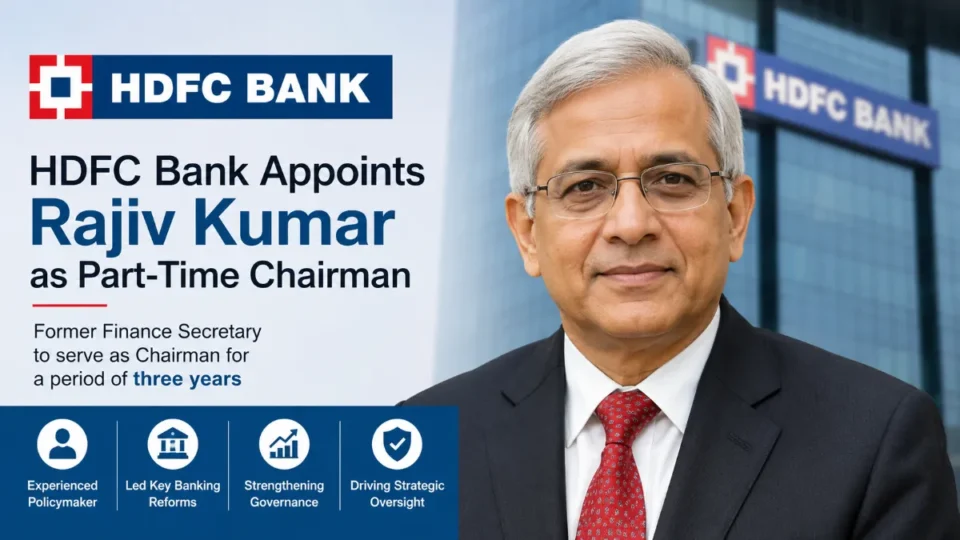
HDFC Bank has appointed former Finance Secretary Rajiv Kumar as its new part-time Chairman for a three-year term. A former IAS officer with over three decades of administrative experience, Kumar played a key role in India’s banking reforms, including the consolidation of public sector banks, governance reforms, and strengthening financial stability. His appointment is expected to enhance the bank’s corporate governance and strategic oversight.
Key Highlights
- HDFC Bank appoints Rajiv Kumar as part-time Chairman for a three-year term.
- Rajiv Kumar is a former Finance Secretary and a 1984-batch IAS officer.
- He played a leading role in India’s banking reforms and PSU bank consolidation.
- The appointment is aimed at strengthening HDFC Bank’s governance and board oversight.
HDFC Bank has appointed former Finance Secretary Rajiv Kumar as its part-time Chairman for a period of three years, bringing one of India’s most experienced financial administrators to the board of the country’s largest private sector lender.
The appointment comes at an important time as HDFC Bank continues to strengthen its corporate governance framework, board oversight, and long-term strategic direction following leadership changes earlier this year.
Rajiv Kumar succeeds Atanu Chakraborty, who stepped down as Chairman in 2026 after citing concerns that certain practices were not aligned with his personal values and ethics. His resignation generated considerable discussion across India’s banking industry.
Following Chakraborty’s exit, Keki Mistry was appointed as the interim part-time Chairman to ensure continuity in the bank’s leadership. Industry experts had viewed the arrangement as temporary because of Mistry’s long association with the HDFC Group.
A 1984-batch Indian Administrative Service (IAS) officer, Rajiv Kumar retired as Finance Secretary to the Government of India in February 2020 after serving the country for more than 35 years. He later served as the Chairman of the Public Enterprises Selection Board (PESB).
During his tenure at the Finance Ministry, Kumar played a significant role in shaping India’s banking sector. He was instrumental in the 2019 consolidation of 10 public sector banks into four larger banks, one of the most significant banking reforms undertaken by the Government of India to improve operational efficiency, strengthen balance sheets, and enhance competitiveness.
Kumar also led several initiatives related to bank recapitalisation, financial sector governance, risk management, regulatory oversight, and financial stability. He promoted technology-driven risk assessment systems, strengthened the monitoring of large credit exposures, and supported reforms designed to improve transparency across the banking system.
Among his major contributions was the decision to increase deposit insurance coverage from ₹1 lakh to ₹5 lakh, a landmark reform that significantly enhanced depositor confidence and strengthened India’s financial safety framework.
With Rajiv Kumar assuming the role of Chairman, HDFC Bank is expected to benefit from his extensive experience in public policy, banking regulation, financial reforms, and corporate governance, helping the bank navigate future growth opportunities while maintaining high standards of governance.
Conclusion
The appointment of Rajiv Kumar as HDFC Bank’s part-time Chairman reflects the bank’s commitment to strong corporate governance, experienced leadership, and prudent financial oversight. His decades of experience in public administration and banking reforms are expected to provide valuable strategic guidance as HDFC Bank continues to expand its leadership position in India’s banking sector.
