

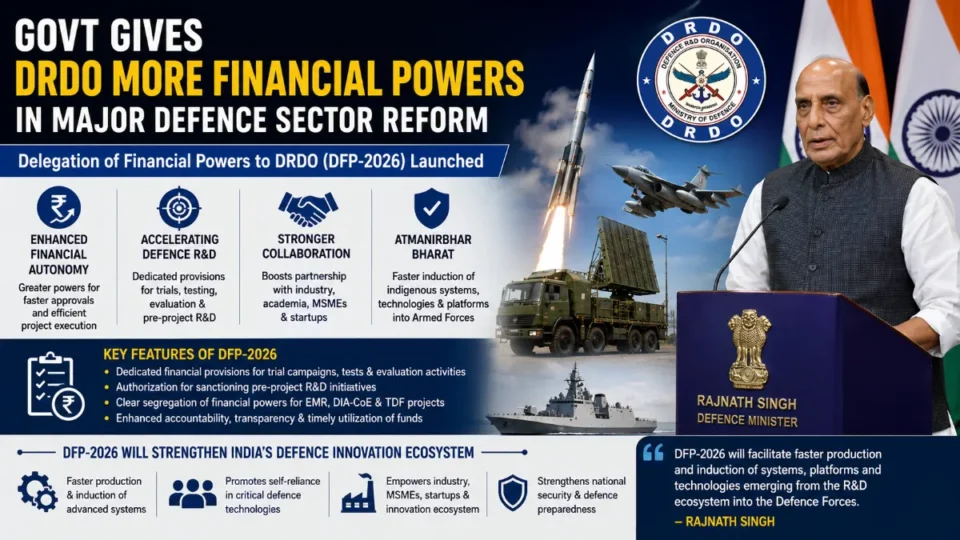
The Government has approved the Delegation of Financial Powers to DRDO (DFP-2026), giving the Defence Research and Development Organisation greater financial autonomy to accelerate defence research, testing, indigenous technology development and faster induction of advanced military systems. The reform is expected to strengthen the Aatmanirbhar Bharat initiative and improve collaboration with industry and academia.
Key Highlights
- Defence Minister Rajnath Singh launches Delegation of Financial Powers (DFP-2026) for DRDO.
- New framework grants greater financial autonomy for defence R&D projects.
- DFP-2026 aims to speed up indigenous defence technology development and induction.
- Reform supports Aatmanirbhar Bharat through stronger industry and academia collaboration.
In a significant reform aimed at strengthening India’s defence research ecosystem, Defence Minister Rajnath Singh on Monday unveiled the Delegation of Financial Powers to DRDO (DFP-2026), granting the Defence Research and Development Organisation (DRDO) enhanced financial authority for executing strategic research and development programmes.
The DFP-2026 framework is designed to improve efficiency, accountability and faster decision-making by empowering various levels within the Department of Defence Research and Development to approve and execute critical defence projects with reduced procedural delays.
According to the Ministry of Defence, the revised financial framework introduces dedicated financial provisions for trial campaigns, testing and evaluation activities, while also enabling pre-project research and development initiatives to receive financial approval more efficiently.
The framework also clearly defines financial powers related to Extra-Mural Research Projects (EMR), Defence Innovation Accelerator-Centres of Excellence (DIA-CoEs) and Technology Development Fund (TDF) projects, ensuring greater transparency and streamlined fund utilisation.
Speaking on the occasion, Defence Minister Rajnath Singh said the reforms would accelerate the production and induction of advanced defence systems, platforms and technologies developed through India’s defence R&D ecosystem.
He emphasised that the enhanced financial delegation would encourage closer collaboration between DRDO, private industry, public sector enterprises, startups, MSMEs and academic institutions, thereby strengthening the Aatmanirbhar Bharat mission in the defence sector.
The minister noted that the new framework would contribute significantly to self-reliance in critical defence technologies, reduce dependence on imports and improve the operational preparedness of the Indian Armed Forces.
The launch event was attended by Chief of Defence Staff General Anil Chauhan (Note: if using the official IANS copy exactly, verify the name before publication as the provided agency copy appears inconsistent with the current CDS designation.), senior officials from the Ministry of Defence, DRDO, Defence Production, Ex-Servicemen Welfare and the Controller General of Defence Accounts, among others.
DRDO has been playing a crucial role in promoting the Make in India initiative by regularly transferring indigenous technologies to public and private sector industries through Technology Transfer Licensing Agreements. The organisation also supports MSMEs and startups through the Technology Development Fund, enabling domestic manufacturing of advanced aerospace and defence equipment.
The latest financial reforms are expected to further strengthen India’s defence innovation ecosystem by improving the speed of project approvals and expanding opportunities for indigenous technology development.
Conclusion
The introduction of DFP-2026 marks an important step towards modernising India’s defence R&D framework. By granting DRDO greater financial autonomy, the government aims to accelerate innovation, strengthen domestic defence manufacturing and enhance the country’s strategic self-reliance under the Aatmanirbhar Bharat vision.
Frequently Asked Questions (FAQs)
1. What is DFP-2026?
DFP-2026 is the Delegation of Financial Powers framework that provides greater financial autonomy to DRDO for defence research and development projects.
2. Why has the government introduced DFP-2026?
The framework aims to speed up defence R&D, project approvals, testing, technology development and induction of advanced defence systems.
3. How will DFP-2026 benefit India’s defence sector?
It will improve decision-making, strengthen indigenous defence manufacturing and encourage collaboration with industry, academia, MSMEs and startups.
4. How does DFP-2026 support Aatmanirbhar Bharat?
The reforms promote self-reliance in defence technologies by accelerating indigenous innovation and reducing dependence on imports.
5. What role does DRDO play in Make in India?
DRDO transfers indigenous technologies to public and private industries and supports MSMEs and startups through the Technology Development Fund.
