

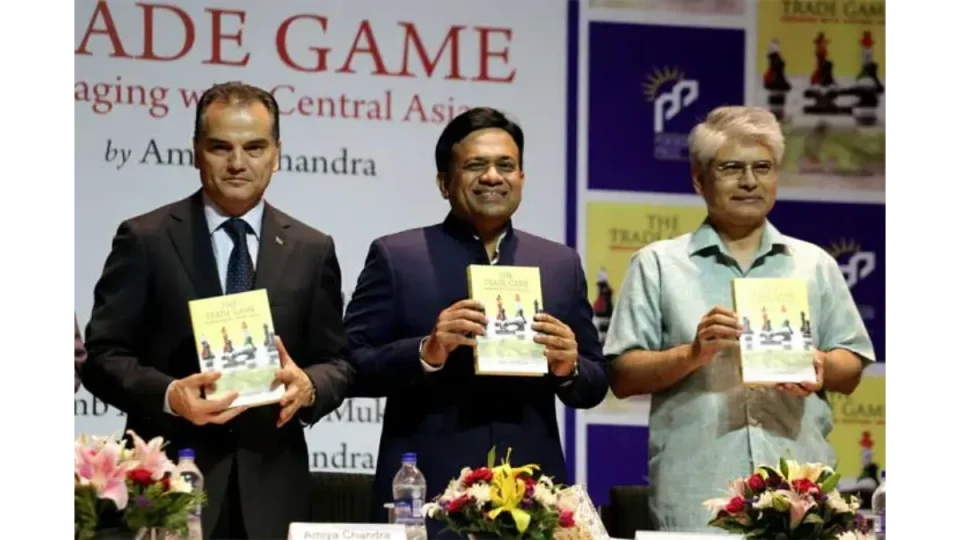
A new book, The Trade Game: Engaging with Central Asia, highlights India’s untapped trade and strategic opportunities in Central Asia. At the launch in New Delhi, experts stressed stronger connectivity, manufacturing, tourism and policy reforms to deepen India’s engagement with the hydrocarbon-rich and geopolitically significant region.
Key Highlights
- The Trade Game: Engaging with Central Asia was launched in New Delhi.
- Experts highlighted India’s strategic and economic opportunities in Central Asia.
- The book calls for greater focus on connectivity, tourism, IT and pharmaceuticals.
- Speakers urged stronger government and private sector collaboration to boost trade.
The book “The Trade Game: Engaging with Central Asia”, authored by senior bureaucrat Dr. Amiya Chandra (ITS), was launched in New Delhi, bringing renewed attention to India’s strategic and economic engagement with Central Asia. The event featured prominent diplomats, policymakers and academicians discussing the region’s growing geopolitical and trade significance.
While unveiling the book, Shakti Sinha, Director of the Nehru Memorial Museum and Library, described Central Asia as “too near yet too far” for India. He highlighted the region’s vast hydrocarbon reserves, mineral wealth and strategic location as a gateway to Eurasia, while recalling Prime Minister Narendra Modi’s landmark visit to all five Central Asian nations.
During his presentation, Dr. Amiya Chandra explained how the historical “Great Game” among global powers has evolved into a modern competition driven by trade, infrastructure and economic influence. He observed that China and Turkey have emerged as key players, with China strengthening its presence through large-scale infrastructure investments and connectivity initiatives.
The author noted that despite India’s centuries-old cultural, historical and spiritual ties with Central Asia, the country’s economic engagement remains limited. He pointed to India’s participation in initiatives such as the Shanghai Cooperation Organisation (SCO), TAPI pipeline, International North-South Transport Corridor (INSTC) and Chabahar Port, while stressing that greater policy focus is still required.
Dr. Chandra advocated a stronger emphasis on connectivity, tourism, pharmaceuticals, information technology, hospitality and manufacturing to enhance India’s regional presence. He also highlighted the significant gap between India’s trade with Central Asia, valued at around $1.5 billion, and China’s nearly $50 billion trade, urging faster decision-making, increased investment and stronger public-private partnerships.
Former Ambassador Ashoke Mukherjee highlighted the spiritual and cultural foundations of India’s relationship with Central Asia, while Prof. Sharad Soni expressed confidence that the book would become a valuable resource for students, researchers and policymakers working on the region.
Conclusion
The book reinforces the need for India to strengthen trade, connectivity and strategic partnerships with Central Asia, positioning the region as a key pillar of India’s long-term economic and geopolitical outreach.
