

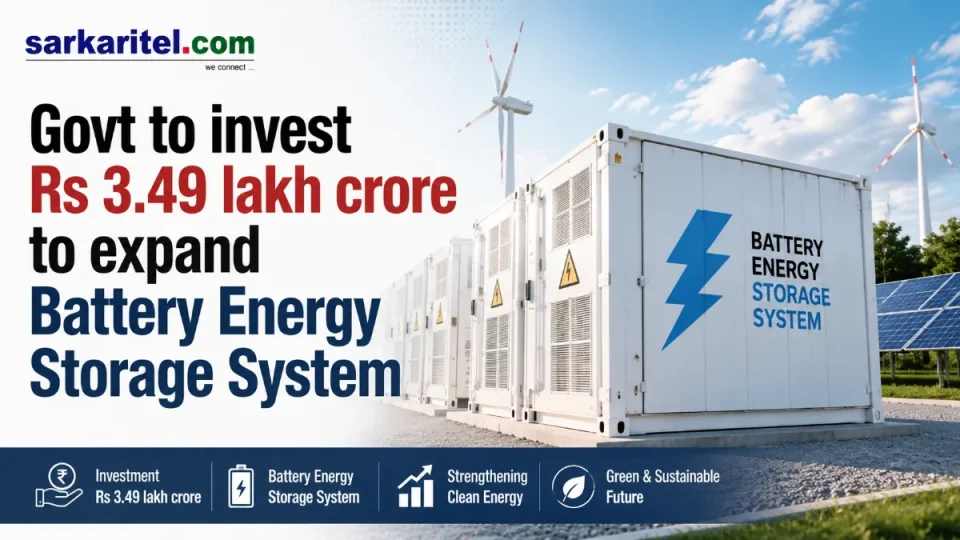
The Government of India plans to invest ₹3.49 lakh crore by 2031-32 to expand Battery Energy Storage Systems (BESS) and support the country’s clean energy transition. The initiative aims to create 47.24 GW/236 GWh of BESS capacity by 2031-32, alongside major investments in Pumped Storage Plants (PSPs) to strengthen grid reliability and renewable energy integration.
Key Highlights
- Government to invest ₹3.49 lakh crore in Battery Energy Storage Systems (BESS) by 2031-32.
- BESS capacity targeted to reach 47.24 GW/236 GWh by 2031-32.
- Additional ₹1.29 lakh crore planned for Pumped Storage Plants (PSPs).
- Policy support includes ISTS charge waivers, PLI incentives, and CERC regulatory reforms.
New Delhi, July 28: The Ministry of Power informed Parliament on Monday that the Government of India will invest ₹3.49 lakh crore by 2031-32 to significantly expand the country’s Battery Energy Storage System (BESS) capacity. Responding to a question in the Rajya Sabha, Minister of State for Power Shripad Naik said the government aims to achieve a projected BESS installed capacity of 8.68 GW/34 GWh by 2026-27, which will increase to 47.24 GW/236 GWh by 2031-32. The investment is part of India’s broader strategy to strengthen grid stability, accelerate renewable energy deployment and support the transition towards a low-carbon energy system.
In addition to BESS, the government plans to invest ₹1.29 lakh crore in developing Pumped Storage Plants (PSPs). The projected installed PSP capacity is expected to reach 7.45 GW/47 GWh by 2026-27 and expand to 26.69 GW/175 GWh by 2031-32. According to NITI Aayog, large-scale energy storage systems will play a critical role in managing the intermittent nature of solar and wind power, ensuring reliable electricity supply while supporting India’s ambitious renewable energy targets. The expansion of storage infrastructure is expected to improve grid flexibility, reduce renewable energy curtailment and enhance overall energy security.
The government has introduced several policy and regulatory measures to accelerate energy storage deployment. These include a 100% waiver of Inter-State Transmission System (ISTS) charges for eligible BESS projects commissioned by specified deadlines, with a gradual reduction in benefits thereafter. Similar transmission charge waivers have also been extended to co-located BESS projects and Hydro Pumped Storage Projects (PSPs) awarded within the prescribed timelines. Additionally, the Central Electricity Regulatory Commission (CERC) has allowed storage-based resources to provide ancillary grid services, including secondary and tertiary reserves, enabling battery storage projects to contribute to real-time grid balancing alongside conventional power plants.
To strengthen domestic manufacturing, the Ministry of Heavy Industries is implementing a Production Linked Incentive (PLI) Scheme worth ₹18,100 crore for establishing 50 GWh of Advanced Chemistry Cell (ACC) manufacturing capacity, with 10 GWh reserved for grid-scale stationary energy storage. The government is also providing financial assistance for hydro PSP infrastructure, offering ₹1 crore per MW for projects up to 200 MW, while larger projects receive ₹200 crore plus ₹0.75 crore per MW. These initiatives are expected to attract significant private investment, promote indigenous manufacturing, create employment opportunities and accelerate India’s journey towards a resilient, sustainable and clean energy future.
The government’s planned investment of ₹3.49 lakh crore in Battery Energy Storage Systems and ₹1.29 lakh crore in Pumped Storage Plants marks a major step towards building a reliable, renewable energy-based power system while strengthening India’s energy security and supporting its long-term clean energy goals.
