

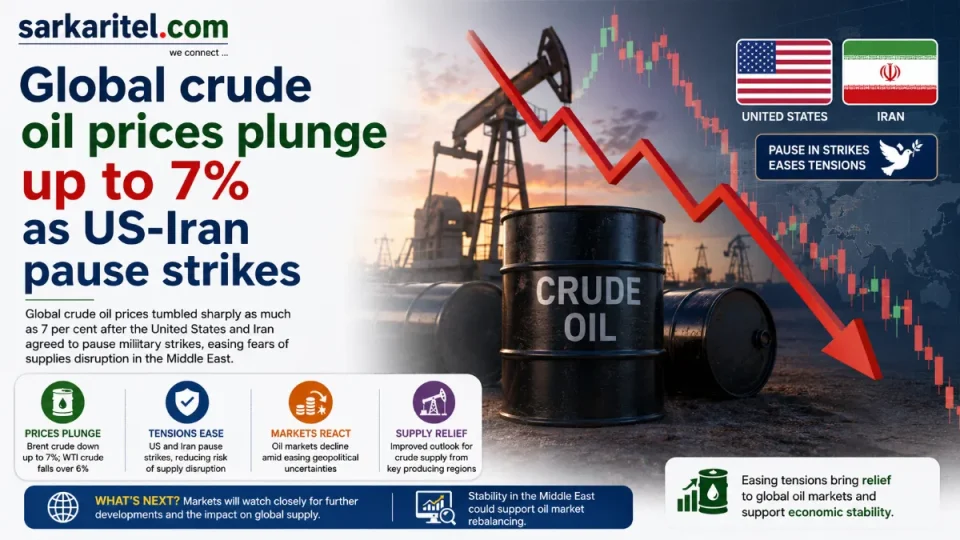
Global crude oil prices fell by up to 7% on Monday after the United States and Iran paused military strikes, easing concerns over supply disruptions. The sharp decline in Brent crude and WTI crude boosted market sentiment, while the Indian rupee posted its biggest gain in nearly two months.
Key Highlights
- Brent and WTI crude prices dropped by up to 7% after the US-Iran pause.
- Diplomatic hopes eased fears of disruptions in the Strait of Hormuz.
- Oil prices remain nearly 40% higher this month despite the correction.
- Indian rupee gained 41 paise, opening at 96.15 against the US dollar.
New Delhi July 27: Global crude oil prices witnessed a sharp correction on Monday as Brent crude and West Texas Intermediate (WTI) tumbled by up to 7% following signs of de-escalation in tensions between the United States and Iran. International benchmark Brent crude fell by more than $7 to trade around $91 per barrel, while WTI crude dropped over $6.4, slipping below $85 per barrel. The decline came after Iran indicated it would refrain from further military action provided the US also halted strikes, raising expectations of a possible diplomatic resolution and easing immediate concerns over global oil supply disruptions.
The latest decline follows a strong rally in crude prices over the past three weeks, during which Brent crude briefly crossed $100 per barrel amid fears that escalating geopolitical tensions could disrupt shipments through the Strait of Hormuz and the Bab el-Mandeb Strait—two of the world’s most strategic energy shipping routes. These waterways handle a significant share of global crude oil exports, making any disruption a major concern for international energy markets. The easing of military activity reduced immediate supply risk, prompting traders to book profits after the recent surge.
Despite Monday’s steep fall, market analysts cautioned that geopolitical risks remain elevated. They pointed to reported attacks by Iran-backed Houthi forces on Saudi Aramco facilities near the Red Sea ports of Jizan and Yanbu, highlighting that threats to regional energy infrastructure persist. Experts noted that crude oil prices are still nearly 40% higher this month, reflecting ongoing uncertainty over global supply chains. Shipping activity through the Strait of Hormuz has also not fully returned to normal, indicating that energy markets remain vulnerable to fresh geopolitical developments.
The easing in crude oil prices also supported emerging market currencies. The Indian rupee appreciated by 41 paise, its strongest single-day opening gain in nearly two months, to 96.15 against the US dollar, compared with the previous close of 96.56. Lower crude prices are generally positive for India, one of the world’s largest oil importers, as they help reduce the country’s import bill, ease inflationary pressures and improve the current account balance. Investors will continue to monitor geopolitical developments in West Asia, as any renewed escalation could once again influence global oil prices and financial markets.
The sharp fall in global crude oil prices reflects easing geopolitical tensions between the US and Iran, but continued uncertainty around key shipping routes means energy markets are likely to remain volatile in the coming weeks.
