

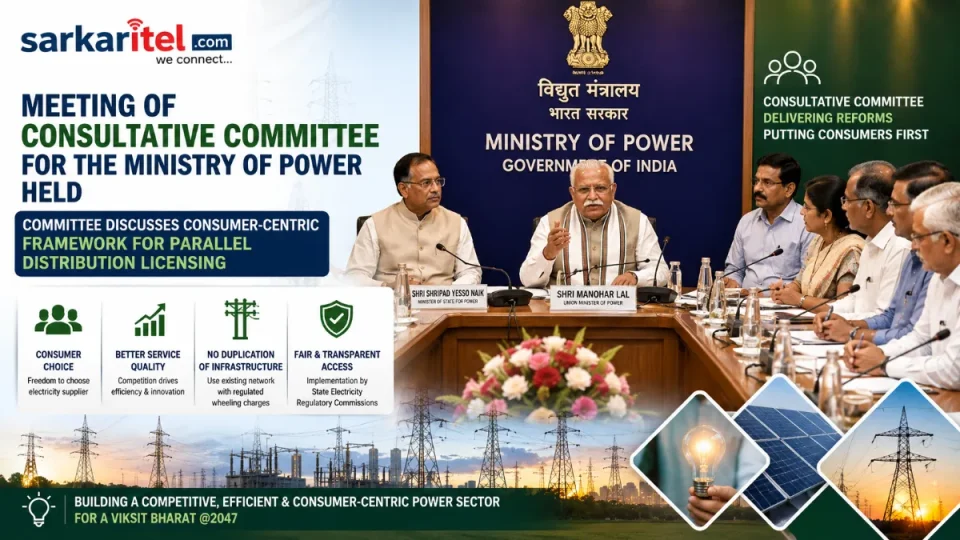
The Ministry of Power has discussed a consumer-centric framework for parallel distribution licensing that would allow multiple electricity suppliers to use the same distribution network. The proposed reform aims to improve service quality, encourage competition, reduce infrastructure duplication, and give consumers the freedom to choose their electricity provider.
Key Highlights
- Power Ministry reviews framework for parallel distribution licensing.
- Consumers may choose their electricity supplier without duplicate networks.
- Existing DISCOM infrastructure to be shared through regulated wheeling charges.
- Reform aims to improve competition, efficiency and service quality.
The Consultative Committee of the Ministry of Power, chaired by Union Power Minister Manohar Lal, discussed a consumer-centric framework for parallel distribution licensing designed to increase competition while improving the quality and reliability of electricity supply across India. The meeting was attended by Minister of State Shripad Yesso Naik, Members of Parliament and senior ministry officials.
The proposed framework seeks to allow multiple electricity distribution licensees to operate in the same area without creating separate physical infrastructure. Instead of building duplicate poles, substations and transmission lines, new distribution companies will be able to use the existing distribution network by paying regulated wheeling charges.
According to the Ministry, the proposal will help eliminate unnecessary infrastructure investment, improve the utilisation of existing electricity networks and encourage greater private participation in the power distribution sector. State Electricity Regulatory Commissions (SERCs) will develop detailed implementation rules to ensure fair, transparent and non-discriminatory access.
The government also assured that the reform will protect the interests of existing distribution companies and their employees. All electricity suppliers will continue to remain bound by the universal service obligation, preventing companies from serving only profitable consumers while neglecting other areas.
The Ministry highlighted that a similar model has already been operating successfully in Mumbai, where consumers have long enjoyed the flexibility to choose their electricity supplier while the network continues to be managed under regulatory supervision. The proposed reform is expected to improve consumer choice, operational efficiency, innovation and service quality, supporting the vision of Viksit Bharat @2047.
The proposed parallel distribution licensing framework represents a significant reform that could transform India’s power distribution sector by promoting competition, improving consumer services and ensuring efficient use of electricity infrastructure.
FAQs
1. What is parallel distribution licensing?
It allows multiple electricity suppliers to serve consumers using the same distribution network instead of building separate infrastructure.
2. Will consumers be able to choose their electricity supplier?
Yes. The proposed framework aims to give consumers the freedom to select their preferred electricity provider.
3. Who will regulate the new framework?
The implementation framework will be developed by the State Electricity Regulatory Commissions (SERCs).
4. Will existing DISCOMs lose their infrastructure?
No. Existing distribution companies will continue to own, operate and maintain the distribution network.
