

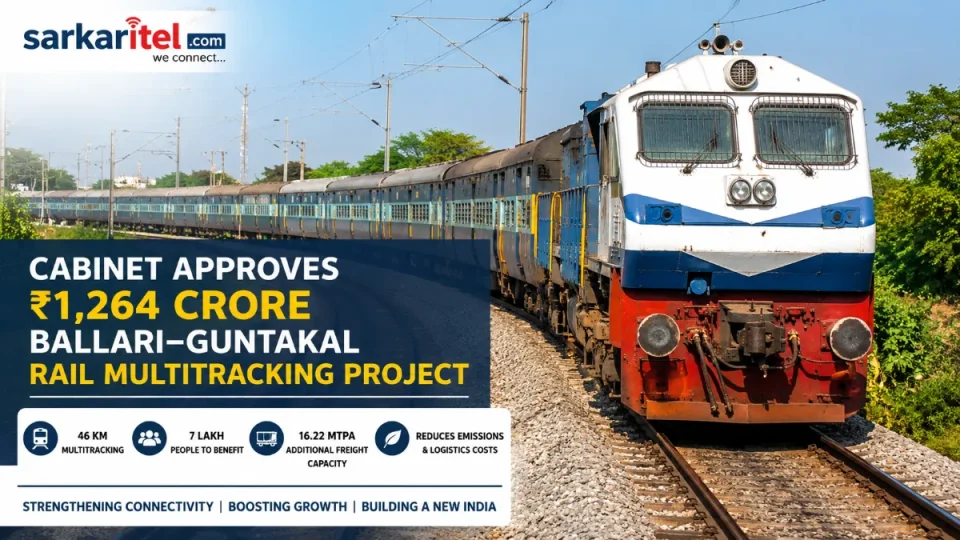
The Union Cabinet has approved a ₹1,264 crore Ballari Guntakal rail multitracking project across Karnataka and Andhra Pradesh. The Indian railways project will add third and fourth railway lines over 46 km, boost freight capacity, improve passenger connectivity for seven lakh people, and strengthen logistics under the PM Gati Shakti National Master Plan.
Key Highlights
- Cabinet approves ₹1,264 crore Ballari–Guntakal rail project.
- 46 km third and fourth railway lines to be built by 2028-29.
- 99 villages and around 7 lakh people to benefit.
- Freight capacity to increase by 16.22 MTPA, reducing emissions and logistics costs.
The Cabinet Committee on Economic Affairs (CCEA), chaired by Prime Minister Narendra Modi, has approved the ₹1,264 crore Ballari–Guntakal rail multitracking project, a major infrastructure initiative aimed at expanding railway capacity in Karnataka and Andhra Pradesh. The project will construct third and fourth railway lines over a stretch of about 46 km.
The railway expansion is expected to significantly improve passenger connectivity and provide better transport access to nearly 99 villages with a combined population of around seven lakh. The upgraded corridor will also improve connectivity to popular tourist destinations, including Ballari Fort and Sri Kumara Swamy Temple.
The Ballari–Guntakal railway section is a key freight corridor handling commodities such as iron ore, coal, limestone, fertilisers, food grains, iron and steel. The additional railway lines are expected to increase freight carrying capacity by 16.22 million tonnes per annum (MTPA) while easing congestion on the busy route.
Planned under the PM Gati Shakti National Master Plan, the project aims to improve multi-modal connectivity, enhance logistics efficiency, and ensure smoother movement of passengers and goods. The increased line capacity will also improve operational efficiency and service reliability for Indian Railways.
The government said the project will also deliver environmental benefits by reducing oil imports by 1.32 crore litres and cutting carbon dioxide emissions by 6.67 crore kg, equivalent to planting nearly 0.27 crore trees. The investment is expected to support regional development and generate employment opportunities while strengthening India’s railway infrastructure.
