

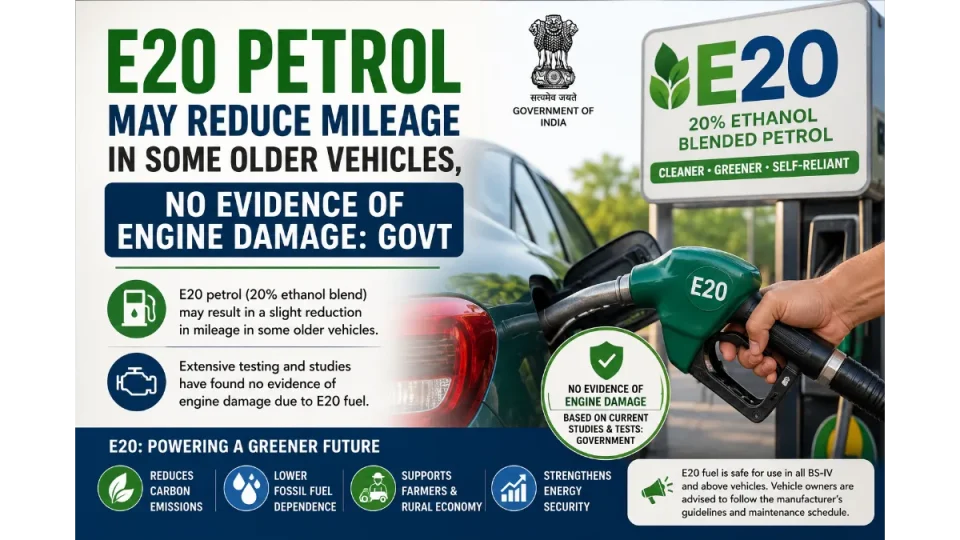
The Central government has said E20 petrol may reduce fuel efficiency by 3–5% in some older vehicles originally designed for E10 fuel, but there is no verified evidence linking ethanol-blended petrol to widespread engine damage or vehicle breakdowns, according to information shared in Parliament.
Key Highlights
- Government says E20 petrol may reduce mileage by 3–5% in some older E10-compatible vehicles.
- No verified evidence of widespread engine damage due to E20 fuel, Parliament informed.
- E20 petrol offers higher octane rating, improved combustion and better anti-knock performance.
- Fuel efficiency depends on driving habits, maintenance, tyre pressure and other factors, the government said.
New Delhi, July 22: The Central government on Wednesday clarified that E20 petrol may result in a marginal reduction in fuel efficiency in certain older vehicles designed for E10 fuel, but there is no verified evidence to suggest that the use of ethanol-blended petrol has caused widespread engine damage or vehicle breakdowns.
In a written reply in the Rajya Sabha, Minister of State for Petroleum and Natural Gas Suresh Gopi said that the reduction in mileage for some older vehicles is generally limited to around 3–5%. He emphasised that fuel economy is influenced by several factors beyond the ethanol content in petrol.
According to the minister, driving habits, vehicle maintenance, tyre pressure, wheel alignment and air-conditioning usage all play an important role in determining fuel efficiency. “Any reduction in fuel economy in certain older E10-designed vehicles is generally marginal (around 3–5%),” he stated.
The government also highlighted the benefits of E20 petrol, noting that it offers a higher octane rating, improved anti-knock performance, better combustion characteristics and smoother acceleration compared to conventional fuel. These advantages can contribute to improved engine performance, particularly in vehicles designed or calibrated for E20 fuel.
The clarification comes amid ongoing discussions over India’s ethanol blending programme, which aims to reduce dependence on imported crude oil, lower carbon emissions and promote the use of domestically produced biofuels.
Earlier this month, Union Minister for Road Transport and Highways Nitin Gadkari strongly defended the E20 programme while speaking at the Viksit Bharat Conclave in New Delhi. Rejecting concerns over vehicle performance, he challenged critics to identify a single vehicle that had suffered damage due to the use of 20% ethanol-blended petrol.
“There is no case of any car facing issues due to E20 petrol. Has there been any car in the country that faced issues due to the use of E20 petrol? Just name one,” Gadkari said. He also alleged that misinformation regarding higher ethanol blending was being spread through “paid campaigns.”
The government’s latest clarification reiterates that while some older vehicles may experience a slight reduction in mileage with E20 petrol, there is no verified evidence of widespread engine damage. As India expands ethanol blending to improve energy security, reduce emissions and support domestic biofuel production, the government maintains that the benefits of E20 outweigh the limited impact on fuel economy.
