

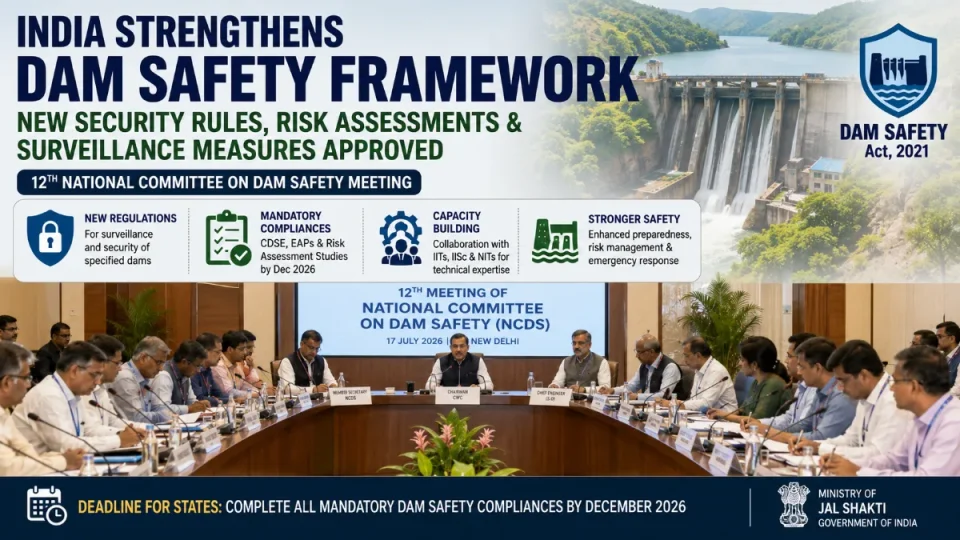
India has accelerated the implementation of the Dam Safety Act, 2021, with the 12th National Committee on Dam Safety (NCDS) approving key initiatives to strengthen dam surveillance, security, risk assessment and emergency preparedness. States have been directed to complete mandatory dam safety evaluations, Emergency Action Plans and risk studies by December 2026 to enhance the safety of the country’s critical water infrastructure.
Key Highlights
- 12th National Committee on Dam Safety (NCDS) meeting held in New Delhi under the Chairmanship of the Central Water Commission.
- New regulations on dam surveillance, security and hazard classification to strengthen critical water infrastructure.
- States directed to complete Comprehensive Dam Safety Evaluations, Emergency Action Plans and Risk Assessment Studies by December 2026.
- Committee reviews recent dam failures and expands collaboration with IITs, IISc and NITs for capacity building.
India has taken another significant step towards strengthening the safety of its critical water infrastructure as the 12th Meeting of the National Committee on Dam Safety (NCDS) reviewed the implementation of the Dam Safety Act, 2021 and approved several initiatives aimed at improving dam surveillance, security, risk assessment and emergency preparedness. The meeting, chaired by the Chairman of the Central Water Commission (CWC) in New Delhi, brought together representatives from Central Ministries, State Governments, State Dam Safety Organisations and technical experts to accelerate nationwide compliance with the Act.
During the deliberations, the Committee emphasised the need to expedite Comprehensive Dam Safety Evaluations (CDSEs), Emergency Action Plans (EAPs), Operation and Maintenance (O&M) Manuals, reservoir rule curves and risk assessment studies for all specified dams. Members agreed that strengthening these critical safety measures is essential for reducing disaster risks, protecting downstream communities and ensuring the long-term sustainability of India’s water infrastructure.
A major outcome of the meeting was the decision to develop new regulations on surveillance and security of specified dams to address emerging threats to critical infrastructure. The Committee also discussed hazard classification of dams, reservoir sedimentation, dam instrumentation, accreditation of agencies, dam failure reporting frameworks and updated technical guidelines to enhance monitoring, maintenance and operational safety across the country.
The Committee reviewed technical presentations on recent dam failures, including Luti Tank and Rajadera dams in Chhattisgarh, Teesta Stage-III Dam in Sikkim, Madhopur Barrage in Punjab, along with reservoir dredging work at Bisalpur Dam in Rajasthan. Lessons from these incidents will help strengthen future engineering practices, improve emergency preparedness and support evidence-based policymaking for dam safety management.
To build long-term institutional capacity, the Committee encouraged dam owners to continue sponsoring engineers for specialised postgraduate programmes conducted by IIT Roorkee and IISc Bengaluru, while expanding partnerships with IIT Guwahati, NIT Surat, NIT Calicut, NIT Nagpur and NIT Shillong. The initiative aims to create a skilled workforce capable of implementing advanced dam safety practices and ensuring effective compliance with the Dam Safety Act, 2021.
Conclusion
The 12th National Committee on Dam Safety has reinforced India’s commitment to creating a modern, technology-driven and resilient dam safety ecosystem. With stronger surveillance, updated regulations and mandatory safety evaluations scheduled for completion by December 2026, the Government is working to improve the safety, reliability and sustainability of the nation’s critical water infrastructure.
Frequently Asked Questions (FAQs)
1. What is the National Committee on Dam Safety (NCDS)?
The NCDS is the apex body responsible for advising the Government on policies, regulations and implementation of the Dam Safety Act, 2021.
2. What was the key outcome of the 12th NCDS meeting?
The Committee approved measures to strengthen dam surveillance, security, risk assessment, emergency preparedness and technical capacity building.
3. What deadline has been given to states?
States have been directed to complete Comprehensive Dam Safety Evaluations, Emergency Action Plans and Risk Assessment Studies by December 2026.
4. Why is the Dam Safety Act, 2021 important?
The Act establishes a nationwide framework for inspection, maintenance, surveillance and safe operation of specified dams to protect lives, property and water resources.
