

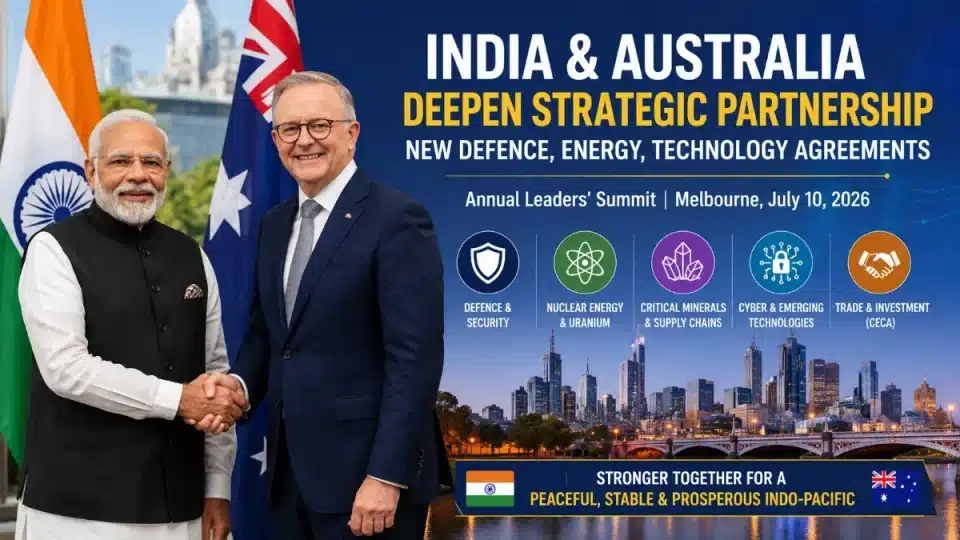
India and Australia have strengthened their Comprehensive Strategic Partnership by signing landmark agreements covering defence, uranium exports, critical minerals, cyber technologies, maritime security, and trade during the Annual Leaders’ Summit in Melbourne. The leaders also agreed to accelerate negotiations on the Comprehensive Economic Cooperation Agreement (CECA).
Key Highlights
- India and Australia signed landmark agreements on defence, energy, cyber technologies, and critical minerals.
- Uranium exports from Australia to India will begin under the 2015 Nuclear Cooperation Agreement.
- Both countries agreed to fast-track CECA negotiations and pursue a bilateral investment treaty.
- Leaders reaffirmed their commitment to a free, secure, and rules-based Indo-Pacific.
India and Australia have taken their Comprehensive Strategic Partnership to a new level following the Annual Leaders’ Summit in Melbourne, where Prime Minister Narendra Modi and Australian Prime Minister Anthony Albanese announced a series of landmark agreements aimed at strengthening cooperation across defence, trade, clean energy, cyber technologies, and critical minerals.
The two leaders released a Joint Declaration on Defence and Security Cooperation, reaffirming their shared commitment to maintaining a peaceful, stable, and prosperous Indo-Pacific. They also endorsed a Joint Maritime Security Collaboration Roadmap and launched the Australia-India Partnership on Cyber, Critical Technologies and Supply Chains, reflecting the growing strategic convergence between the two democracies.
A major outcome of the summit was the signing of an administrative arrangement to operationalise uranium exports from Australia to India under the 2015 Australia-India Nuclear Cooperation Agreement. The initiative is expected to support India’s clean energy transition while creating new opportunities for Australia’s resources sector.
The leaders also agreed to accelerate negotiations on a Comprehensive Economic Cooperation Agreement (CECA) and a bilateral investment treaty to further expand trade and investment. Both countries will continue to deepen collaboration in critical minerals, support India’s Gaganyaan human spaceflight programme, and strengthen cooperation in advanced technologies and resilient supply chains.
Prime Minister Modi highlighted the remarkable progress achieved since the signing of the Economic Cooperation and Trade Agreement (ECTA) in 2022 and described the proposed CECA as a balanced, ambitious, and mutually beneficial agreement. He also emphasised that cooperation in critical minerals, nuclear energy, and emerging technologies would strengthen both countries’ strategic and economic resilience.
The summit also reaffirmed the two nations’ shared commitment to combating terrorism and enhancing regional security. Describing cricket as a common language connecting both countries, Prime Minister Modi remarked that the partnership combines the speed of a T20, the focus of a one-day match, and the endurance of a Test match, symbolising the long-term nature of India-Australia relations.
Conclusion
The Melbourne summit marks a significant milestone in India-Australia relations, with both nations expanding cooperation in defence, clean energy, technology, trade, and regional security while reinforcing their shared vision for a stable and prosperous Indo-Pacific.
