

Featured Snippet (40–60 words)
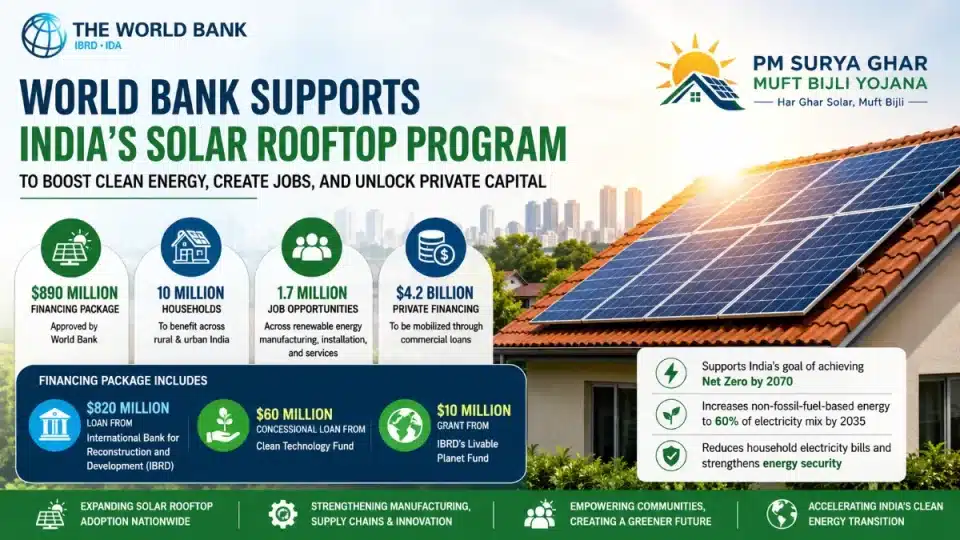
The World Bank has approved an $890 million financing package to support India’s PM Surya Ghar: Muft Bijli Yojana, accelerating rooftop solar adoption for 10 million households. The initiative is expected to create 1.7 million jobs, attract $4.2 billion in private investment, and advance India’s clean energy transition.
Key Highlights
- World Bank approves $890 million financing for India’s rooftop solar programme.
- PM Surya Ghar Yojana aims to benefit 10 million rural and urban households.
- Initiative is expected to create 1.7 million jobs across the renewable energy value chain.
- Program will mobilise $4.2 billion in private financing for residential solar installations.
India’s clean energy transition received a major boost as the World Bank’s Board of Executive Directors approved a comprehensive financing package to accelerate the country’s PM Surya Ghar: Muft Bijli Yojana. The programme seeks to expand residential rooftop solar installations across 10 million households, helping families reduce electricity costs while promoting sustainable energy.
Related News on World Bank
- World Bank Raises India Growth Forecast to 6.6% Despite Middle East Conflict
- India Leads Region with 7.6% Growth as South Asia Slows: World Bank
- World Bank Approves $198 Million Funding for India Rooftop Solar Expansion
The financing package comprises an $820 million loan from the International Bank for Reconstruction and Development (IBRD), a $60 million concessional loan from the Clean Technology Fund, and a $10 million grant from the IBRD Livable Planet Fund. In addition, the World Bank expects to mobilise $4.2 billion in private financing through commercial lending to support household solar rooftop installations.
The initiative aligns with India’s commitment to achieve net-zero emissions by 2070 and increase the share of non-fossil fuel-based electricity to 60% by 2035. While utility-scale solar capacity has expanded rapidly in recent years, residential rooftop solar has significant untapped potential, making the programme a key component of India’s clean energy strategy.
According to the World Bank, the programme will generate around 1.7 million employment opportunities across renewable energy manufacturing, installation, maintenance, financing, and related services. The expansion of rooftop solar is also expected to strengthen domestic manufacturing and encourage innovation throughout the clean energy ecosystem.
The World Bank has supported India’s solar rooftop sector for more than a decade, helping expand installed rooftop solar capacity from 500 MW to over 27 GW through investments exceeding $2 billion. The new financing aims to build on this momentum by expanding access to affordable solar energy for households nationwide.
The programme will also strengthen the capacity of distribution companies, banks, and solar vendors to provide integrated services. Through collateral-free financing, more households will be able to install rooftop solar systems, reducing monthly electricity bills while contributing to India’s long-term energy security and climate goals.
Conclusion
The World Bank’s latest financing package marks a significant milestone in India’s clean energy journey, supporting wider rooftop solar adoption, job creation, private investment, and progress towards the country’s ambitious climate and energy targets.
Excerpt
The World Bank has approved an $890 million financing package for India’s PM Surya Ghar: Muft Bijli Yojana, supporting rooftop solar installations for 10 million households, creating 1.7 million jobs, and mobilising $4.2 billion in private investment.
