

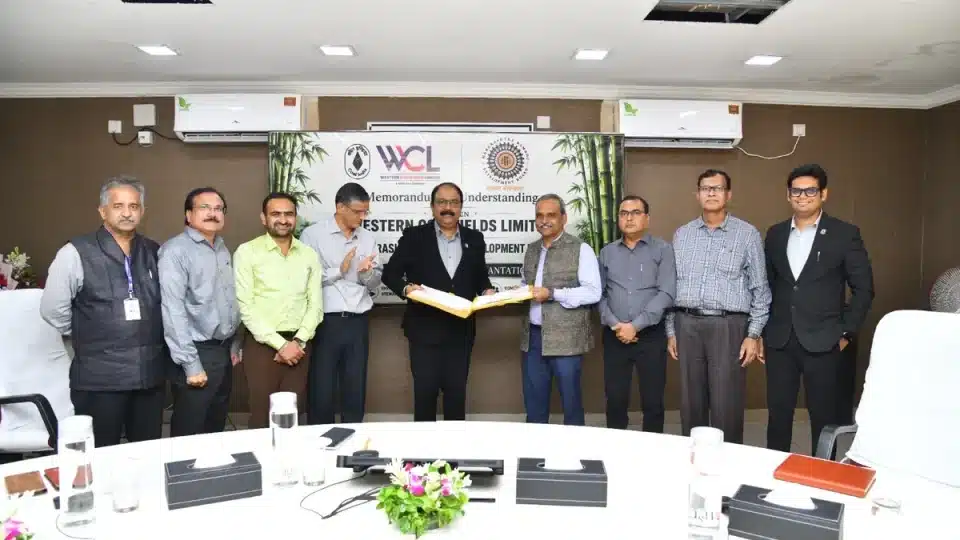
Western Coalfields Limited (WCL), A Miniratna-I Status PSU Under the Ministry of Coal has signed its fourth MoU with the Maharashtra Bamboo Development Board to develop a 28-hectare commercial bamboo plantation at Dhuptala Opencast Mine. The project expands WCL’s bamboo plantation area beyond 121 hectares, supporting sustainable mining, ecological restoration, carbon sequestration, and non-coal revenue generation.
Key Highlights
- WCL signs fourth MoU with Maharashtra Bamboo Development Board for bamboo plantation.
- 121 hectares of reclaimed mine land now covered under commercial bamboo projects.
- ₹2.57 crore investment planned with over 31,000 plants to be planted.
- Project will boost green mining, biodiversity, carbon capture, and local employment.
WCL has taken another significant step towards sustainable mining and environmental conservation by signing its fourth Memorandum of Understanding (MoU) with the Maharashtra Bamboo Development Board (MBDB), Nagpur. The agreement will facilitate a commercial bamboo plantation across 28 hectares at the Dhuptala Opencast Mine (OCM) in the Ballarpur Area, transforming reclaimed mine land into productive green assets.
The MoU was signed by Dr. Hemant Sharad Pande, CMD and Director (Technical), WCL, and Shri Rishikesh Ranjan, Managing Director, MBDB, in the presence of senior WCL officials. The partnership reflects WCL’s long-term vision of combining business diversification with environmental sustainability.
With this latest initiative, WCL’s cumulative commercial bamboo plantation area has crossed 121 hectares, building on successful projects at Makardhokra-III OCM, Amalgamated Inder Kamptee OCM, and Sasti OCM. The company continues to demonstrate how reclaimed mining land can be converted into environmentally and economically valuable resources.
The Dhuptala project includes 26 hectares of commercial bamboo plantation and 2 hectares of indigenous tree species, including Jamun and Arjun, with a total plantation of 31,108 saplings. WCL will invest around ₹2.57 crore during the first five years, while MBDB will be responsible for plantation, maintenance, harvesting, marketing, and sale of bamboo through a transparent mechanism.
The 15-year project is expected to recover its investment by the eighth year. Under the agreed revenue-sharing model, WCL will receive 85% of the net profit, while MBDB will receive 15% as facilitation charges, creating a sustainable non-coal income source alongside coal mining operations.
Beyond financial returns, the initiative will support carbon sequestration, soil conservation, dust suppression, biodiversity enhancement, and ecological restoration, while also generating employment opportunities for local communities and Project Affected Persons (PAPs). The project further strengthens WCL’s commitment to green mining and responsible resource management.
Conclusion
The fourth MoU between WCL and MBDB highlights the company’s growing focus on sustainable mining, environmental restoration, and diversified revenue generation, setting a strong example for responsible mining practices in India.
