

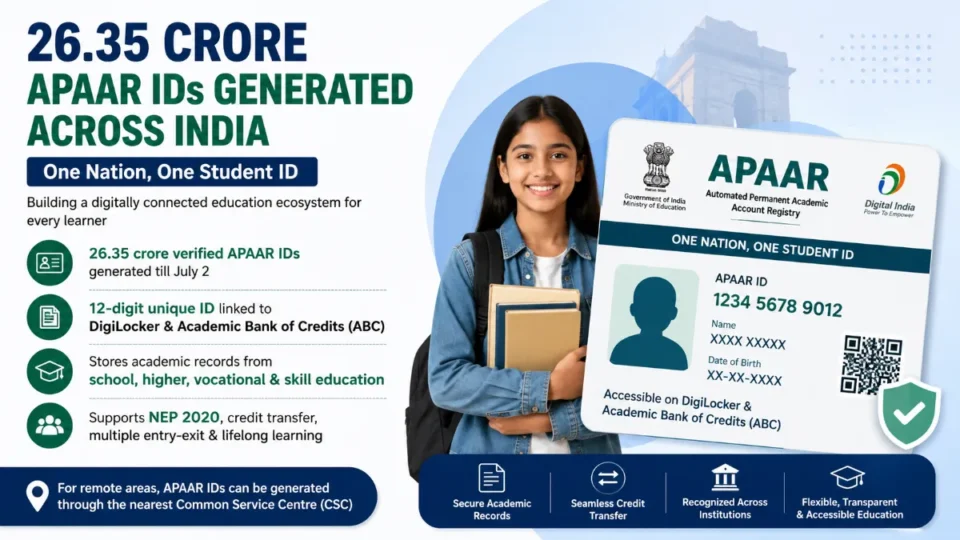
India has generated over 26.35 crore verified APAAR ID under the One Nation, One Student ID initiative, enabling students to maintain a single lifelong digital academic identity. Integrated with DigiLocker and the Academic Bank of Credits (ABC), the system supports seamless credit transfer, academic record management, and flexible learning pathways. This initiative comes under the Ministry of Education.
Key Highlights
- 26.35 crore verified APAAR IDs generated across India as of July 2.
- APAAR ID provides every learner with a unique 12-digit digital academic identity.
- Integrated with DigiLocker and the Academic Bank of Credits (ABC) for secure record management.
- Supports NEP 2020, lifelong learning, credit transfer, and multiple entry-exit options.
India has crossed a significant milestone in digital education with the generation of 26.35 crore verified APAAR (Automated Permanent Academic Account Registry) IDs across the country till July 2. The initiative, launched under the One Nation, One Student ID programme, is designed to provide every learner with a single, lifelong digital academic identity.
The APAAR ID is a 12-digit unique student identification number linked to the Academic Bank of Credits (ABC) system. Accessible through DigiLocker and the ABC platform, it securely stores a learner’s educational records, including higher education, vocational education, skill development programmes, and professional learning achievements, on a unified digital platform.
According to an official factsheet, school education records will also be integrated with APAAR IDs under the National Academic Depository-Academic Bank of Credits (NAD-ABC) framework. To ensure wider accessibility, students living in remote and underserved regions can generate their APAAR IDs through their nearest Common Service Centre (CSC).
The Academic Bank of Credits (ABC) aims to build a flexible, learner-centric education system by allowing students to earn, store, transfer, and redeem academic credits throughout their educational journey. The initiative aligns with the vision of the National Education Policy (NEP) 2020 and the National Credit Framework (NCrF).
One of the key advantages of the system is that students who temporarily discontinue their education do not lose their earned credits. These credits remain securely stored in the ABC repository and can be redeemed when they resume their studies, with a validity period of up to seven years for transfer and utilisation.
Together, APAAR and ABC are creating a trusted digital education ecosystem by simplifying academic record management, enhancing transparency, enabling seamless credit mobility between institutions, and making education more accessible, flexible, and student-friendly across India.
Conclusion
With 26.35 crore verified APAAR IDs already generated, India is steadily advancing towards a digitally connected education ecosystem, ensuring learners benefit from secure academic records, flexible learning opportunities, and lifelong recognition of their educational achievements.
FAQs Related to APAAR ID
1. What is an APAAR ID ?
APAAR, which stands for Automated Permanent Academic Account Registry, is a specialized identification system designed for all students in India. This initiative is part of the ‘One Nation, One Student ID’ program launched by the government, aligning with the new National Education Policy of 2020.
2. Why should students have APAAR ID ?
APAAR ID – a unique 12-digit code will help students to digitally store, manage, and access all their academic credits, including Score card, marksheets, gradesheet, degrees, diplomas, certificates & co-curricular accomplishments. This ID functions as a permanent digital identity for the student in the education ecosystem.
3. What are the key features of APAAR ID ?
Lifelong Academic Identity: Each student gets a unique 12-digit ID
Centralized System: Manages academic records in one place.
Credit Transfer: Facilitates the transfer of credits between institutions
Lifelong Identity: Stays with the student throughout their educational and professional career
Additionally it has features to; Preserving student achievements, Streamlines credit recognition, Enhance educational flexibility & Credit transfer across institutions
4. How APAAR ID is useful for future ?
The APAAR ID is linked to Academic Bank of Credits (ABC) & DigiLocker, an online repository, where students securely access their essential documents like exam results & academic credentials and documents. It receives academic credits of students directly from institutions and awarding bodies through the National Academic Depository. Thus being a single source of truth, this streamlines authentication for transfers, entrance examinations, admissions or job applications, simplifying the verification of academic records.
APAAR ensures accountability and transparency in education by tracking student progress and streamlining academic records. It enhances efficiency, removes duplicity, minimizes fraud, and includes co-curricular achievements for holistic student development. With multiple use cases, APAAR facilitates following :
– Facilitate student mobility
– Enhance academic flexibility
– Empower students to choose their learning paths of their choice
– Acknowledge and validate learning achievements
– Since no additional certificates are required to be provided except sharing APAAR id where all credentials are stored, there is no fear of losing hard copy certificates and hence useful for all type of use cases such as transfer from one school to the other, entrance examination, admission, job application, skilling, upskilling etc.
Unified Academic Identity: A single platform to consolidate and showcase academic
– Student ID Proof: It’s an identity proof, which may have many other possible benefits as envisaged by schools, state government colleges & universities.
– Seamless Academic Mobility: Facilitating smooth transitions between educational levels
– Lifelong Academic Identity: Facilitate skilling reskilling upskilling from early school education to higher education and beyond during employment
– Student Lifecycle Monitoring: Students can effortlessly monitor their academic journey, enabling personalized study plans and real-time performance analytics
– Skill Gap Analysis: The system aids in skill gap analysis and provides industry-relevant content for upskilling programs
– Streamlining Student Academic Records: Simplifying academic record-keeping for students
5. What facilities are mapped through APAAR ID ?
Admissions, Scholarships, Concessions, Credit accumulation, Credit redemption, Credit accounting, Credit transfer form one institution to another institution, Internships, Certifications, Job applications, & verification of academic records.
How can students access APAAR ID ?
Yes, students can access and manage their academic records through the APAAR ID, which is linked to the ABC, and DigiLocker platforms.
2. What is the Academic Bank of Credits (ABC) ?
ABC is a digital repository that enables students to store, transfer, and redeem academic credits across recognised institutions. APAAR integrates with the Academic Bank of Credits (ABC), allowing students to accumulate, transfer, and redeem credits across institutions. The ABC system facilitates credit transfers and tracks academic achievements.
4. What is the procedure for generating APAAR ID ?
Students need to follow these steps :
The name of student as per student records in UDISE+ must match with the name of the student as per Aadhaar
PEN of student is mandatory for generation of APAAR ID
Verification: Visit the school to verify demographic details
Parental Consent: Obtain parental consent if the student is a minor
Authentication: Authenticate identity through the school
ID Creation: Upon successful verification, the APAAR ID is created and added to DigiLocker for secure online access
5. What is UDISE+ Portal ?
The UDISE+ (Unified District Information System for Education Plus) portal is a comprehensive database used for managing information related to students, teachers, and schools across India.
UDISE+ Unique Student Identifier (PEN), Student Name, Date of Birth (DOB), Gender, Mobile Number, Mother’s Name, Father’s Name, Name as per Aadhaar, Aadhaar Number
