

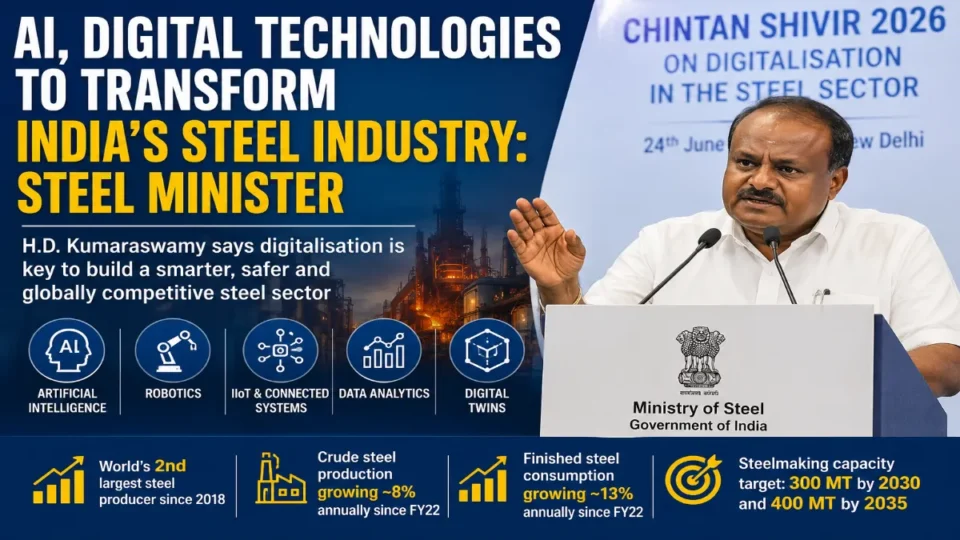
Union Steel Minister H.D. Kumaraswamy said that Artificial Intelligence (AI), Machine Learning (ML), Industrial Internet of Things (IIoT), Digital Twins and Robotics will play a crucial role in transforming India’s steel industry. Speaking at the Chintan Shivir 2026 on Digitalisation in the Steel Sector, he emphasized that digitalisation is essential for enhancing efficiency, safety and global competitiveness while supporting India’s vision of becoming a developed nation by 2047.
Key Highlights
- India remains the world’s second-largest steel producer since 2018.
- Crude steel production has grown nearly 8% annually since FY22.
- Finished steel consumption has increased by around 13% annually.
- Government targets 300 million tonnes steelmaking capacity by 2030 and 400 million tonnes by 2035.
New Delhi: Union Minister for Steel and Heavy Industries H.D. Kumaraswamy on Wednesday said that Artificial Intelligence (AI) and other advanced digital technologies will redefine India’s steel industry, making it smarter, safer and globally competitive.
Addressing the ‘Chintan Shivir 2026 on Digitalisation in the Steel Sector’ in New Delhi, the minister asserted that digitalisation is no longer optional but a necessity for the long-term growth and sustainability of the steel sector.
He stated that the future of steel manufacturing will depend not only on production capacity but also on the industry’s ability to develop intelligent, connected and data-driven manufacturing ecosystems. According to Kumaraswamy, digital transformation will play a key role in achieving Prime Minister Narendra Modi’s vision of Viksit Bharat 2047.
Describing steel as the backbone of nation-building, the minister highlighted the sector’s contribution to infrastructure development, manufacturing, renewable energy, urbanisation, transportation and defence production. He noted that India has maintained its position as the world’s second-largest steel producer since 2018 despite sluggish demand in several advanced economies.
The minister said that crude steel production has grown at an average annual rate of nearly 8 per cent since FY22, while finished steel consumption has expanded by around 13 per cent annually. He reiterated the government’s ambitious target of increasing steelmaking capacity to 300 million tonnes by 2030 and 400 million tonnes by 2035.
Kumaraswamy emphasized that technologies such as Artificial Intelligence (AI), Machine Learning (ML), Industrial Internet of Things (IIoT), Digital Twins, Robotics and Advanced Data Analytics are transforming steel manufacturing worldwide. These technologies can significantly reduce unplanned downtime, minimise human errors, improve operational efficiency and enhance workplace safety.
The event, organised by the Ministry of Steel, brought together senior government officials, technology experts, industry leaders, startups and heads of major public sector steel companies including SAIL, NMDC and MOIL to discuss the future of digital transformation in the steel sector.
The discussions focused on leveraging emerging technologies to improve productivity, sustainability and competitiveness, positioning India’s steel industry as a global leader in the coming decades.
Conclusion
The government’s push for AI-driven digitalisation is expected to accelerate the modernization of India’s steel industry, enabling higher productivity, improved safety standards and sustainable growth while supporting the nation’s long-term economic development goals.
FAQ
Q1. What did H.D. Kumaraswamy say about digitalisation in the steel sector ?
He said digitalisation is essential for the long-term survival, efficiency and global competitiveness of India’s steel industry.
Q2. Which technologies are expected to transform steel manufacturing ?
AI, Machine Learning, IIoT, Digital Twins, Robotics and Advanced Data Analytics.
Q3. What is India’s current position in global steel production ?
India has been the world’s second-largest steel producer since 2018.
Q4. What are India’s steel capacity targets ?
The government aims to achieve 300 million tonnes capacity by 2030 and 400 million tonnes by 2035.
