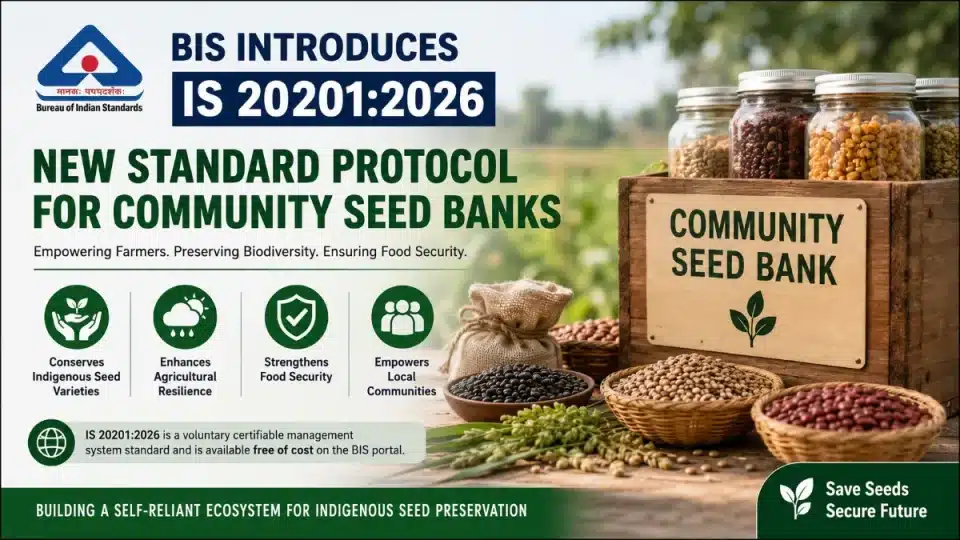
The Bureau of Indian Standards (BIS) has launched IS 20201:2026, a new management system standard for Community Seed Banks (CSBs) aimed at preserving indigenous seed varieties, improving agricultural resilience, and ensuring long-term food security. The framework provides standardized guidelines for seed collection, storage, quality assurance, and exchange, helping farmers adapt to climate change challenges such as droughts, rising temperatures, and erratic rainfall.
Key Highlights
✅ BIS launches IS 20201:2026 for Community Seed Banks across India
✅ Framework promotes conservation of indigenous and climate-resilient seed varieties
✅ Supports food security and sustainable farming amid climate change challenges
✅ Standard available free of cost and open for voluntary adoption
The Bureau of Indian Standards (BIS) has published IS 20201:2026, a new Indian Standard designed to establish a comprehensive management framework for Community Seed Banks (CSBs) across India. The initiative seeks to promote the conservation of indigenous seed varieties, strengthen agricultural resilience, and support long-term food security in the face of increasing climate-related challenges.
The newly introduced standard provides a structured operating protocol for decentralized, community-led seed banks, enabling farmers and local communities to systematically collect, preserve, store, and exchange high-quality seeds adapted to local conditions. With climate change causing erratic rainfall, rising temperatures, and prolonged droughts, traditional seed varieties are emerging as a valuable resource due to their natural drought tolerance, disease resistance, and nutritional benefits.
IS 20201:2026 aligns with Prime Minister Narendra Modi’s vision of preserving agricultural biodiversity and promoting sustainable farming practices. The standard complements government initiatives such as the National Food Security and Nutrition Mission (NFSNM), which offers financial support of up to Rs 50 lakh for establishing community seed banks. It also supports the objectives of the Protection of Plant Varieties and Farmers’ Rights Act, 2001, and the Biological Diversity Act, 2002.
The standard outlines detailed requirements covering the entire lifecycle of seed bank operations. These include organizational arrangements, seed collection and acquisition, viability testing, cleaning, drying, storage, documentation, quality assurance, seed regeneration, risk management, and continuous improvement mechanisms.
By functioning as decentralized repositories of agricultural biodiversity, standard-compliant Community Seed Banks can empower farmers with reliable access to locally adapted and climate-resilient seeds. This not only helps protect the livelihoods of small and marginal farmers but also contributes to strengthening food systems at the grassroots level.
The draft standard was developed under the convenorship of the ICAR-National Bureau of Plant Genetic Resources with contributions from the National Biodiversity Authority, the Protection of Plant Varieties and Farmers’ Rights Authority, Rythu Sadhikara Samstha, and the BAIF Development Research Foundation.
BIS has clarified that IS 20201:2026 is a voluntary certifiable management system standard and is available for free download through its official portal. Community seed banks, agricultural cooperatives, farmer groups, and other stakeholders are encouraged to adopt the framework to build a self-reliant ecosystem focused on indigenous seed preservation and sustainable agriculture.
The introduction of IS 20201:2026 by BIS marks a significant step toward safeguarding India’s agricultural biodiversity and strengthening food security. By providing a standardized framework for Community Seed Banks, the initiative empowers farmers to preserve indigenous seed varieties, improve resilience against climate change, and promote sustainable agricultural practices for future generations.
FAQ Section
Q1. What is IS 20201:2026 ?
IS 20201:2026 is a new Indian Standard introduced by BIS that provides a management framework for Community Seed Banks.
Q2. Why are Community Seed Banks important ?
They help preserve indigenous seed varieties, improve biodiversity, and ensure farmers have access to climate-resilient seeds.
Q3. Is the BIS standard mandatory ?
No, IS 20201:2026 is a voluntary certifiable management system standard.
Q4. How does the standard help farmers ?
It provides guidelines for seed collection, storage, quality assurance, and exchange, helping farmers access reliable and locally adapted seeds.
Q5. Where can stakeholders access the standard ?
The standard can be downloaded free of cost from the BIS portal.