

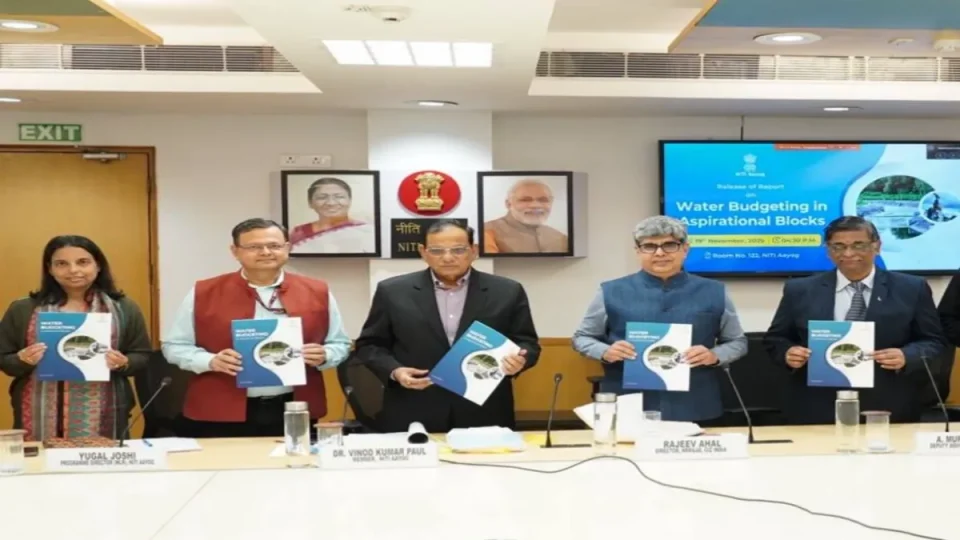
New Delhi, Nov 20 The report was released by Dr. V. K. Paul Member , NITI Aayog. The report outlines a user-friendly scientific methodology for preparing a water budget at block level, with the help of web-based water budgeting platform developed for this purpose.
The water budgeting exercise has been conducted across 18 Aspirational Blocks covering 8 agro-climatic zones in 11 states of the country.
With India entering a decisive phase of its Amrit Kaal journey, the nation has intensified its focus on long-term water sustainability. Reaffirming this commitment, Prime Minister Shri Narendra Modi recently emphasized water’s central role in shaping human civilization and called for collective, community-driven action to secure this resource for future generations.
This national vision gained momentum at the Second All-India State Water Ministers’ Conference, held in Udaipur on 18–19 February 2025. The conference underscored the need for Water Vision @2047 and identified water budgeting as a cornerstone for ensuring water security across regions.
Varuni App: A New Tool for Water Security
To support ground-level planning, the Indo-German WASCA project developed Varuni, a first-of-its-kind web application designed to generate Block-level water budgets using scientific yet simple methods.
Varuni integrates publicly available datasets—including rainfall, groundwater levels, crop water needs, livestock populations, and surface water storage—to assess whether a Block is facing water surplus or water deficit. The tool provides quick diagnostics and guides local officials toward suitable interventions.
Aspirational Blocks Assessed Across India
The Varuni application was piloted across 18 Aspirational Blocks, representing diverse geographical zones—coastal regions, Gangetic plains, Himalayan districts, arid/semi-arid landscapes, plateau regions, and reservoir-fed areas.
Key Findings
Severe Water Deficits were observed in Namchi (94%), Gangiri (60%), Baldeogargh (53%), Andimadam (42%), Abu Road (41%), among others.
Groundwater Overexploitation exceeded 100% in Blocks like Kotri and Abu Road.
Surface Water Underutilization was notable in Fatehpur, Buxwaha, and Abu Road despite available infrastructure.
Regional Challenges Varied Significantly:
Coastal Blocks faced salinity intrusion.
Bundelkhand required urgent groundwater recharge measures.
Himalayan Blocks needed spring protection and catchment conservation.
Gangetic plains showed heavy dependence on groundwater.
Towards Water Vision 2047
The findings highlight a critical need for region-specific water management strategies. Officials conclude that Varuni serves as a valuable diagnostic tool for immediate planning and has the potential to become a cornerstone in India’s long-term water governance framework.
As India marches toward 2047, tools like Varuni are expected to strengthen data-driven decision-making, enhance resilience, and support the nation’s journey toward water security.
WaterVision2047 #Varuni #WaterBudgeting #SustainableWaterManagement #JalShakti #WaterSecurity #GroundwaterRecharge #ClimateResilientIndia #WaterConservation #IndiaWaterCrisis #Hydrology #WaterGovernance #IGrow2030 #AspirationalBlocks #DigitalWaterTools #WASCA #IndoGermanCollaboration #NaturalResourceManagement #WaterData #SmartWaterPlanning #RuralDevelopment
Related posts :
 राजस्थान में जल संरक्षण महज सरकारी कार्यक्रम नहीं, अब जन आंदोलन : शेखावत
 NMCG Sets New Course for Yamuna Revival in Delhi
 Led by Nagpur Police Commissioner Dr. Ravinder Singal, Sarkaritel.com, National Water Mission & Western Coalfields Limited Organise ‘Ek Ped Maa Ke Naam’ Tree Plantation Drive at Nagpur Police Training Center
 Virtual Workshop on Safe Drinking Water Held Under Sujalam Bharat Summit by Jal Shakti Ministry
 Jal Panchayat : Nature can fulfill our Needs but not our Greed : Arif Mohammad Khan
 India to Celebrate Water Conservation Efforts as President Murmu Presents First JSJB Awards 2025
