

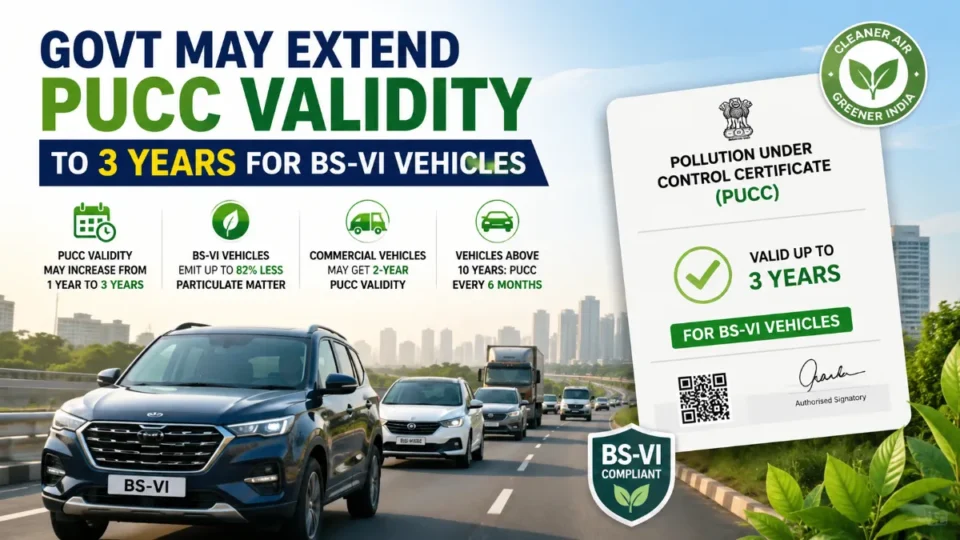
The Central government is reportedly considering extending the Pollution Under Control Certificate (PUCC) validity for new BS-VI vehicles from the current one year to three years. The proposal under the Ministry of Road Transport and Highways (MoRTH) aims to reduce compliance burdens for owners of cleaner vehicles while maintaining stricter pollution monitoring for older and more polluting vehicles. If approved, BS-VI private vehicle owners may need only two PUCC renewals during the first six years of vehicle ownership.
Key Highlights
| Key Point | Details |
|---|---|
| PUCC Validity | May increase from 1 year to 3 years for new BS-VI private vehicles |
| Cleaner Emissions | BS-VI vehicles emit up to 82% less particulate matter than BS-IV vehicles |
| Commercial Vehicles | BS-VI commercial vehicles may get 2-year PUCC validity |
| Older Vehicles | Vehicles above 10 years may continue requiring PUCC every 6 months |
Story
The Centre is reportedly considering a significant change in the renewal norms for Pollution Under Control Certificates (PUCC) for BS-VI vehicles, a move that could provide relief to millions of vehicle owners across the country.
According to reports, the proposal seeks to extend the PUCC validity period for new BS-VI private vehicles from one year to three years. If implemented, vehicle owners would be required to renew their pollution certificates only twice during the first six years of ownership instead of every year.
Under the proposed framework, BS-VI private vehicles up to six years old would enjoy a three-year PUCC validity period. Vehicles between six and ten years old would require annual renewals, while vehicles older than ten years would continue to need pollution certificates every six months.
The government is also considering separate norms for commercial vehicles. Under the proposal, BS-VI commercial vehicles up to six years old could receive a two-year PUCC validity period. After six years, the same renewal schedule applicable to private vehicles would apply.
The move is being considered because BS-VI vehicles produce significantly lower emissions compared to older BS-IV models. Studies indicate that BS-VI-compliant vehicles emit up to 82 per cent less particulate matter (PM) and around 25 per cent less nitrogen oxides (NOx), making them substantially cleaner and more environment-friendly.
Officials believe the proposal could help reduce compliance burdens on owners of newer vehicles while encouraging the gradual phase-out of older and more polluting vehicles. At the same time, authorities are working to strengthen the PUCC testing process to improve transparency and prevent manipulation of emission readings.
Transport and environmental experts have largely welcomed the proposal, noting that the lower emissions from BS-VI vehicles justify a longer validity period. However, some experts have stressed that regular vehicle maintenance remains essential, as poorly maintained vehicles can still generate higher emissions regardless of age.
Conclusion
If approved, the proposal to extend PUCC validity for BS-VI vehicles to three years could simplify compliance for vehicle owners while recognising the environmental benefits of cleaner vehicle technology. The move may also allow authorities to focus more closely on monitoring older and higher-emission vehicles that contribute more significantly to air pollution.
FAQ Section
Q1. What is the proposed PUCC validity for BS-VI private vehicles?
The government is considering extending PUCC validity from one year to three years for new BS-VI private vehicles.
Q2. How long will the extended validity remain applicable?
The proposed three-year validity would apply to BS-VI private vehicles up to six years old.
Q3. What are the proposed rules for commercial BS-VI vehicles?
Commercial BS-VI vehicles up to six years old may receive a two-year PUCC validity period.
Q4. Why is the government considering this change?
BS-VI vehicles produce significantly lower emissions than older BS-IV vehicles and are considered cleaner and more environmentally friendly.
Q5. Has the proposal been officially approved?
No. The proposal is currently under consideration and has not yet been approved.
