

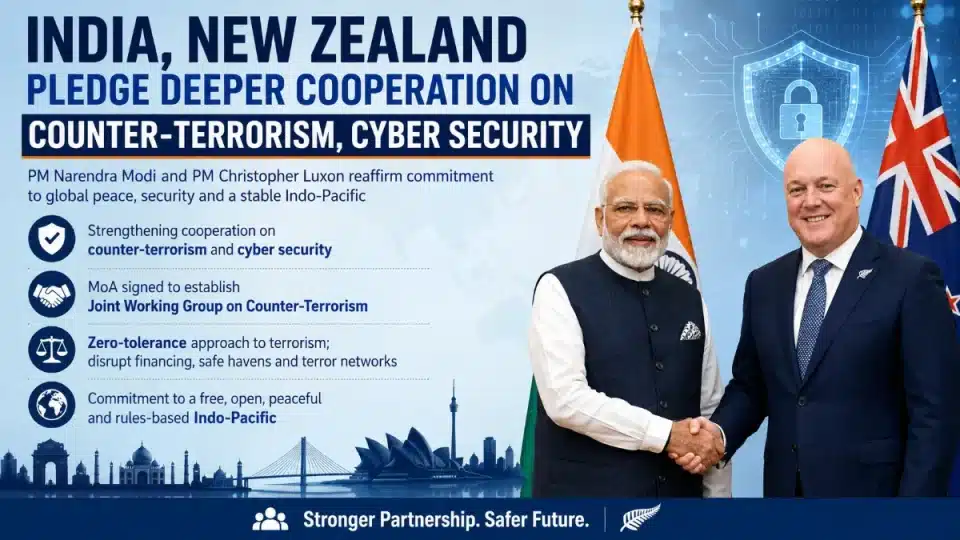
India and New Zealand have pledged to strengthen cooperation on counter-terrorism, cyber security, law enforcement, and Indo-Pacific security following talks between Prime Minister Narendra Modi and New Zealand Prime Minister Christopher Luxon. Both countries also agreed to establish a Joint Working Group on Counter-Terrorism and enhance collaboration against transnational crime.
Key Highlights
- India and New Zealand pledged stronger cooperation on counter-terrorism and cyber security.
- Both nations signed an MoA to establish a Joint Working Group on Counter-Terrorism.
- Leaders jointly condemned the Pahalgam and Red Fort terror attacks and reiterated a zero-tolerance approach to terrorism.
- Both countries reaffirmed support for a free, open and rules-based Indo-Pacific while expanding law enforcement cooperation.
India and New Zealand have agreed to significantly deepen bilateral cooperation in counter-terrorism, cyber security, and regional security, reflecting their shared commitment to addressing evolving global security challenges. During high-level discussions, Prime Minister Narendra Modi and New Zealand Prime Minister Christopher Luxon pledged closer coordination through regional and multilateral platforms to strengthen international peace and resilience.
The two leaders strongly condemned terrorism in all its forms, including cross-border terrorism, and reiterated that there can be no justification for acts of terror. They specifically condemned the April 2025 Pahalgam terrorist attack in Jammu & Kashmir and the November 2025 Red Fort terror incident in New Delhi, calling for the perpetrators and their supporters to be brought to justice without delay.
Both Prime Ministers endorsed a zero-tolerance approach to terrorism and stressed the importance of dismantling terror financing networks, eliminating safe havens, and disrupting online extremist infrastructure. They also welcomed the signing of a Memorandum of Arrangement (MoA) establishing a Joint Working Group (JWG) on Counter-Terrorism, creating a structured framework for information exchange, intelligence cooperation, and capacity building.
The leaders further committed to expanding law enforcement cooperation to combat transnational organised crime, including drug trafficking, financial crimes, cyber-enabled offences, terrorism-related activities, human trafficking, and people smuggling. They also agreed to expedite formal arrangements on counter-narcotics cooperation between the relevant agencies of both countries.
On regional security, Prime Minister Modi and Prime Minister Luxon reaffirmed their shared vision for a free, open, peaceful and prosperous Indo-Pacific based on respect for sovereignty, territorial integrity, international law, and freedom of navigation. Both sides reiterated support for the United Nations Convention on the Law of the Sea (UNCLOS) and emphasized the peaceful resolution of disputes.
The two countries also highlighted the importance of ASEAN centrality and agreed to deepen engagement through regional institutions, including the East Asia Summit, ASEAN Regional Forum, and ASEAN Defence Ministers’ Meeting Plus, reinforcing their long-term commitment to stability, security, and prosperity across the Indo-Pacific.
Conclusion
The latest India-New Zealand understanding marks a significant step in strengthening their strategic partnership, with enhanced cooperation on security, cyber resilience, counter-terrorism, and Indo-Pacific stability expected to shape closer bilateral engagement in the years ahead.
