

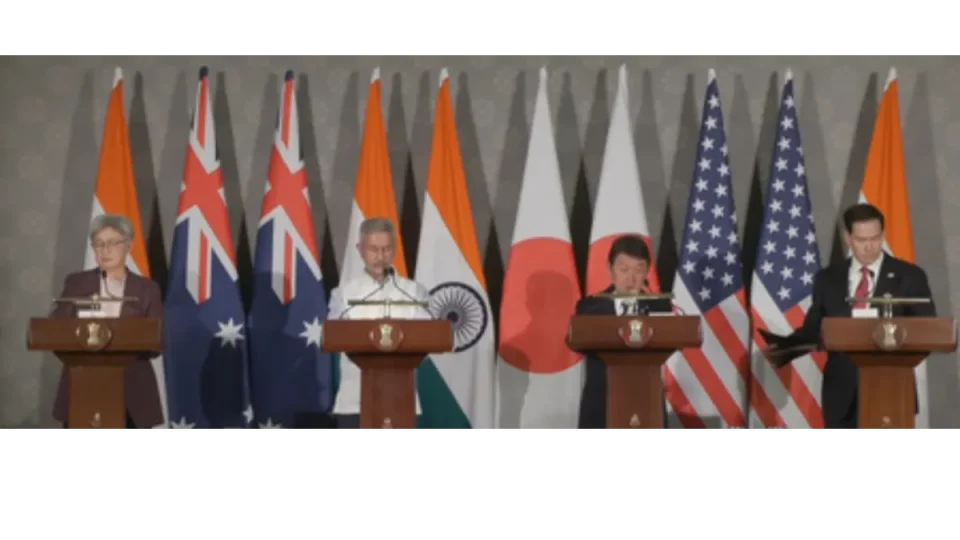
New Delhi, May 26: The Quad foreign ministers on Tuesday intensified cooperation on trade, energy security and maritime connectivity, unveiling a series of initiatives aimed at strengthening supply chain resilience and economic stability across the Indo-Pacific.
The discussions, hosted by India as the current Quad chair, brought together External Affairs Minister S Jaishankar, US Secretary of State Marco Rubio, Australian Foreign Minister Penny Wong and Japanese Foreign Minister Toshimitsu Motegi.
The four countries announced five key initiatives covering maritime surveillance, port infrastructure, critical minerals, regional maritime coordination and energy security, reflecting the grouping’s growing focus on operational and economic collaboration.
Addressing the meeting, Jaishankar said the Indo-Pacific would play an increasingly central role in global economic activity, maritime commerce and energy trade in the years ahead.
He also stressed the need for a coordinated approach against terrorism, stating that democratic nations must maintain zero tolerance towards terror threats and uphold their right to self-defence.
The ministers discussed ways to strengthen resilient supply chains and safeguard maritime routes amid geopolitical uncertainty and concerns over global energy flows.
US Secretary of State Marco Rubio described the Quad as a “partnership of action”, emphasising the bloc’s transition from policy dialogue to practical implementation.
Australian Foreign Minister Penny Wong highlighted concerns over West Asia tensions and their potential impact on energy markets, particularly risks linked to the Strait of Hormuz and regional energy security.
Japanese Foreign Minister Toshimitsu Motegi said the meeting underscored the Quad’s commitment to advancing a free and open Indo-Pacific amid evolving global geopolitical dynamics.
The Quad grouping, comprising India, the US, Australia and Japan, has steadily expanded cooperation across trade, infrastructure, technology, maritime security and supply chain networks as the Indo-Pacific grows in strategic and economic significance.
