

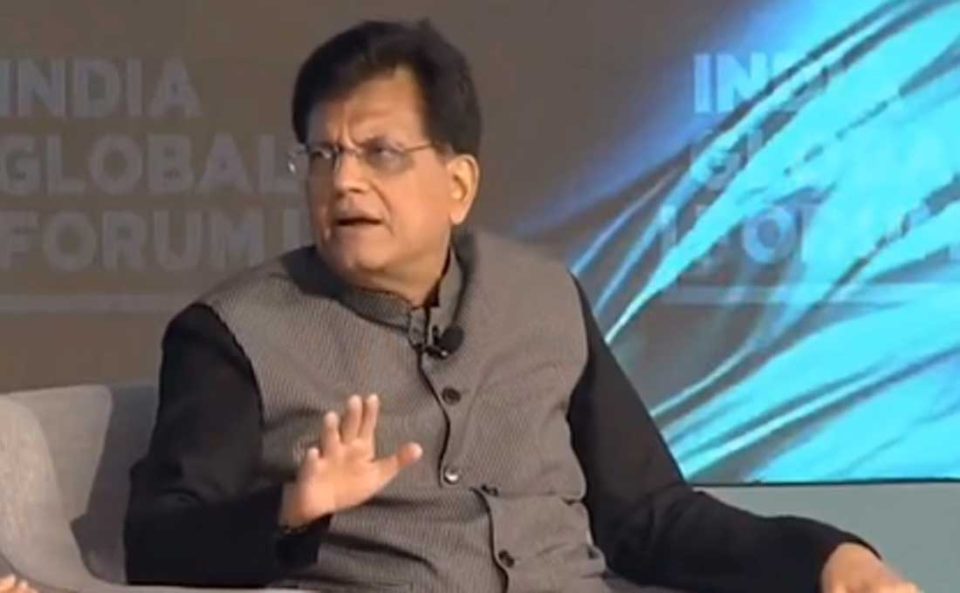
New Delhi, April 17 India is set to establish itself as a reliable bridge for global connectivity through the India-Middle East-Europe Economic Corridor (#IMEC), according to Union Minister of Commerce and Industry, Piyush Goyal.
He expressed this vision at an event, highlighting that the IMEC represents a significant partnership between India, the Middle East, and Eastern Europe. This initiative has garnered international interest as a forward-thinking concept.
Goyal emphasized that the IMEC transcends traditional trade routes, referring to it as a modern Silk Route. It symbolizes equal partnership aimed at fostering synergy, connectivity, and shared prosperity. He stated, “Logistics costs could decrease by up to 30 percent, transportation time reduced by 40 percent, creating seamless trade links across continents.”
He underlined that this corridor will connect not just trade, but also civilisations and cultures, bridging Southeast Asia to the Gulf, and the Middle East to Central Europe. Furthermore, he noted the corridor’s potential to enhance connectivity to Africa via the Middle East.
The IMEC will comprise railways, roadways, energy pipelines, and infrastructure for clean energy, including undersea cables. India is currently in talks with Singapore regarding clean energy transmission and is engaging with Saudi Arabia and the UAE.
Sustainability and digital connectivity are central to this corridor. Goyal clarified that this initiative respects sovereignty and focuses on mutual trust, inclusivity, and sustainability rather than dominance or creating economic unions.
He proposed five essential strategies for advancing the IMEC initiative:
The first suggestion is to approach IMEC as a Public-Private Partnership (PPP). Goyal stressed that a solely government-led initiative would hinder efficiency and financial viability. He advocated for private sector leadership to inject real-world expertise and innovation.
Secondly, he highlighted the necessity of Regulatory Connectivity—addressing not just the physical infrastructure but the regulatory environment as well.
Third, he called for Innovative Financing Models to bolster the corridor’s development and facilitate trade.
The fourth suggestion involves active dialogue with industry bodies and trade associations, emphasizing that their insights are critical for creating a corridor that meets business needs.
Finally, Goyal proposed integrating think tanks and academic institutions into the design process. Their research capabilities and long-term perspectives would contribute valuable creativity.
Related posts :
 Nepal Appoints Balendra Shah as New PM
 NTPC Shines with Four Major Wins at SHRM HR Excellence Awards 2025
 India Breaks Into Global Top 6 Patent Filers with 64,000+ Applications: Jitendra Singh
 BHEL Declares and Pays ₹109.98 Crore Final Dividend to Government of India
 NHAI’s 4 Guinness Records Showcase India’s Engineering Excellence
