

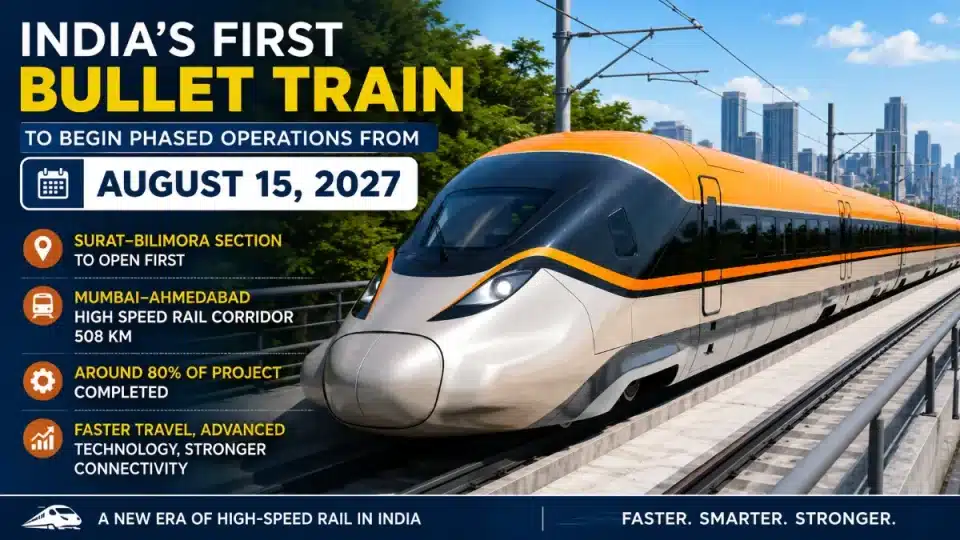
India’s first bullet train will begin phased operations from August 15, 2027, starting with the Surat-Bilimora section of the Mumbai-Ahmedabad High Speed Rail Corridor, Union Railway Minister Ashwini Vaishnaw announced. The project is expected to transform high-speed rail connectivity, reduce travel time, and support economic growth.
Key Highlights
- India’s first bullet train to begin phased operations from August 15, 2027.
- Surat-Bilimora will be the first operational section of the Mumbai-Ahmedabad High Speed Rail Corridor.
- Around 80% of the project has already been completed, says Railway Minister Ashwini Vaishnaw.
- Government also plans new bullet train corridors connecting Hyderabad with Pune, Chennai, Bengaluru and Mumbai.
India’s first bullet train project has reached a major milestone, with Union Railway Minister Ashwini Vaishnaw announcing that phased operations will commence from August 15, 2027. The inaugural service will run on the Surat-Bilimora section of the 508-km Mumbai-Ahmedabad High Speed Rail (MAHSR) corridor, marking the beginning of India’s high-speed rail era.
The Mumbai-Ahmedabad Bullet Train Corridor will be commissioned in multiple phases to enable early passenger services before the entire route is completed. After the Surat-Bilimora section becomes operational, additional stretches including Vapi-Surat, Vapi-Ahmedabad, Ahmedabad-Thane, and Ahmedabad-Mumbai will be opened progressively.
According to the Railway Minister, nearly 80 per cent of the project has already been completed, with construction progressing rapidly. The high-speed rail project is expected to significantly reduce travel time between Mumbai and Ahmedabad while introducing world-class rail technology and improving passenger convenience.
The bullet train corridor is also expected to boost regional development by enhancing connectivity, attracting investment, creating employment opportunities, and supporting economic growth across Gujarat and Maharashtra. It represents one of India’s most ambitious transport infrastructure projects.
Vaishnaw also announced the Centre’s long-term vision to expand the high-speed rail network through three proposed corridors centred on Hyderabad. These include the Pune-Hyderabad, Hyderabad-Chennai, and Hyderabad-Bengaluru routes, with an additional Hyderabad-Mumbai bullet train also under consideration to further strengthen connectivity across southern and western India.
The Railway Minister further highlighted the government’s railway modernisation programme, stating that 261 railway stations are being redeveloped under the Nav-Nirmaan initiative. In Telangana, major stations such as Secunderabad, Begumpet, and HITEC City are being upgraded with improved passenger amenities and modern infrastructure.
Conclusion
The launch of India’s first bullet train in 2027 will mark a historic milestone in the country’s transport infrastructure, paving the way for faster travel, advanced rail technology, and a larger nationwide high-speed rail network.
