

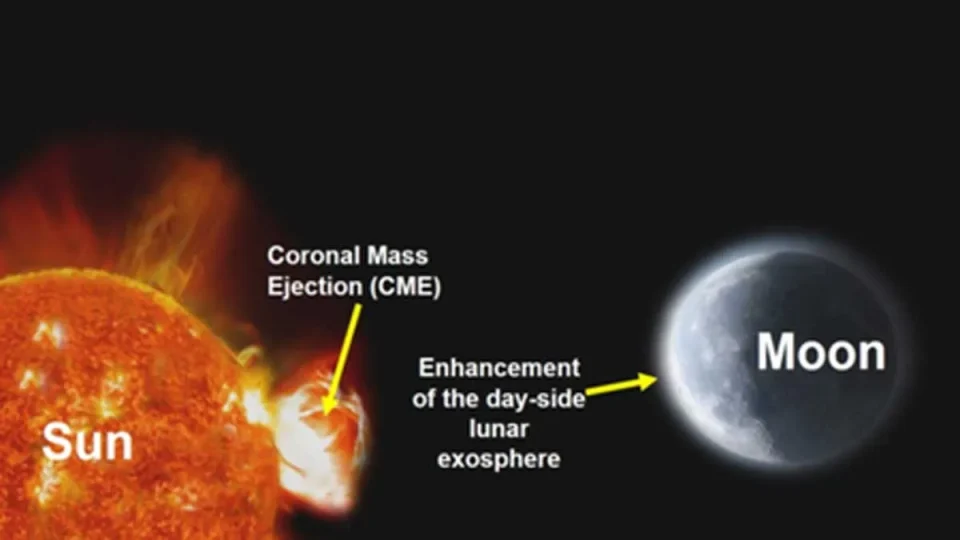
New Delhi, Oct 19: ISRO’s Chandrayaan-2 has made the first-ever observation of the effects of Coronal Mass Ejections (CMEs) from the Sun on the Moon’s exosphere. The observation was made using the Chandra’s Atmospheric Composition Explorer-2 (CHACE-2) instrument onboard the orbiter.
During a rare solar event on May 10, 2024, a series of CMEs impacted the Moon, leading to a significant increase in the total pressure of the dayside lunar exosphere.
ISRO scientists reported that the number density of neutral atoms and molecules in the exosphere increased by more than an order of magnitude, confirming theoretical predictions that had never before been validated through direct observation.
The Moon’s exosphere, classified as a surface boundary exosphere, is highly sensitive to solar activity due to the absence of a global magnetic field. The CME event enhanced the liberation of atoms from the lunar surface, temporarily altering the Moon’s atmospheric conditions. The findings not only deepen scientific understanding of lunar space weather but also have implications for future lunar missions and the design of human habitats on the Moon.
The study, published in Geophysical Research Letters on August 16, 2025, published the findings in Geophysical Research Letters. The findings provide scientific insight into the lunar exosphere and space weather effects on the Moon, as well as highlighting the challenges of building scientific bases on the Moon. Lunar base architects need to account for extreme events, which would temporarily alter the lunar environment before the effects subside.
Related posts :
 PM Modi speaks with Canadian counterpart, confirms participation in G7 Summit
 India embraces cashless revolution in last 11 years: Nirmala Sitharaman
 India now stands proudly among top five economies: Rajnath Singh on ’11 Years Of Seva’ under PM Modi
 Piyush Goyal leaves for Switzerland and Sweden to bolster India’s trade ties
