

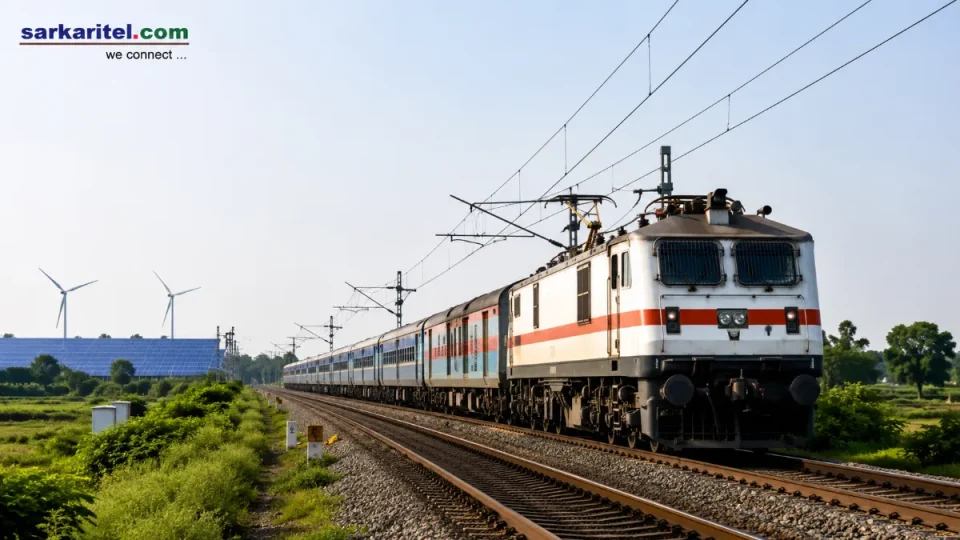
Indian Railways has electrified 99.6% of its Broad Gauge network, making India the world’s second most electrified major railway system after Switzerland. The mission has significantly reduced diesel consumption, lowered carbon emissions, strengthened energy security and accelerated the adoption of renewable energy across railway operations.
Key Highlights
- Indian Railways has electrified 99.6% of its Broad Gauge (BG) network, with the remaining routes under execution.
- Diesel consumption for railway traction declined from 293 crore litres in 2015-16 to 108 crore litres in 2024-25, saving foreign exchange and reducing emissions.
- Rail transport emits around 89% less CO₂ than road transport for moving one tonne of freight over one kilometre.
- 1,161 MW of solar power and 103 MW of wind power capacity have been commissioned to support sustainable railway operations.
India has emerged as one of the world’s leading railway electrification success stories, with Indian Railways electrifying 99.6% of its Broad Gauge network under its mission-mode programme. According to information provided by Union Minister for Railways, Information & Broadcasting and Electronics & Information Technology Shri Ashwini Vaishnaw in a written reply in the Lok Sabha on 22 July 2026, India now ranks second globally after Switzerland in railway electrification.
The pace of electrification has accelerated sharply over the past decade. While 21,801 route kilometres were electrified over nearly six decades before 2014, 48,072 route kilometres have been electrified during 2014-26. In addition, all new railway lines and multi-tracking projects are now being sanctioned and constructed with electrification, supporting the long-term expansion of an energy-efficient rail network.
According to the latest International Union of Railways (UIC) report published in June 2025, Switzerland has achieved 100% railway electrification, followed by India (99.6%), China (82%), Spain (67%), Japan (64%), France (60%) and the United Kingdom (39%). This places Indian Railways among the world’s most extensively electrified large railway systems after completing one of the largest infrastructure transformation programmes in a decade.
The shift towards electric traction has delivered significant environmental and operational benefits. Referring to the NITI Aayog report titled “Fast Tracking Freight in India” (June 2021), the government stated that transporting one tonne of freight over one kilometre by rail generates 11.5 grams of CO₂, compared with 101 grams by road, making rail transport approximately 89% cleaner. Railway electrification also improves haulage capacity, enables higher train speeds, reduces travel time and lowers dependence on imported fossil fuels.
The transition has substantially reduced diesel usage across the railway network. Diesel consumption for traction declined by 185 crore litres, falling from 293 crore litres in 2015-16 to 108 crore litres in 2024-25. The government said this has helped save valuable foreign exchange by reducing fuel imports while contributing to lower carbon emissions.
To further strengthen sustainable operations, Indian Railways is expanding the use of renewable energy. As of June 2026, around 1,161 MW of solar power capacity, including rooftop and ground-mounted installations, along with 103 MW of wind power capacity, had been commissioned. The remaining electrification work is progressing under the Mission 100% Electrification initiative, supported through enhanced funding, strengthened project monitoring mechanisms and the Project Monitoring Group (PMG) portal. Most railway zones have already achieved full electrification, while several states including Andhra Pradesh, Bihar, Madhya Pradesh and Uttar Pradesh have reached 100% electrification. The achievement positions Indian Railways as a global leader in sustainable rail infrastructure.
Why It Matters
Near-complete railway electrification strengthens India’s transport infrastructure by reducing dependence on imported diesel, lowering greenhouse gas emissions, improving operational efficiency and supporting the country’s clean energy and climate goals through greater use of renewable electricity.
The rapid expansion of Indian Railways’ electrification programme demonstrates India’s commitment to sustainable, energy-efficient and modern rail transport. With 99.6% of the Broad Gauge network electrified and renewable energy capacity steadily increasing, the railway system is advancing towards cleaner and more resilient operations.
Frequently Asked Questions
What percentage of the Indian Railways Broad Gauge network has been electrified?
About 99.6% of the Broad Gauge (BG) railway network has been electrified, with work continuing on the remaining routes.
Which country ranks ahead of India in railway electrification?
According to the International Union of Railways (UIC) report, Switzerland ranks first with 100% railway electrification, followed by India at 99.6%.
How much has diesel consumption reduced due to railway electrification?
Diesel consumption for railway traction declined from 293 crore litres in 2015-16 to 108 crore litres in 2024-25, a reduction of 185 crore litres.
How much renewable energy capacity has Indian Railways commissioned?
As of June 2026, Indian Railways had commissioned approximately 1,161 MW of solar power capacity and 103 MW of wind power capacity.
