

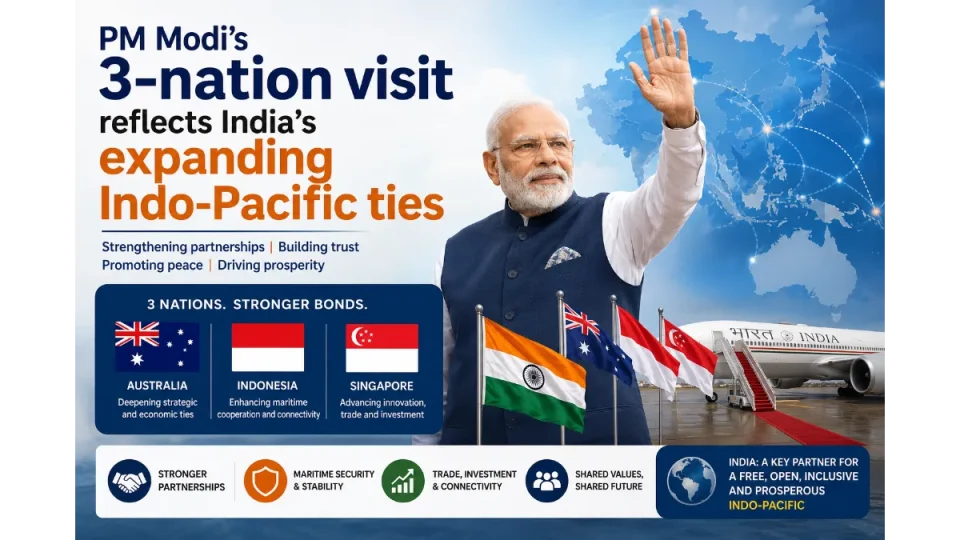
Prime Minister Narendra Modi’s recent visits to Australia, New Zealand and Indonesia reflect India’s expanding Indo-Pacific strategy, according to a Politeia Research Foundation (PRF) analysis. The report says the tour strengthened India’s Act East Policy, MAHASAGAR vision, and integrated trade, maritime security and strategic partnerships across the region.
Key Highlights
- PRF says PM Modi’s three-nation tour reflects India’s expanding Indo-Pacific engagement.
- The visit reinforced the Act East Policy and the MAHASAGAR vision.
- India and New Zealand announced an FTA and Strategic Partnership alongside maritime cooperation initiatives.
- The report highlights India’s growing focus on the South Pacific through trade, security and diaspora engagement.
New Delhi, July 23: Prime Minister Narendra Modi‘s recent three-nation visit to Australia, New Zealand and Indonesia represents a coordinated effort to deepen India’s engagement across the Indo-Pacific, rather than a series of standalone bilateral visits, according to an analysis published by the Politeia Research Foundation (PRF).
The article, authored by Rahul Sen, states that the Prime Minister explicitly linked the tour to India’s Act East Policy and the MAHASAGAR (Mutual and Holistic Advancement for Security and Growth Across Regions) vision. According to the report, the visit to New Zealand was positioned as part of a broader regional strategy aimed at expanding India’s influence in the Indo-Pacific, particularly in areas where its presence has traditionally been limited.
The analysis notes that the announcement of the India-New Zealand Free Trade Agreement (FTA) and the elevation of bilateral ties to a Strategic Partnership were presented together, signalling India’s growing preference for combining economic integration with security cooperation. The report suggests that India’s evolving Indo-Pacific partnerships increasingly integrate trade liberalisation, maritime security, and defence collaboration from the outset.
According to the PRF article, India has also extended its Maritime Cooperation Arrangement and Mutual Logistics Support Arrangement to New Zealand, agreements that New Delhi had previously concluded with strategic partners such as Australia, the United States, and France. The move is seen as an effort to expand India’s network of logistics and interoperability partners beyond the traditional Quad-centric framework.
The report further highlights the significance of Prime Minister Modi’s community event in Auckland, where members of the Indian diaspora were actively engaged. It argues that India’s outreach in the Pacific increasingly leverages diaspora networks as an important diplomatic asset to strengthen people-to-people ties and support broader strategic objectives.
According to the analysis, India’s engagement with the South Pacific marks a notable expansion of its Indo-Pacific strategy. The report states that New Zealand’s inclusion in India’s trade-plus-security framework, already applied with partners such as Australia and Japan, demonstrates the widening geographic scope of New Delhi’s regional ambitions.
The PRF concludes that although India’s partnership with New Zealand may be smaller in scale compared to some of its larger Indo-Pacific relationships, it nevertheless reflects the country’s long-term objective of strengthening economic, strategic and maritime cooperation across the region.
According to the Politeia Research Foundation, Prime Minister Modi’s three-nation tour underscores India’s evolving Indo-Pacific strategy by integrating trade, maritime security, logistics cooperation and diaspora engagement. The report views the visit as an important step in extending India’s strategic footprint into the South Pacific while reinforcing its broader Act East Policy and MAHASAGAR vision.
