

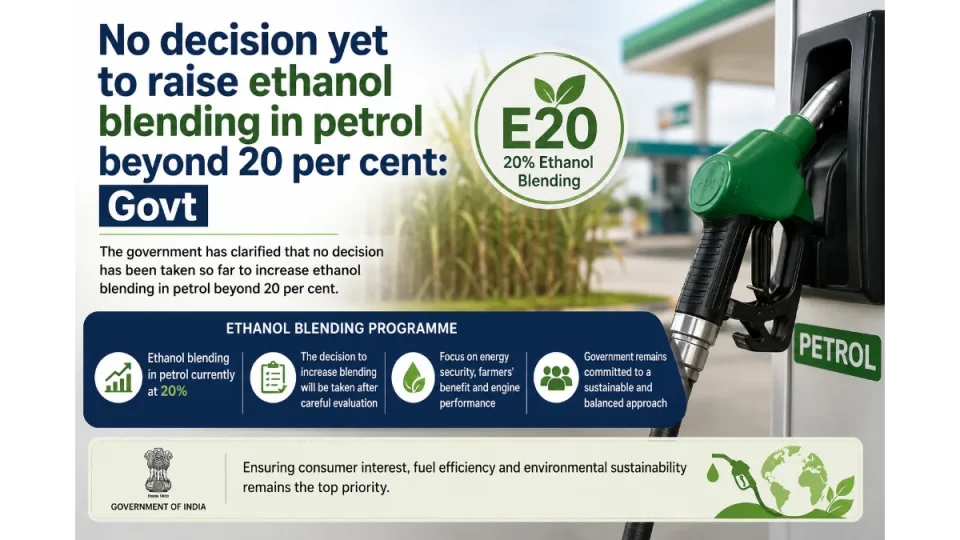
The Union government has informed Parliament that no decision has been taken to increase ethanol blending in petrol beyond 20% (E20). It said any future move will be based on scientific studies and stakeholder consultations, while reaffirming that E20 fuel is safe and has delivered significant economic and environmental benefits.
Key Highlights
- Government says no decision has been taken to increase ethanol blending beyond E20.
- Any future move will follow scientific studies and consultations with stakeholders.
- More than 20 crore two-wheelers and over 3 crore petrol cars have used E20 without verified engine damage, the government said.
- The Ethanol Blended Petrol Programme has saved ₹1.97 lakh crore in foreign exchange and reduced 952 lakh metric tonnes of CO₂ emissions.
New Delhi, July 23: The Union government on Thursday clarified that no decision has been taken to increase ethanol blending in petrol beyond 20% (E20), assuring Parliament that any future proposal will be considered only after comprehensive scientific evaluation and consultations with all relevant stakeholders.
In a written reply in the Lok Sabha, Minister of State for Petroleum and Natural Gas Suresh Gopi said that any decision on introducing higher ethanol blends would be based on technical studies and discussions with automobile manufacturers, oil marketing companies (OMCs), research institutions, and other stakeholders.
The minister clarified that the introduction of E85 fuel, which contains 85% ethanol and 15% petrol, is restricted exclusively to Flex Fuel Vehicles (FFVs) that are specifically designed and certified to operate on such fuel. He stressed that E85 does not represent an increase in the nationwide base ethanol blending level, which remains capped at 20%.
E20 Programme Based on Scientific Validation
According to the government, India’s Ethanol Blended Petrol (EBP) Programme has been implemented through a phased, scientifically validated and consultative approach involving NITI Aayog, the Automotive Research Association of India (ARAI), the Society of Indian Automobile Manufacturers (SIAM), the Indian Institute of Petroleum (IIP), oil marketing companies and automobile manufacturers.
The minister said extensive laboratory research, field validation and real-world operational experience have demonstrated that E20 is a safe, cleaner and technologically superior fuel when used according to manufacturer recommendations.
No Verified Evidence of Widespread Engine Damage
The government said E15+ petrol has been in widespread use in India for more than three-and-a-half years, while E19–E20 fuel has been used for over two-and-a-half years.
During this period, more than 20 crore two-wheelers and over 3 crore petrol-powered cars have operated on ethanol-blended fuel without any verified evidence of widespread engine failure or vehicle breakdowns attributable to ethanol blending, according to the minister.
He added that vehicle manufacturers’ service records show no abnormal corrosion, excessive wear or reduction in vehicle life due to the use of E20 fuel, and manufacturers continue to honour warranty claims for E20-compatible vehicles.
The minister cited the example of one of India’s largest passenger vehicle manufacturers, which serviced 2.84 crore vehicles during FY 2025–26, including nearly 1.5 crore older non-E20-certified vehicles, without reporting E20-related engine damage. Similarly, a leading two-wheeler manufacturer found no higher incidence of engine damage in vehicles using E20 compared with earlier fuel blends.
Mileage Impact and Performance Benefits
Addressing concerns over fuel efficiency, the government said mileage depends on multiple factors, including driving habits, traffic conditions, vehicle maintenance and tyre pressure.
For older vehicles originally designed for E10 fuel, any reduction in fuel economy is generally limited to 3–5%. However, the government said E20 offers several performance advantages, including:
- Higher octane rating
- Improved anti-knock characteristics
- Cleaner combustion
- Smoother engine performance
- Better acceleration and ride quality
- Lower carbon emissions
According to SIAM and ARAI, ethanol’s higher octane number supports modern high-compression engines, while its higher heat of vaporisation enhances combustion efficiency.
Economic and Environmental Benefits
The government highlighted the significant gains achieved through the Ethanol Blended Petrol Programme.
According to Minister Gopi, the programme has:
- Saved more than ₹1.97 lakh crore in foreign exchange
- Substituted nearly 316 lakh metric tonnes of crude oil imports
- Reduced around 952 lakh metric tonnes of CO₂ emissions
- Transferred over ₹1.66 lakh crore to farmers through ethanol procurement
These outcomes, the government said, reinforce the programme’s contribution to India’s energy security, environmental sustainability, and farm incomes.
The government has made it clear that India’s ethanol blending programme will remain capped at E20 for now, with no immediate plans to move beyond the current level. While emphasising that E20 has proven safe and effective through scientific validation and large-scale usage, the Centre said any future increase will be guided by evidence-based studies and stakeholder consensus.
